Author: Denis Tahiri
With 4 firefighting vehicles belonging to three decades ago, for which the documentation shows that they are manufactured from 1984 onwards, the Municipality of Gjirokastra had planned to successfully cope with the emergency caused by the fires caused during the summer. But the calculations were wrong. At the top of several hours, some villages gave the alarm and when the local structures lost their thread, confused, soldiers of the Armed Forces were distributed with emergency Services both in the mountains of Vlora and in Gjirokastër. The region was also going through difficult days fueled by high temperatures, but the local authorities under pressure declared that helicopters sent by partners as support would normalize the situation. In Gjirokastër, the number of firefighters of the local structures turned out to be insufficient to cope with the outbreaks in the city and in the forests. All the more so that out of the troop of 33 firefighters, only ten of them had fire-resistant uniforms. In just one day during the beginning of August, 700 hectares were occupied by flames in this area, while the balance became tragic with human lives.
Andrea Haxhiaj died while trying to save his home and vineyards, and almost two weeks later, his wife, Tatjana, also died from severe burns. At the height of summer, many citizens in the country experienced the fear of the raging fires that lasted for weeks and that threatened and threatened depending on the direction of the wind. For Murat Këraj from Zhulati in Gjirokastra, facing the flames while waiting for the army was the only solution. Firefighters were nowhere to be seen. “ In August, there were four or five fires that broke out near the vineyard and beehives, luckily I was at home and not in Gjirokastra,” Këraj begins describing the battle with these words.
The man from Zhulati considers himself lucky. " For an hour, we managed to control it, until the army arrived. If it had gotten out of control, it could have gone higher, into the pine forest," he says, adding that after the army took control of the situation, the next 6 hours were a fight between people and makeshift means against the fire.
“ For a moment we lay on the boat because there was a big boost in the flames, that’s when I saw how dangerous the fire is,” explains Këraj. Without much knowledge of what the laws stipulate, the agency in Tirana and the tools that should all be available, he still suggests “ What they could have done was to leave a fire engine in the area,” he says. He is convinced that if there had been a quick intervention from the air, it would have helped reduce the fires in the Gjirokastra area.
In the area of Labëria, many kilometers from Gjirokastra, one of the victims of the fires lives in the village of Gjorm. The 68-year-old mourns that he didn't have the fate of Murat, he saw how his wealth, vineyards and everything else burned at a frightening speed. Initially, the residents gathered there, then when the helicopters appeared in the sky, the residents decided to give the alarm and the request for help through the media. During a day that resembled hell, dozens of residents of the villages of Gjorm, Kotë and Gumenicë experienced moments of anxiety for their homes, vineyards and olive groves, which are the hard work of their whole lives. So Defense Minister Niko Peleshi was evaluating the possibility of evacuation. The army was also brought to these mountains.
" They burned 57 olive trees, it's the work of many years that crumbled within an hour. Don't even talk about the damage to the barn, where a large part of them have been damaged," says the farmer, saying that they have notified him of a damage assessment, but his hopes are low. " They have come 7-8 times, they fill out the papers, and twice they don't fill them out the same way, once they say you have 35 trees, once 45, once 55, and I myself have lost track of how many I have. They say that we will receive compensation, but so far we have not seen anything."
Of the four municipalities that went through the fire emergency during the summer, specifically Gjirokastër, Vlorë, Kukës and Selenica, none of them has yet a balance of the economic damage caused by the destruction of crops, the burning of livestock and forests.
From the data provided by "Sinjalizo", it is reported that in Gjirokastër, the fires burned an area of 1172.7 hectares during the months of January - September. In Kukës, the flames occupied 2043 ha, of which 1086.3 ha in forests and 957 ha in pasture, but fortunately there were no casualties. Meanwhile, in Vlora, the fire burned 455 ha, of which 100 ha were the property of the residents of these villages. But the flames were threatening for days in the Sazan-Karaburun Protected Area, where at the end of the emergency it was said that 4800 ha were engulfed in flames.
" You didn't know what to do, we don't have mountain equipment, water pumps, picks, and shovels can't put out the fire. We tried very hard, together with the army forces, to not let it pass into the Llogara forest area, because if it did pass there, the only thing left to do was to sit and watch as the forest burned," says a firefighter from the Vlora District.
Why does history repeat itself every year?
In July 2020, the Minister of Defense at the time, Olta Xhaçka, accompanied the ceremony of donating 1250 uniforms with the consideration that the adoption of the civil defense law was a revolution.
"Today, when it has not yet been a year since the beginning of the work to establish this important structure, I proudly say that we have succeeded in establishing a truly efficient structure, but most importantly, also equipped with the most modern and professional tools," said Ms. Xhaçka. But more than two years after the "revolution" of the National Civil Protection Agency, it is evident that the structure of this agency has not yet been established to be functional at full capacity, let alone efficient.
The approach to having a civil emergency agency started in 2017, when the government transferred the Civil Emergency Unit from the Ministry of Interior to the Ministry of Defence. But the ACQJ's investigation shows that apart from the change of offices at the Ministry of Defense by naming it as the National Civil Defense Agency, the transformation remains only on paper. In its vehicle inventory, this agency has only three vehicles to support the transportation of staff, which has not yet been completed.
" The organic structure of AKMC is 55% complete (out of 106 functions, 59 vacant positions have been filled )," AKMC officially states for the Albanian Center for Quality Journalism. The recruitment delays are explained by the restrictions of anti-COVID measures (social distancing).
" The process of organic completion is closely linked to the process of functionalization (creation of premises and provision of work equipment) which is still ongoing. Also, recruitment procedures require 30-45 days to be completed", says AKMC for "Sinjalizo", among other things. And while the Prime Minister has issued 3 orders for the drafting of emergency plans and risk prevention documents, nothing has yet been done to assess the risk of disasters.
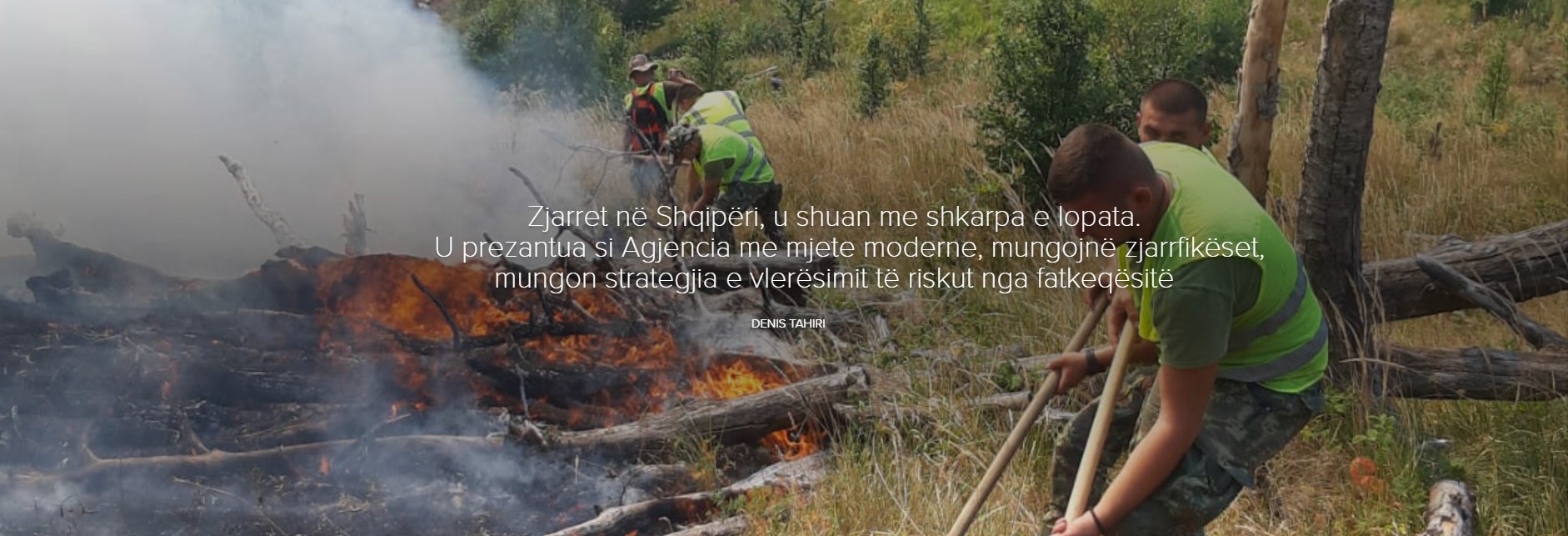
"In addition to the National Civil Emergency Plan and harmonized plans at the regional and local levels, strategic documents are currently in the process of being drafted, such as the National Civil Emergency Plan, Disaster Risk Assessment, and National Strategy," says AKMC, which claims to meet European Civil Protection standards, despite the fact that even in the summer fires of 2021, it was seen that the response and interventions were improvised to the point that the armed forces intervened by extinguishing the fires with shovels and earth.
A difficult summer for farmers
This situation of slow reaction, which forced the head of KLSH Arben Shehu to make a public appeal to the head of emergencies to return to duty, brought an audit, the findings of which will be made known at the end of the year. All this happened in the Karaburun area, the fires were advancing, but the intervention was nowhere to be seen. The authorities woke up late.
" One after another, with picks, shovels, axes, chainsaws, everything, a cordon must be created so that the fire does not pass beyond this point," this was one of the orders given by the head of the National Civil Protection Agency, who descended on the ground almost 10 days after the Karaburun peninsula was under the power of the flames. A helicopter that was used for aerial intervention was considered insufficient.
" We have insisted for four years and have also strongly requested the Prime Minister's Cabinet that we cannot proceed with pragmatism because an event occurred and we must send in the army and police with picks and shovels. The time has passed to fight a natural disaster with picks and shovels. It was shameful in 2021 to see the army with picks and shovels going to put out the fire," says former Civil Emergencies Director Shemsi Prençi, who emphasizes that it is necessary to increase the air fleet, the cost of which, when balanced with the damage caused by the fire, is small.
For Prenc, the establishment of Civil Emergencies under the Ministry of Defense should not have been done.
"An agency subordinate to the prime minister would have given him more flexibility, more competence to react operatively, both with the human and technical capacities that the Agency had, but also with the capacities of the Ministries of Defense and Interior," adds the expert, who recalls the truncated law and the fact that dependence on the Ministry of Defense has militarized this institution.
Agency not coordinating, tools out of order
AKMC is currently in the role of coordinating authority and does not own any air or ground means for intervention in an emergency situation. According to Law 45/2019, there are local civil defense institutions and structures which are responsible for prevention and intervention in case of disasters as well as risk assessment. These local institutions start from the District Prefect, the Civil Defense Commission at the district and municipality level, the Municipalities and the decentralized structures of the institutions and the central civil defense structures. But technical capacities are also missing at local levels, as these local structures do not have the appropriate capacities.
Although from the data pertaining to 2020, the General Directorate of Fire Protection and Rescue describes that it owns 150 firefighting vehicles and 1250 employees, there is no fact of how their condition is actually presented on the ground and whether or not they are all functional tools.
Bledar Bajrami, Head of the Firefighters' Union, insists that there is a lack of tools for controlling forest areas.
"What should be there is not enough, a small 4×4, with a quantity of water, with a simple pump, they are in short supply, " adds the fire specialist, who recalls that in 61 municipalities, none of them meet the necessary number according to the legal provisions that require firefighters for 1500-2000 inhabitants. This brings about a repetition of scenes where the army intervenes by extinguishing the fire with shovels and shovels. " You can't extinguish the forest with a shovel or backpack. You need aerial vehicles because even firefighters can't climb the mountain and with backpacks you will extinguish the remaining fires, you will return with troops with backpacks and you will extinguish them," says Bajrami, according to whom despite everything, the fleet of firefighting vehicles is also uncertified. "This means that when you leave, you don't have any kind of guarantee. They have found some points to repair them, but the vehicles have not been certified," he says.
However, the Municipality of Kukës mentions that the Directorate of the Fire Service of Kukës with a total number of employees of 41 firefighters, 5 of whom in an administrative role and 36 in an operational role, has in its inventory 3 vehicles with a capacity of 8000 L of water, but three of these vehicles are out of technical condition, so not functional. This Municipality also owns two vehicles, one of them installed in the "Thirrë-Kalimash" tunnel and another one at the Kukës station. Both of these tools have a capacity of 4000 L of water. All this infrastructure is considered insufficient to keep the mountainous terrain of Kukës under control, even though chainsaws, stone-grinding stones, electric drums, picks, shovels, sledgehammers, shovels, and backpacks with a capacity of 20L of water are also mentioned as equipment. .

The data are pessimistic even for the municipality of Vlora, which was submitted for the neutralization of the fires. One fire engine manufactured in 2012 and three Iveco vehicles are counted. With 30 firefighters on staff, even they are not all equipped with the fire-resistant clothing that belonged to them a few years ago.
The Albanian Center for Quality Journalism asked the Ministry of Defense about the engagement of the air fleet of this institution in the emergency situation created by the fires. But since 28/09/2021 in all communication channels, from the office e-mail, phone calls to the media relations office, there was no response until the moment of publication of this article.