Ida Ismail
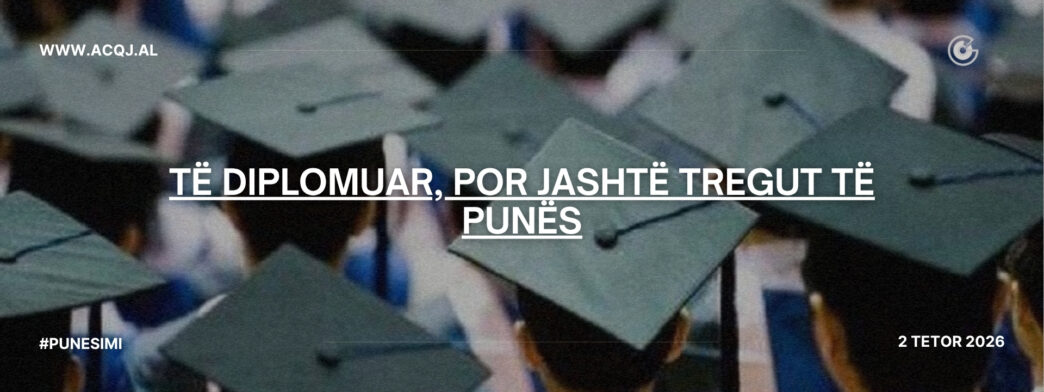
For thousands of young Albanians, graduation day no longer marks the beginning of a career, but the start of an unknown crossroads. After years invested in the classroom, the dream of a job in the profession quickly collides with the harsh reality of the market: a closed door with the standard answer: "We need someone with experience."
According to INSTAT data, in 2025, 17.800 people with higher education were unemployed, of whom over 9.600 belonged to the 15-29 age group. The situation worsened further in the second quarter of 2026, where the number of unemployed young people (15-29 years old) reached 36.7 thousand, an increase of 5 thousand people compared to the same period of the previous year. These figures clearly demonstrate that the biggest bottleneck appears precisely at the threshold of entering a career.
"They want experience, but where do we get it?"
This is the question that plagues every recent graduate. Valbona, 23, who started looking for a job after completing her master's degree in psychology, immediately faced this barrier. In every application, she was asked for previous experience or volunteer work.
Employment expert Gertjana Hasalla explains that this is a structural problem. The education system produces mostly graduates with theoretical knowledge, while businesses require practical and digital skills.
“Lack of experience is the main barrier to entry,” says Hasalla. “Many businesses don’t have the time or financial resources to train a new employee from scratch, so they prefer candidates who can produce results immediately.”
On the other hand, the challenges do not stop with experience. Another problem is related to market transparency. Job vacancies often remain active on social networks or in stores even after the positions have been filled. Young people waste time applying or showing up in person, only to find out that the position has long been taken.
"It's not a problem if a position is filled, but the announcement should be removed. We need to know where we are," says one of the young job seekers, disappointed.
The gap between auditors and the market
In 2025, according to INSTAT, there were a total of 107.548 unemployed people in Albania. Of these, 45.764 had secondary education, 43.984 had 8/9-year education, and 17.800 had higher education.
Unemployed people with university education accounted for about 16.5% of the total unemployed. However, the problem is not only related to the number of jobs. But, beyond the numbers, the main concern remains the discrepancy between what is studied and what the market requires.
According to Hasalla, while the supply of graduates in some traditional fields exceeds demand, other sectors suffer from a severe shortage of professionals.
"Universities continue to graduate students in classical profiles, while the economy has moved rapidly towards technological Services, energy, tourism and construction," she emphasizes.
The labor expert highlights that the market needs professionals in fields such as IT, cybersecurity, and food technology, while in some profiles of social sciences, political sciences, journalism, law, and business administration, competition is higher.
The data of the National Employment and Skills Agency (AKPA) for the first 7 months of 2026 confirm this negative trend: Unemployment among holders of Bachelor and Master of Science degrees. In the first 7 months of 2026, the number of unemployed with a Bachelor's degree is higher than in 2025 and at levels similar to the corresponding period of 2024. Even for graduates with a Master of Science degree, unemployment in the first 7 months of 2026 is higher than in 2023, 2024 and 2025. At the same time, the number of employees during the first 7 months of 2026 is lower compared to the employment figures of the previous 3 years. The data raises the question of whether the pace and direction of university education are matching the real needs of the economy.
The Ministry of Education and Sports (MASR) explains that admission quotas are determined by the universities themselves, in accordance with their academic capacities. Although MASR argues that the opening of programs is accompanied by analyses of potential employment, it also acknowledges that there cannot be a fixed compatibility with the market, as the latter changes at a much faster pace than academic curricula.
Although the Agency for Quality Assurance in Higher Education (ASCAL) reports that 689 were accredited with external evaluation reports during the period 2023-2026, it remains unclear how functional these mechanisms are in preventing the production of "marketless" diplomas.
Education expert Ndriçim Mehmeti sees the problem on several levels. According to him, one of the obstacles for recent graduates is the requirement for work experience, while another is related to the lack of a stable connection between universities and the job market.
"They are required to have work experience, which is paradoxical, since they have just graduated," says Mehmeti.
According to him, universities and businesses should have more sustainable cooperation to adapt curricula and professional directions to the needs of the economy.
"The main problem is the lack of connection between the labor market and education. So, there is no institutional cooperation between companies and businesses with universities to improve curricula and professional directions in line with the labor market," says Mehmeti.
Another problem, according to him, is the pace of change in university programs. Institutional processes for changing curricula and opening new programs are lengthy, while market needs change more quickly. Mehmeti argues that there is a lack of regular studies on the labor market and the effectiveness of diplomas, which could show where the gaps are and what measures need to be taken.
IMF alarm
This gap has also become a subject of concern in international reports. The International Monetary Fund (IMF) analyzes that Albania suffers from deep gaps in education and vocational training, which is weighing on the country's productivity.
STEM: Albania ranks last in the region (after Serbia and North Macedonia) and far behind the EU average in the number of graduates in science, technology, engineering and mathematics. According to the IMF, the origin of the problem begins in pre-university education. The low results of Albanian students in the international PISA test (especially in mathematics) weaken analytical skills, reducing the number of students choosing scientific fields.
On the other hand, vocational schools remain limited, present in only 20 of the country's 61 municipalities, while their cooperation with the private sector is almost superficial.
The IMF urgently recommends expanding STEM programs, strengthening dual education (work-study), and creating a real partnership between universities and entrepreneurship.
Ultimately, the youth employment crisis in Albania is not simply a matter of a lack of jobs, but a huge gap between what is taught in the classroom and what economic reality requires. Without a deep reform of curricula, without an orientation towards technology and without close cooperation with business, the university diploma risks remaining simply an expensive piece of paper hanging on the wall, while young people, hopeless, will continue to seek a future outside the profession or abroad./ acqj.al