Author: Bejli Çaušaj
It's Monday, the week is starting fast in Tirana. On the "Kongresi i Manastirit" street, there are many residential buildings, and among them the "Andon Zako Çajupi" high school. Right next to the high school there is a garbage can, which, even before the day started, is overflowing. The same situation is also in the roundabout area of Pazari i Ri , where 4 garbage cans serve as a collection point for an area populated by residents, tourists or businesses, whose waste exceeds the volume of 4 cans.
How do these wastes affect the Tirana habitat? What are the pollution levels like? How does the Municipality of Tirana react?
Pollution levels by category clearly show that Tirana suffers in almost all sectors with high or very high ratings, marking a moderate level only in light pollution and noise pollution. The concentration of particulate matter in the air (PM2.5) in Tirana is twice as high as that recommended by the WHO, while the nitrogen dioxide level is 86.2, with the allowed value suggested to be lower than 50. Tirana is ranked as one of the most polluted capitals in Europe and Albania is ranked 55th out of 106 countries for the most polluted countries in the world. Tirana's pollution level is twice as high compared to the level allowed by the EU, according to a study conducted by CoPlan.
According to INSTAT , in 2019, around 1,08 million tons of urban waste were managed at the national level, marking a decrease of around 18% compared to 2018.
This downward trend has continued in 2020 , in which the amount of solid waste has fallen to 1.04 million tons. The annual amount of urban waste managed per capita nationwide in 2020 is 369 kg/capita, down from 381 kg/capita the previous year. Are we dealing with a decline in management or a decline in the amount of solid waste generated?
At the same time, when the city of Tirana suffers, not only from the production and management of solid waste, but also from low air quality, a question that arises is: How do constructions in the city or even the mismanagement of dirt affect that result in the reduction of air quality in Tirana? In recent years, Tirana has turned into a construction site. The data of the Municipality of Tirana show 96 construction permits only in the first half of 2021. Only in the areas of Allias and Kashari in the last two years, during the pandemic, more than 50 construction permits were granted.
A decision of the Municipal Council of the capital, from 2018 , obliges, among other things, all entities to take the necessary measures to curb the pollution of public spaces from tires and equipment of vehicles of various types and tonnages, which leave the construction site without taking measures to clean them, the pollution of public spaces outside the construction site perimeter from inert or other construction materials, as well as the pollution of public spaces during transportation in cases where trucks transporting construction materials are not covered, providing for their fines in case of violation of these obligations.
The ACQJ , during the summer months, but also during November 2021, conducted an on-site verification of the implementation of this decision and the pollution situation from new construction in the city, noting that many firms were not only not complying with this order, but were also causing interference in the community's infrastructure, which led to a significant deterioration of the environmental situation.
Following a request for information addressed to the Municipality of Tirana, it was confirmed by the latter that in 2021 there was only one violation punished in the amount of 20 thousand ALL, but without mentioning the name of the company.

In fact, there have been many cases where, when a reconstruction or conversion of an area into a construction site is carried out, the Code of Work Ethics is violated and the municipality's order is followed, and the area around the work site is transformed into a dumping ground for inert materials. A general example is when a road is demolished to open the sewers that serve the site, interfering with the road infrastructure, but also creating extraordinary pollution for the area. Such examples can be seen everywhere, both in the center of Tirana and in the suburbs.
Interventions in the road infrastructure by various builders that have led to the destruction of roads and pollution of the environment, on the roads "Themistokli Gërmenji", "Faik Konica", "Asim Zeneli", "Inajete Dumi", "Liqeni i Thatë"
After the work is finished, the asphalt is rarely re-laid from scratch. A concrete example is the recently reconstructed “Perlat Rexhepi” street, where the pavement resembles a war trench, despite being a residential area and very close to the former Blloku and the Faculty of Law. The dust and pollution created by these construction sites has increased exponentially in recent years, endangering the health of residents, but also negatively affecting their quality of life as members of the community.
Health damage from polluted air, which area's residents are most at risk?
Mehmet Rrodhe, an allergist, says that air pollution is what affects the lungs the most. "It is this pollution that turns harmless particles into aggressive ones for the respiratory tract. Air pollution or hydrocarbon circulation attacks bronchitis the most, while allergies are not caused as a result of air pollution, but air pollution has an indirect link with allergic diseases. However, there has been no scientific, epidemiological research by health institutions ," he explained.
Likewise, a public health expert, who declined to be identified due to her position in the administration, raised concerns that in Tirana we will face a higher than usual increase in lung diseases in the coming years, this because a good portion of citizens have had COVID-19 and a good portion of them have been left with consequences in their respiratory tracts. "The December 21st area, the pollution hotspot, will soon be surpassed by other areas, where construction work is constantly being carried out. The Porcelani Street area has shown a significant increase in cases of patients visiting neighborhood ambulances due to respiratory complications, which may be related to the construction work that has been carried out recently, although it is almost impossible to determine. It will be difficult in the future to find out whether lung diseases or deaths caused as a result of weakened immunity due to the coronavirus will have their origin in environmental pollution, but it is certain that there will be a high influx," the expert explained, adding that not only the elderly, but also young people are equally at risk from this combination of factors.
Another serious consequence of this level of pollution, but rarely mentioned by doctors or relevant institutions, is the damage to the individual's skin, which comes as a result of harmful particles in the air. Dermatologist, Erjona Shehu, says that the most at risk are individuals prone to allergies or who have sensitive skin. "These individuals are more likely to suffer from these factors, including air particles, which are loaded with construction materials, car fumes, or biological loads, as a result of human waste that is thrown everywhere. The most affected remain children and the elderly. The main pathologies as a result of pollution can be dermatitis, irritant contact dermatitis, allergic dermatitis and even acne or infections on possible wounds that may be on their skin" , - she said.
The doctor explained that the number of citizens, who complain about skin infection problems, is higher during the summer period, where microbes or environmental microbial loads are more increased, favored by high temperatures, but on the other hand, the surface of of the skin, which is exposed by loads as a result of light clothing, is greater and increases the possibility of their infection.
According to her, environmental cleaning is the main measure. " We must avoid throwing away waste, we must avoid biological products that are thrown away in common landfills, we must avoid throwing away masks that are used during this pandemic period, which are loaded with secretions and microbial content ," she advises.
In the middle of construction sites, residents: We can't breathe
EB, a resident of “Papa Gjon Pali II” Street, located between two construction sites, “DownTown One” and Piramide , says that she suffers from both noise and environmental pollution. “As soon as you approach the area, you notice that there is dust everywhere. Even inside the house, you notice that there is more dust than in the period before construction began. Then there is noise pollution, there is noise, not only annoying, but also disturbing, from early morning until afternoon. Given that we are also in the period of the pandemic, where we have to be very careful, especially with the respiratory organs, I think that construction in this area makes care even more difficult. It feels like you can’t breathe when you are near that area ,” she says.
Despite this, when asked about any problems or complaints that may have occurred at the Pyramid construction site , its technical director stated that there were no irregularities with the works, where everything went in accordance with the inspections by the municipality.
Also, another resident with the initials JY, in the Ali Demi area , says that construction has been going on for about 2 years. The main problem for her has been dust pollution and noise without hours. "I have no information about health problems, but the constructions very close to each other have blocked the circulation of air and ventilation of the apartments. Citizens seem very indifferent." , - she says.
 Last year the Municipality of Tirana opened the competition for 3 areas of Tirana, offering 1.3 billion lek for the tender in the cleaning and urban maintenance service. In the contracts issued to the winning companies, the Municipality of Tirana requires these businesses to provide quality service through the installation of standard bins or bins, technological means of street cleaning, implementation of contractual requirements, as well as inspection of the work performed. These are the concessionaire companies, which offer the service in question: "Eco Tirana" in the red zone, which within an 18-month space has expanded its activity throughout Tirana in relation to the contract, "Ante Group", zone I, " Korsel", zone II, "Alko Impex Construction", foreign company, zone III, "Fusha" sh.pk, zone IV.

While the cleaning and maintenance of the Grand Ring Road is not the responsibility of the Municipality of Tirana, as it is owned by the Albanian Road Authority, despite the fact that the Mayor of Tirana himself was at the center of the scene at the inauguration of these axes.
The latter has become one of the most polluted segments in the city, not only in the segment under construction, from the Palace of Arrows to the Customs roundabout, but also in other segments that have already been in operation for some time, and the main cause is the frequent passage of trucks with inert materials and heavy machinery, as well as the lack of maintenance by the ARA.
A short while ago, photographer Aurel Duka posted on his Facebook profile drone footage of construction sites in Tirana during the period June-July 2021. He also posted a map of Tirana with active construction sites, which turn out to be 414 of them.
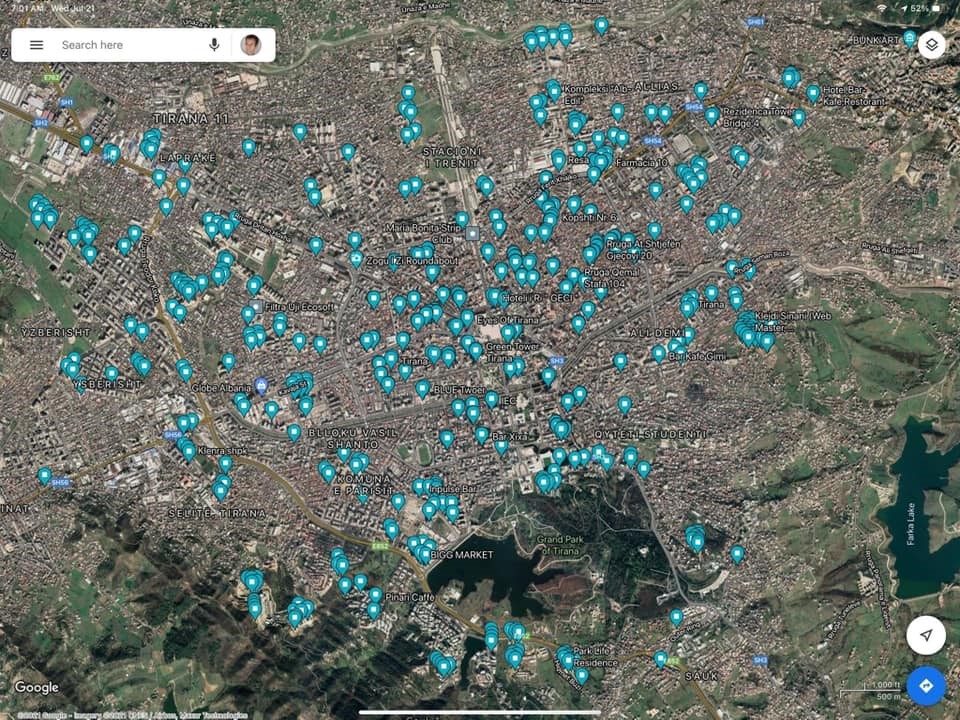
He also reports another case on his Facebook profile: "We are inside the Astir Palaces (as they are known). An 8-story building is being built here, a permit granted on June 29, 2020 by the current mayor of Tirana. The distance between the building under construction and the surrounding buildings: 5 meters."
The pollution created by the facilities under construction in the city is considerable, but both the citizens and the local authorities, who have issued strict rules for managing the situation, have turned a blind eye to this issue.
Statistics/ In 2020, 1 permit was issued every 48 hours
In 2021, about 96 building permits were obtained. In 2021, the following entities received two building permits each: Metal Nesimi , Daton , Kaso , Progeen , Ndërtim-projektim Alliu , Arlis Ndërtim and GBK . While in 2020, the year when the pandemic began, 201 permits were issued or, in other words, one permit every 42 hours. But, the record is held by 2019, when 276 permits were issued. Practically, since 2018, about 755 permits have been issued by the Municipality of Tirana, translated into 755 construction sites in Tirana.
From 2017 to date, 97 construction permits have been obtained in the Farka Administrative Unit, more than in all other areas; followed by Kashari (82), Vaqarri (44) and Sauku (32). While within the urban planning of Tirana, Kavajës Street and Dibrës Street lead with 10 and 12 permits respectively. The companies that have dominated during this period of time are led by “Arlis” with 10 permits obtained, followed by “Tirana Vision” (8), “GBK” (8) and “Ndërtim dhe projektim Alliu” (7), which have operated in all areas of Tirana.
It is also worth mentioning that Samir Mane's main construction company, "TCI Mane", has 7 construction permits, however his construction activity has not stopped there, as he owns more than this number of other companies, which he has purchased, after they have received the permit from the Municipality of Tirana. In a specific case, the company, which is building "DownTown" near Elbasan Street , was purchased by him, after the permits were received and the works began.
Law No. 10440, dated 7/07/2011 for "Environmental Impact Assessment", defines the rules, procedures and deadlines for the identification and assessment of direct or indirect impacts of projects or activities on the environment. The law defines the necessary steps for the implementation of EIA procedures: submission of the request, preliminary review, selection and classification criteria, public hearings and consultations, access to information, duties and rights of other bodies. The law also defines the list of activities that must be the subject of the In-depth and Preliminary EIA Process.
In a communication with Vlatka Matkovi ć , coordinator of the Health and Environment Alliance ( HEAL ), which cooperates with the European Union, a study report on air pollution and greenhouse gases in the Western Balkans has been made available, which also mentions Albania. This document mentions that one of the main steps for EU accession is the adaptation, implementation and enforcement of Chapter 27 of the EU Acquis on the environment, which states: “It is an obligation for member states and candidate countries to reduce emissions of air pollutants and greenhouse gases (GHG). It is a priority, which is closely linked to energy, transport and health policies.”

Albania has made progress in recent years in environmental protection, but lags behind other Western Balkan countries, where it is reported to have the highest emissions of industrial gases and from large combustion plants (LCP). It also lags behind in reporting and monitoring greenhouse gases. The same report documents for Albania that: “The approximation of Albanian legislation on the environment and air quality with the EU Acquis is an ongoing process. However, a cross-sectoral, environmental strategy has not yet been adopted.”
The report notes in its main findings that the maximum daily concentrations of PM10 and SO2 , both daily maximum and hourly maximum, concentrations are among the air quality indicators that are most frequently above the legislative limits for Balkan countries. Also, O3 (ozone) levels in Albania were above the maximum threshold in several areas, adding that the establishment of national, efficient air monitoring systems, which meet all the criteria to provide accurate and detailed information on air pollutant concentrations and the planning of measures to reduce air pollution, should be a priority.
Despite the efforts and developments of recent years, the current air quality and monitoring practices are not fully in line with EU requirements and national legislation, and there is a lack of independent monitoring of industrial pollution in Albania.
In many EU capitals, alternatives and ways have been found for the minimal reduction of urban waste. Many of them aim to have 0% waste, where all waste is recyclable. So, not only reused, but also to serve as a source of energy, while in Tirana, recycling factories serve only in the reprocessing of metals and very little in plastic waste. Between the cooperation of the municipality and Eco Tirana, the slogan “I Recycle” was released, but it remained a short-term attempt, as the management of urban waste did not change.
In 2017, the Albanian government signed a contract to build an urban waste incinerator for the city of Tirana, followed by similar contracts for construction in the cities of Fier and Elbasan. These investments are expected to provide a long-term solution to the urban solid waste situation in the surrounding cities, but to date, being non-functional, the impact on citizens' health from waste incineration has remained on paper. The situation of urban waste management remains a daily problem for all residents of the capital and surrounding cities.
The capital city also expands in volume. Every construction site "grabs" a good territorial space, and then throws it out as construction waste. Even though we are still in a pandemic period, where the main concentration of investments or funds should go to medical Services, economic aid, the water supply and energy sector with winter ahead, or with the emergencies in the villages of Tirana with the rainy season approaching , it seems that the construction sites or the permits together with the funds given by the Municipality of Tirana have not stopped. On the contrary, they have undergone a drastic increase compared to previous years before the pandemic.
Among many problems, institutions and experts point the finger elsewhere for the chaotic environmental situation created, while construction companies do not accept any responsibility for their contribution to environmental pollution. Meanwhile, the local authorities to date have not taken any measures against the violators of the environmental rules, beyond writing down the penalties