Denada Jushi
In eastern Albania, between Librazhd, Prrenjas and the border with North Macedonia, Shebenik National Park lies in one of the richest areas of the country in forests, water resources and biodiversity. The surrounding villages have traditionally been linked to water, forests, agriculture and livestock, while the protected status of the area requires a higher level of care against interventions that may affect these resources.
The largest part of the water network of the Shebenik-Jabllanica massif belongs to the Shkumbin basin. Two of the main rivers are the Qarrishta, which through Rrapuni ends in Shkumbin, and the Bushtrica, which flows directly into it. This system also includes the Luniku, Gjuraj and a number of smaller streams that descend from the slopes of the massif.
It is precisely on this water network that several hydropower projects have been developed over the years. Among them are the Gizavesh HPP, the Steblevë HPP, the Qarrishtë HPP and the Rrapun 1 and 2 HPPs; hydropower projects for which the National Environment Agency itself responds to the ACQJ that the relevant file does not contain Environmental Impact Assessments. The presence of hydropower plants in the park and in the surrounding water basins has raised questions for years about water use, compliance with permits, the impact on habitats and the consequences for communities that depend on these flows.
At the heart of this relationship between hydropower plants and rivers lies a fundamental indicator: ecological flow.
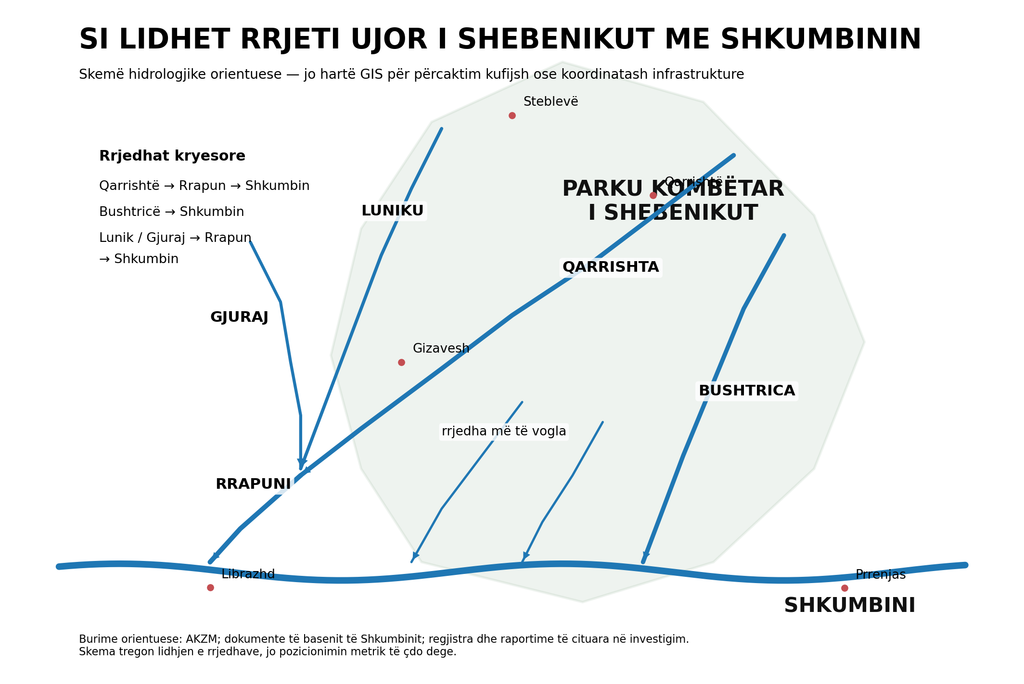
In simple terms, it is the amount of water that must remain in a river even after part of the flow is taken or diverted, in order for the river to continue to function as an ecosystem. In a protected area, maintaining this flow takes on even greater importance, as interventions in the water directly affect the habitats and biodiversity that the park status aims to protect.
But the documents and official responses provided reveal a fragmented system. Responsibilities are divided among several institutions, field monitoring remains limited, and data on flows, respect for ecological flow, and the impact of several hydropower plants on the same water system are not always easily accessible.
At the heart of this story, therefore, lies a simple question: who ensures that the river does not run out of the water it needs to live?
Environmental expert Erjon Kalaja says that ecological flow should not be seen simply as an amount of water that is left in the riverbed.
"A river is not just made up of water. It includes the energy of the flow, sediments, aquatic life, and surrounding vegetation. If a significant amount of water is taken away, a river may still look like a river, but it will no longer be a living ecosystem," explains Kalaja.
According to him, the first signs of a stream's change can be detected even without specialized measurements: a noticeable decrease in water, a lack of living organisms or sediments, unusual turbidity or, conversely, an abnormal transparency of the water, as well as erosion of the bed and banks.
In mountain rivers, especially in protected areas, such changes can accumulate over the years. When some of the water is piped for power generation and natural flows drop during dry months, the pressure on the ecosystem increases even more.
According to Kalaja, this is precisely where one of the problems with the way ecological flow is treated in Albania lies: it cannot be reduced to just a mathematical formula. Each river has its own characteristics, flows, sediments, habitats and living things that depend on it, and therefore the assessment must take into account the functioning of the entire ecosystem.
The law exists, implementation remains fragmented
In Albanian legislation, the ecological flow is determined by taking as a reference point the minimum flows recorded over multi-year periods. But, according to the interviewed experts, this is precisely where one of the problems begins: a minimum recorded in exceptional drought conditions can become the standard for the normal functioning of the river.
Environmental expert Erjon Kalaja argues that such an approach risks putting the ecosystem in a permanent state of stress.
"If a river is stressed by natural factors and we use that minimum level as a permanent standard for ecological flow, then we are practically planning for the gradual shrinkage of life in that river," he says.
The issue takes on even greater importance in the context of Albania's approximation with European Union legislation. The Water Framework Directive requires integrated management of water bodies and aims to maintain or achieve good ecological status. These standards are also part of the obligations related to Chapter 27 of the accession negotiations, which covers the environment and climate change.
In practice, however, water control remains divided between several institutions. Data on water flows and use are not always centralized in a single system, while some information on the operation of hydropower plants relies on reports that the operators themselves submit to the institutions.
In the Shebenik National Park, there is another complication: the timing of when projects were approved.
Article 16 of Law No. 81/2017 “On Protected Areas” prohibits the construction of infrastructure for energy production, including hydroelectric power plants, in national parks. But some of the concessions and approvals in the Shebenik area were granted before the entry into force of this law. The documents for Rrapu 1 and Rrapu 2, for example, date the concession to 2008, while a territorial decision for the projects dates back to 2009.
This shifts the question from whether such a hydropower plant would be permitted today to a more complicated issue: what status do previously approved projects have and, above all, how are their impacts controlled today in a territory that is now subject to a stronger protection regime?
Lawyer Irena Dule sees the problem in the decision-making phase. According to her, the debate is not whether small hydropower plants should exist as an energy source, but whether their environmental consequences are realistically considered before a project gets the green light.
"As is often the case in Albanian legislation, the government adopts acts without consulting and without looking at the 360-degree problem that a regulation of a sector could bring," says Dule.
According to her, one of the most problematic points is the Environmental Impact Assessment process, which in practice risks being transformed from a decision-making instrument into an administrative formality.
"The EIA is done for show. The permit is given in advance or promised to be given, and everything that is done afterwards is in a roundabout way, like 'let's sew up the file'," says Dule.
Similar problems have been raised about how communities are informed. Journalist Artan Rama, who has followed the conflicts over hydropower plants in the area for years, says that in some cases consultation has come after decision-making had already been completed.
“It has often happened that the community has been notified long after the permits have been issued. The community has been notified after the permits have been issued and this has reduced the opportunity for reaction. Often what are called ‘public hearings’ have been conducted formally. The community has not been informed and has not understood how it could react.”
The pressure on Shebenik's water network is not new. Environmental expert Olsi Nika says that in 2013–2014, environmental organizations had identified plans for more than 44 hydroelectric power plants within the park and in the hydrographic network connected to the Shkumbini basin, including the Rrapuni, Dragostunja, Rrafqavica and other streams.
Another assessment published by Ekolëvizja in 2013 presented the pressure on an even broader scale. The organization reported 84 permits or concessions for hydropower plants in the Librazhd area and estimated that about 75 percent of them affected the Shebenik–Jabllanicë Park. The figure is not an officially certified total and refers to the wider Librazhd area, not just the physical territory of the park.
"Some of the hydroelectric power plants were built, even though there was resistance, revolt and protests not only from residents, but also from organizations," says Nika.
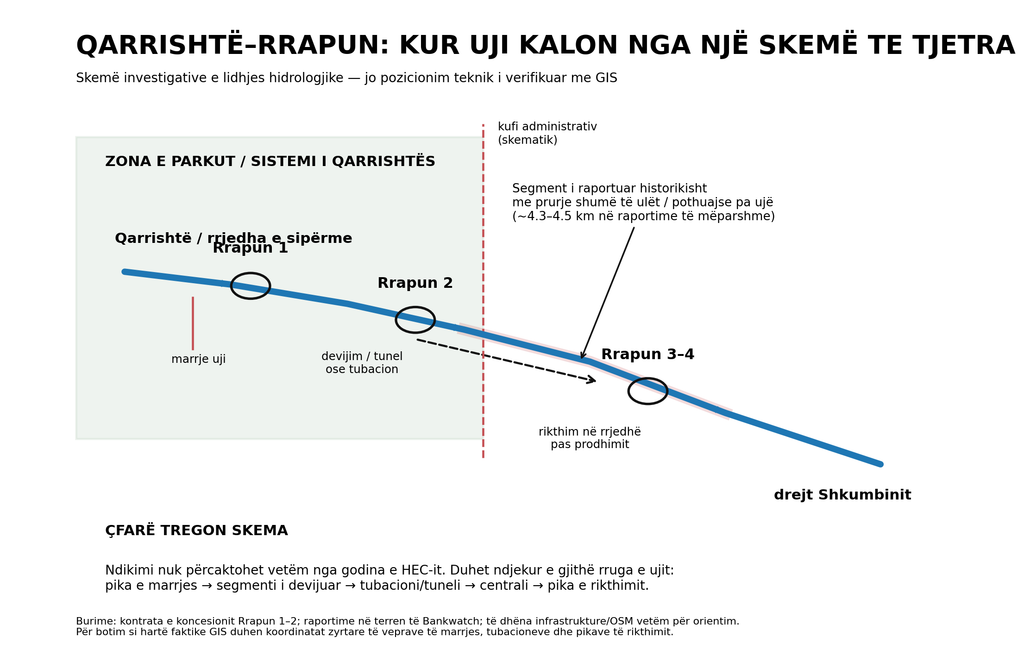
He particularly singles out Rrapu 3 and Rrapu 4, which, he says, have fragmented the river's flow and left segments of the bed with little or no water. The impact, he says, is not limited to the ecosystem.
In villages like Dorëz and Togëz, water has traditionally been used for consumption, irrigation, gardens, livestock, and mills. Its diversion to hydroelectric power plants changes not only habitat conditions, but also the way communities use the river.
"The fauna and flora that are in the water are the first to suffer. Macrovertebrates, fish, birds and in certain cases even mammals like otters, which are closely related to water," explains Nika.
According to him, a dam or a diverted segment of river can interrupt what he describes as a “natural highway” for aquatic life. Trout, for example, must move upstream to reproduce; when the continuity of the flow is interrupted, this cycle is also interrupted.
Changes are not only visible in the amount of water. The diversion and reduction of flows can also affect the temperature, turbidity and oxygenation of the water, parameters that determine whether a river continues to function as a habitat.
At this point, the question is no longer just whether the hydroelectric plants have permits. It is whether the system that permitted them and that today oversees them is able to show, with verifiable measurements and controls, that the river is still receiving the water it needs to survive.
Five HPPs or none? The boundary that changes the answer
How many hydropower plants operate within the Shebenik National Park?
The answer depends on the institution asking.
Environmental expert Erjon Kalaja says that five licensed hydropower plants operate in the territory connected to the park, with impacts that extend both to the protected ecosystem and to the streams downstream.
The National Agency of Natural Resources gives another answer. According to AKBN, currently within the official border of the Shebenik National Park there is no hydropower plant or concession facility active in production. The “Sheja e Librazhdit” project, envisaged within the park, was not completed and the concession contract was terminated in 2018.
But the same response lists several hydropower plants operating in the areas surrounding the park: Rrapun 1–2, Rrapun 3–4, and the HPPs in the stream Sheja e Hotolishtit. Another project on Zall i Qarrishta, according to AKBN, has not started construction.
This division between “inside the park” and “outside the park” is important for administration, but much less clear for a river.
Water flows do not stop at the drawn boundary of a protected area. Water taken at one point, fed into a tunnel or pipeline, and returned several kilometers downstream can affect an entire segment of the river, even when the physical source is outside the administrative boundary of the park.
"They say that the HPPs are outside the park, but that doesn't make sense," says Bashkim Koçi, a retired forestry technician from Gizavesh.
For this reason, the location of a hydroelectric power plant cannot be determined solely by the coordinates of the power plant building. To understand the real impact, the point where the water is taken, the diverted segment, the pipeline or tunnel, the power plant, and the point where the water returns to the riverbed must be seen together.
The water permit file further expands this picture. In the Shkumbini basin, not only Rrapun 1–2 and Rrapun 3/3A/4 appear, but also projects in Gurshpat, Dragostunje, Stravaj, Lunik, Orenje and other streams. The ecological question, therefore, is not only whether a HPP is located a few meters inside or outside the park, but how much free flow remains in the entire system after successive interventions.
This is what experts call cumulative impact : interventions that, assessed separately, may seem limited, but that together change the functioning of a river.
A violation found, but without sanction from the institution that found it
AKBN's response contains another important element.
The institution acknowledges that during monitoring, cases of non-compliance with the ecological flow at the Rrapun 1–2 HPP were found.
But AKBN clarifies that it does not have the authority to impose punitive measures. According to it, the findings have been forwarded to the Contracting Authority for further action.
So, the technical institution identifies the problem, but the responsibility for the measure is transferred to another institution.
The documents also show that institutional assessments also change over time.
In June 2026, the Water Resources Management Agency informed that the operators of the Gizavesh, Steblevë, Qarrishtë and Rrapun 1–2 HPPs had permits for the use of water resources and that the most recent verifications had not identified any violations of ecological flow conditions.
The two findings are not necessarily mutually exclusive. They may refer to different periods, different controls, and different verification methods.
But to understand what really happened to the river, the most important element is missing: the series of measurements.
How much water was in the river at the time of the check? How much was diverted towards the hydroelectric power plant? How much remained in the riverbed? Where and when was the measurement taken?
Without this data, the wording “no violations were found” does not allow for independent verification.
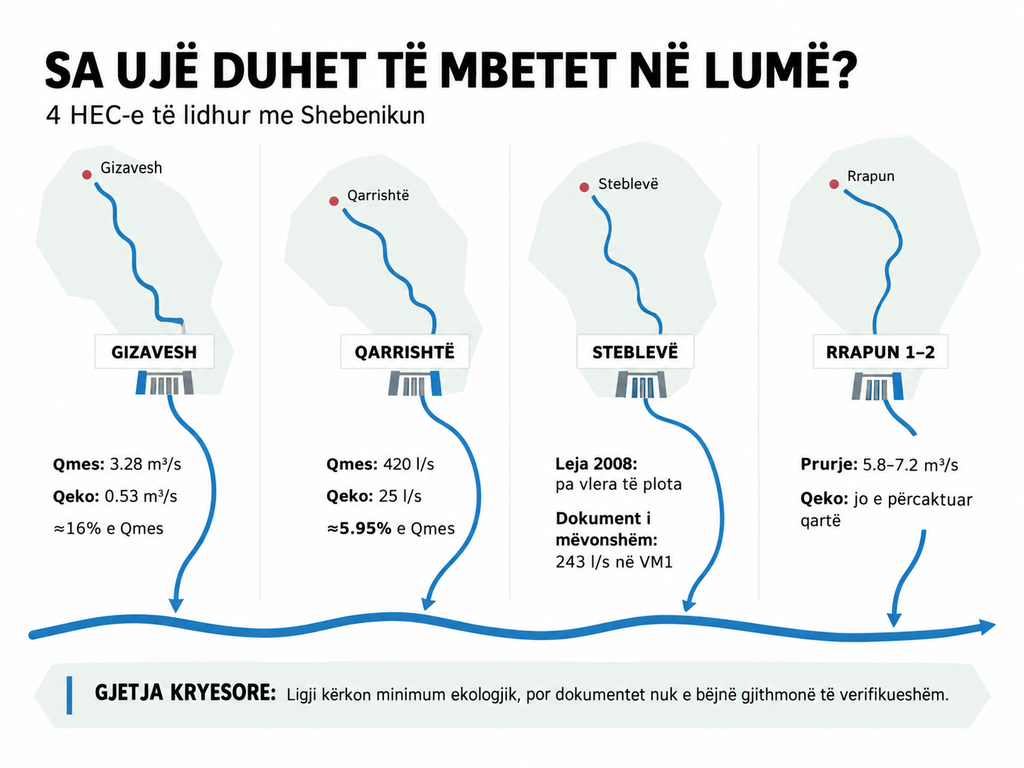
For at least two hydropower plants, the documents set concrete thresholds. The environmental documentation for the Steblevë HPP sets an ecological flow of 243 liters per second at point VM1, in Zallin i Bardhë. The water use permit for the Qarrishtë HPP, from 2022, sets an ecological flow of 25 liters per second.
These figures can be verified, but only if measurements taken during the operation exist and are made public.
Who measures the water?
In theory, environmental conditions and permits define the parameters that must be respected during the operation of a hydropower plant. In practice, part of the monitoring relies on reports prepared by the operators themselves.
Erjon Kalaja says that these reports are submitted periodically, but the problem is that there is not always clear information on how many of them are checked in the field.
"One of the main challenges of Albanian institutions remains precisely the follow-up and verification of these self-monitoring reports," he says.
Environmental reports are filed with the responsible institutions, while inspections and administrative measures are divided between several structures. It is precisely in this division of powers that the gaps appear.
The National Inspectorate of Territory Protection, for example, states that the Shebenik National Park is mainly monitored by the AKZM and the Regional Administration of Protected Areas and that the IKMT intervenes when it receives a notification or referral from them.
According to the official response from IKMT, during the period 2018–2026 there was no request from AKZM or ADZM for cooperation or intervention in the park in implementation of environmental protection legislation.
On the other hand, the National Agency for Protected Areas states that the Shebenik National Park is managed on the basis of a plan approved in 2018 and that during the period 2018–2025, a total of six field inspections were carried out regarding the activities of hydropower plants in the park and surrounding areas.
In seven years, this translates to less than one check per year.
The AKZM says that these inspections have not revealed any cases of complete interruption or non-compliance with the ecological flow within the park territory. The institution adds that it has not itself issued any permits or authorizations for interventions in water resources and that existing hydropower plants were provided with documentation before the establishment of the AKZM and before the entry into force of the current legislation on protected areas.
This raises a question that is not only related to the past: who today reassesses the impacts of projects approved under a different legal regime?
And another: are six inspections in seven years enough to guarantee compliance with ecological flow in a water system exposed to several hydroelectric power plants?
"We have no complaints"
The Librazhd Municipality says that the administration of rivers and streams within the park is not within its competence and directs the information to the Elbasan Protected Areas Administration.
The municipality also states that it has not received any complaints from residents about a lack of water for irrigation or the drying up of rivers in the area.
A similar response is given by the Prrenjas Municipality, which says that it has not received any complaints about lack of water or drying up of rivers in the park's territory.
But the absence of an administratively registered complaint is not the same as the absence of concern on the ground.
Bashkim Koçi, who says he has worked for 25 years as a forestry technician in the Gizavesh area, compares today's river to the one he knew several decades ago.
"In 1977, we were soldiers there, in Rrapun. The French ambassador would come and fish for trout with a hook. Even Demir Hyska, who was the great actor of Elbasan, would come there. That is, there was water all year round. Now, the water they take there is taken back and put into the other HPP across the way, in Zalli i Qarrishta. They don't let it flow freely and join the Shkumbini. This is what impresses me the most. After the HPPs take the water there, the Rrapun River dries up completely up to the train bridge in Librazhd. It's a shame. I don't know how this thing will go."
This is testimony from a resident, not hydrological measurements. But it shows the gap between what is recorded as a “complaint” and how the river’s change is perceived by the people living near it.
Lyto Alliu also links the reduction in flow to the water sources used by residents.
"Then there's the issue of drinking water. When the river flows in its bed, it nourishes and refreshes the underground water veins. When the flow decreases, unfortunately the sources of drinking water also decrease."
This too remains evidence that requires comparison with hydrological and hydrogeological data. But it is precisely this type of comparison that becomes difficult when complete data is not public or is not collected consistently.
"One of the most serious problems is that people become accustomed to the loss and, in many cases, the gradual death of rivers," says Kalaja.
Missing data
To determine the ecological flow, one must first know how much water the river has.
Hydrometric data is administered by the institutions responsible for water monitoring, but interviewed experts say that the network of measuring stations has been reduced compared to the period before the 90s and that data from recent years is not always easily accessible.
Consequently, historical series can also be used in technical documentation.
Lawyer Irena Dule says this becomes particularly problematic when an Environmental Impact Assessment must be based on the real state of a river.
"You have to measure this over a period of a year, because you have to look at the day with the most rainfall. There is a methodology for how this flow is measured. When official data is missing, this will be produced and their production is formal and does not correspond to reality," says Dule.
Even AKBN admits that it does not have technical data on the flows and quantities of water allowed for use, as they are administered by the institutions that issue permits for the use of water resources.
Thus, the institution that follows the energy side does not necessarily administer the main hydrological data. The institution of protected areas says that it has not issued water permits. IKMT says that it has not received referrals. Municipalities say that they have no competence or complaints.
Responsibility is shared between several doors.
Permits show the minimum, but not always how it is calculated
Documents provided by AMBU highlight one of the main problems observed: the law requires that every hydropower plant leave a minimum ecological flow in the natural riverbed, but for some of the projects analyzed it is not clear on what data this amount was determined and how its compliance is currently verified.
The law stipulates that the ecological flow cannot be less than Q355, an indicator calculated based on the daily river flows. To check whether this limit is respected, at least a hydrological study, a series of flows and the value of Q355 itself are required.
For the Gizavesh HPP, the 2024 permit sets an average annual flow of 3.28 m³/s and an ecological flow of 0.53 m³/s, about 16 percent of the average. But the documentation made available only gives the final figure, without indicating the methodology and data on which it was calculated.
At the Qarrishte HPP, the difference is even starker. The average annual flow is set at 420 liters per second, while the ecological flow is only 25 liters per second, or about 5.95 percent of the average. This does not automatically mean that the permit violates the law, as the legal criterion is not a fixed percentage, but Q355. However, without the value of Q355 and without the hydrological study, it cannot be independently verified whether 25 liters per second is indeed the legal minimum for this river.
For the Steblevë HPP, the 2008 documents made available do not contain complete values for the average flow, ecological flow or the amount of water authorized for use. For Rrapun 1–2, the documents contain data on flows, but do not determine a clear value for the ecological flow.
This does not mean that these hydropower plants are currently exempt from the obligation to release water into the river. The current law imposes this obligation on every water user.
But this is precisely where the question arises that the documents do not resolve: with what concrete value are licensed HPPs controlled today before the ecological flow was clearly defined in legislation?
This question becomes even more important for Rrapun 1–2, where AKBN has reported previous cases of non-compliance with the ecological flow, while AMBU says that the most recent inspections have not identified any violations.
To understand which picture is correct, it is not enough to conclude “it was respected” or “it was not respected.” Measurements are needed: what was the river flow, how much water did the hydroelectric power plant take, how much remained in the riverbed, and what legal value was it compared to.
The law stipulates that the river must have a minimum water content. However, for some of the Shebenik HPPs, the documents provided do not yet make it possible to clearly verify how this minimum has been determined and how it is controlled on the ground.
Four HPPs and a gap in documentation
Another question arises from the response of the National Environmental Agency.
The NEA confirms that it has conducted inspections at four hydropower plants operating in the Shebenik area: Gizavesh HPP, Steblevë HPP, Qarrishtë HPP and Rrapun 1–2 HPP.
The institution says that respecting ecological flow is part of water inspections and that, when violations are identified, they should be reflected in the final inspection reports.
But according to the KTA's verification in the e-permit system, no Environmental Impact Assessment decisions were issued for these projects.
This does not prove that the hydropower plants have necessarily operated without EIA. Some of the projects are older than the electronic system itself and environmental documents may exist in other archives. For the Steblevë HPP, for example, there is environmental documentation indexed later by the NEA, while the production license is earlier.
The problem is precisely this chronological gap.
What environmental documentation existed when each project was approved? What hydrological study was used? What conditions were set for the ecological flow? What was checked after the hydropower plant began production?
Not finding documents on a portal is not the answer. It is a reason to search for the full file.
One HPP feeds another
The Rrapuni case shows why cumulative impact cannot be assessed by looking at each project separately.
Previous field reports have documented insufficient flow below Rrapun 1–2, problems with fish passage, and the connection of water from a hydropower scheme to Rrapun 3–4 below. In some segments, a bed of about 4.3–4.5 kilometers with very low or almost no water flow has been reported, as well as conflicts with traditional water users.
These are historical findings, which should be read in light of AMBU's statement that the most recent inspections have not identified any violations.
Only measurements can make the difference.
"One thing is what is declared in documents and another thing is to conduct an on-site inspection to see if what has been declared has been respected," says journalist Artan Rama.
Ultimately, this is the crux of the ecological flow debate. When water leaves its bed and flows into pipes for miles, the question is not just how many liters of water are left.
A river transports sediments, oxygenates the water, connects habitats, and allows living things to move along the stream.
As Kalaja summarizes:
"There is no life inside the tubes."
One file, many institutions
For a resident living near a hydroelectric power plant, understanding how the project was approved, how much water it is allowed to take, and whether it respects the ecological flow is not a simple process.
There is no single folder where all this data can be found.
The production license is with one institution, the water use permit with another, the environmental documentation somewhere else, the concession contract is administered separately, while for projects near protected areas, the documentation of the institutions that manage the park is also added.
The result is an administrative history that must be reconstructed document by document.
For the Gizavesh HPP, with a capacity of 0.5 MW, the historical documents of the Energy Regulatory Authority identify “DOSKU-ENERGY” as the licensed entity for energy production, while the AMBU water permit register, in June 2026, identifies “Dardania Green Energy” as the holder of the permit for the use of the water resource. The documents provided do not clearly indicate the act linking these two phases of the project.
For the Qarrishte HPP, the story begins with a 55 kW municipal plant built in 1968, which went out of operation in the late 80s. The facility was sold at auction in 2017, and today it appears as a 0.30 MW plant with a current water permit issued in 2022.
Even for the Steblevë HPP, the documents require chronological reconstruction: the production license dates back to 2009, while the environmental file found in the KTA archive appears in 2018.
These discrepancies do not in themselves prove violations. But they show that in order to understand the history of a hydroelectric power plant, documents produced in different years, by different institutions, and in registers that are not always linked to each other, must be brought together.
"The problem is that every aspect of a hydropower plant is supervised by different institutions. There is no single information point where citizens can go and find all the necessary documentation," says Erjon Kalaja.
According to him, even experts are forced to rely on requests for the right to information, professional knowledge, field experience and distributed resources. Albania has taken steps to create a Water Cadastre at the Water Resources Management Agency, but the system still does not provide a complete picture of interventions and permits on water bodies.
The problem of access to information has also ended up in court.
On May 20, 2019, the Tirana Administrative Court ruled in favor of journalist Artan Rama and ordered the Ministry of Infrastructure and Energy to provide him with the requested information on hydropower plants.
"Yes. Getting information is a battle in itself," says Rama.
And, according to him, it is not enough for the information to be provided eventually.
"Keep in mind that information, if not provided on time, loses its value and is no longer of interest."
This is especially important for environmental projects. Information about an EIA, a public hearing, a water permit, or a project change has value to the community before the intervention is carried out, not just after it has become a fact.
In the case of Shebenik, the lack of a unified file makes it difficult not only for public control, but also for verifying a fundamental question: how much water is a HPP allowed to take, how much should remain in the river, and who controls this?
This issue is also directly related to the European integration process.
The Water Framework Directive requires that water bodies are managed at the basin scale and that their ecological status is not deteriorated. Meanwhile, recent European nature restoration policies are placing increasing emphasis on returning rivers to as natural a state as possible and removing unnecessary barriers.
In this context, the question for Albania is not just how many hydropower plants it has built, but how well it is able to measure and document their impact on the same river system.
According to Kala, many small hydropower plants spread across a basin can be more difficult to control than a single facility, because the impact of each may seem limited, while the joint impact becomes apparent only when the river is viewed as a single system.
This is where transparency becomes part of river protection.
If data on permits, flows, monitoring and controls remain scattered among several institutions, it becomes difficult to verify whether the ecological flow is actually respected. The ecological flow exists as an obligation, but public control over how it is implemented remains fragmented.
In the end, the question is simple: how much water does a hydroelectric power plant take in, how much does it release into the river, and who can prove this with verifiable data?/ acqj.al