Author: Merxhan Daci
Everything Prena Buraku had was destroyed in the blink of an eye on a June afternoon. 250 heads of small cattle were destroyed by a powerful lightning where the family had set up a camp in the village of Zaj, Selitë e Mirdita unit. Luck was with the shepherd who fortunately escaped. But the small cattle, sheep, goats, goats and heifers that were owned by the Buraku family all died. This was an event that hit the economy of Prena, Kol, her husband, and Clinton, their son.
The months passed in difficult conditions, and as Clinton says for "Signal" with them, ordinary people were more in solidarity than the state. The Buraku family's economic damage is estimated at an average of 20 million old ALL. Clinton, the 27-year-old son of the family, says that the family is trying to increase the herd of cattle from scratch, but it is already very difficult since they have to start from zero.
" Without registration, they said why don't you register? When you have all the papers in order, they say the law doesn't provide for it," Klinton Buraku complains to "Sinjalizo".
From the mountain to the field, farmers are "crying their troubles", they are getting ready to close the greenhouses
Gentian Ziu is a 41-year-old farmer in the area of Kutallia in Berat. He has been farming for 12 years, he tells "Sinjalizo" that this is the first time in so many years that he feels ruined and ready to lock up his greenhouses of several hectares. The reasons are different, but in recent years it has been systematically damaged by bad weather.
"I had damage both from high temperatures, where 1 bushel of Ozgan tomatoes was damaged, as well as from cold and frost, where in December 1 bushel of vegetables was damaged. I also had a problem with floods, especially in the last 2-3 years, I was damaged a lot, agriculture went downhill", said Ziu.
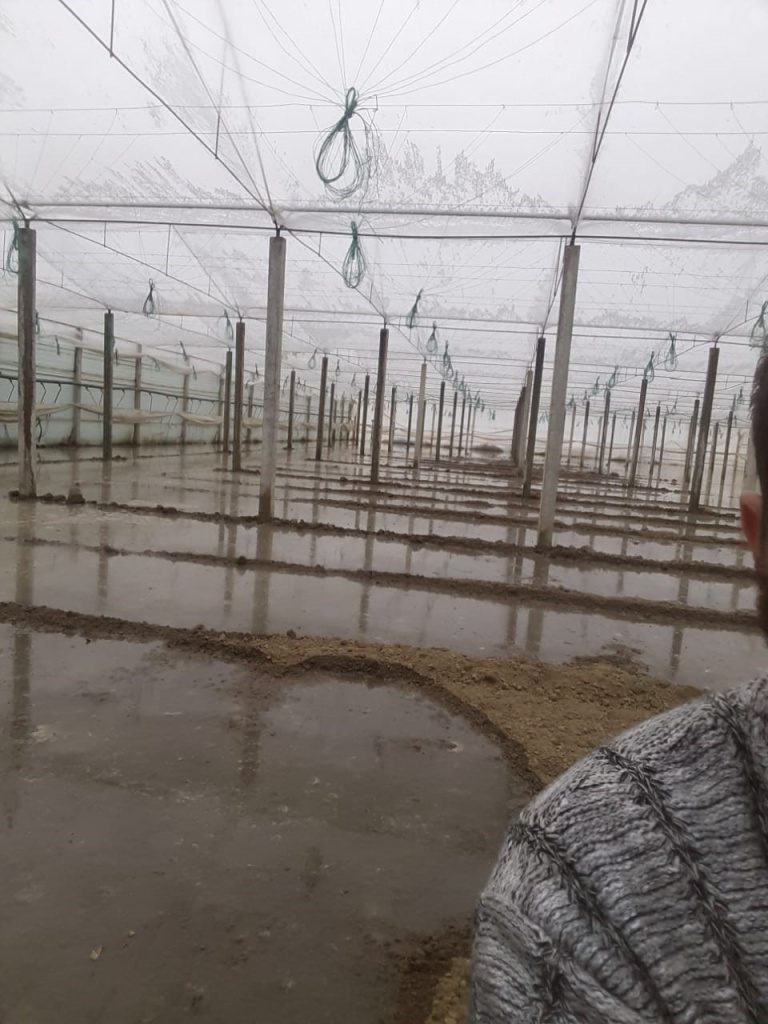
When asked if he was offered support or compensation from the state, he answered briefly "nothing".
Ziu adds that as if that were not enough, there are other problems in agriculture such as seeds, inputs that are not of the right quality, smuggled pesticides, collection points that are not controlled by the state and many others.
"This job will end. 97 percent of the money we have received for investments in agriculture is borrowed, on credit. There is no happy farmer. I will not invest anymore. Agricultural pharmacies are drowning in debt from farmers," Ziu says sadly.

Nikolin Çela, 34 years old, is a young farmer in the village of Samaticë in Berat. He has been back from Greece where he worked as an immigrant for several years. He returned to Albania with the idea of investing in agriculture and taking back his hard work. However, it did not go as he had originally thought. The damages he has had in recent years in agriculture are incalculable.
"I had six dynam sera flooded last December. Three dynym were with cucumbers, the rest with alfalfa and wheat. The Osum River came out of its bed and flooded them," he says.
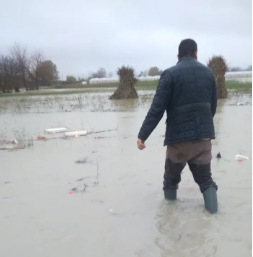
He painfully tells "Sinjalizo" that he has not received any compensation or other form of support from the Albanian state.
" I didn't get anything, I did the paperwork, I didn't get anything, I paid the taxes. I came with 40 thousand euros brought from Greece, now I'm in debt to my people. I have 1 hectare of greenhouses. I tried to get a loan and it didn't work out. It's not worth it. I'm going to emigrate again. I've had greenhouses since 2000. I was flooded 4 years ago. I didn't get a single lek. We're leaving, it's gone where it belongs ," Çela tells "Sinjalizo".

The figures of only the last two years speak of a catastrophic balance
The official data of the Ministry of Agriculture and Rural Development speak of hundreds of hectares flooded by water, episodes of fires, hailstorms, landslides and many other phenomena.
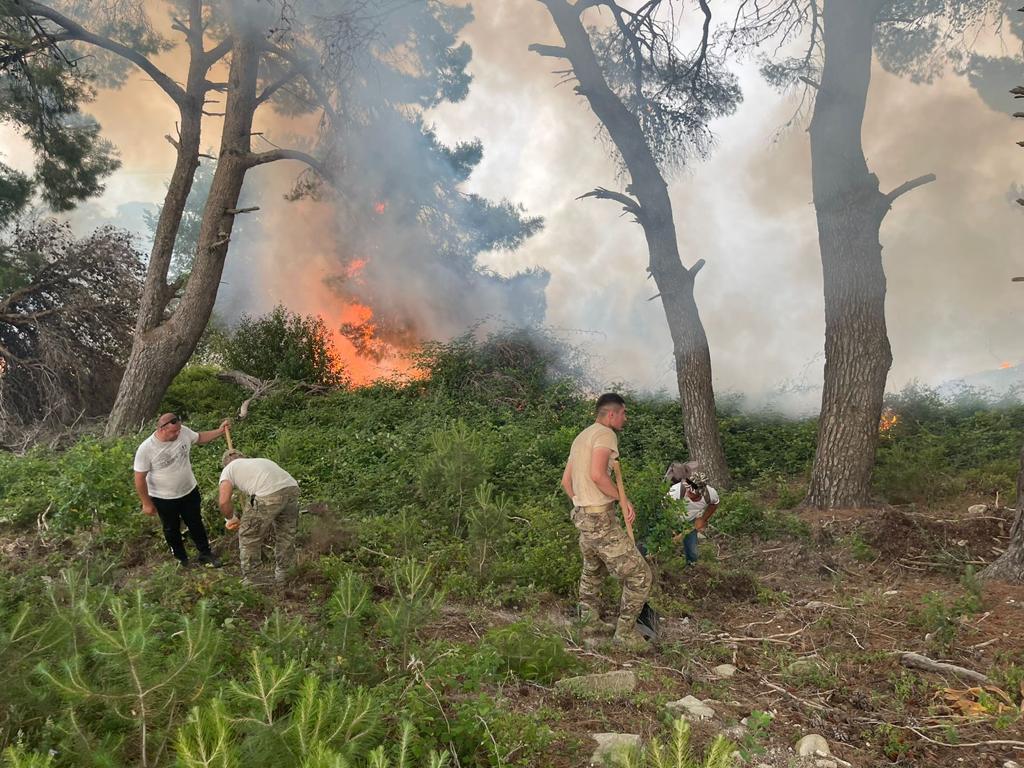
In the area of Korça, there were problems with the strong wind and rain, around 11 roots of fruit trees, mainly apples, plums, etc., fell. While in other orchards there is a 20-25% drop in production on the ground. The area most damaged by these natural disasters was the area of Devolli. As a result of the rain and strong wind in the Korça district, there have been problems with the production mainly of apples, in some plots the trees and the support system of the orchards have also been uprooted. There were other damages from deliberate arson that have not yet been clarified.

In the district of Shkodra, during January and February 2021, there were 3890 hectares of flooded land. Meanwhile, the strong hail of May 2021 caused great damage to 203 hectares in Gur te Zi, planted mainly with alfalfa, corn, vegetables and tobacco. As if that were not enough, in July and August of the same year, 17 hectares of olive groves and 1 and a half hectares of medicinal plants were burned by fires.
Even in the Lezha district, there was no lack of damage. During the last two years, over 3 hectares planted with various agricultural crops were flooded.
Even in the counties of Tirana, Durrës, Dibra, there were thousands of hectares of agricultural crops flooded, where damage to olive groves was the main cause.
In the area of Myzeqe, the granary of Albanian agriculture and economy, over the last two years there have been over 31 thousand olive roots damaged by phenomena such as fire and floods. Entire wheat and fodder fields were also damaged and destroyed in this area during the same period.
Insuring farmers and their properties, no one undertakes to insure the "vagaries" of the weather
One of the main reasons why Albanian farmers are exposed to great economic damage in agriculture is the lack of insurance in agriculture. Currently, insurance in agriculture is almost non-existent.
The World Bank report , "Assessment of Disaster Financing in Albania," notes that property insurance against natural disasters is a necessity as Albania is a country at risk from these events, which damage local government revenues and the country's economy as a whole.
The farmer from Berat, among other things, tells "Sinjalizo" that almost no farmer has his agricultural property insured, including himself.
"No company covers them, there is no market stability. No one works with insurance. That's what the insurance companies say," says Ziu.
Even Nikolini, the 34-year-old farmer from Berat, has nothing secured from his agricultural properties.
"I don't have insurance for anything. A wind blows and it takes them. A cold one, an extreme heat one. There is no insurance, in Greece where I come from there is insurance for example," he said.
Gjok Vuksani, an expert in agriculture, told "Sinjalizo" that insurance in agriculture is not only necessary but indispensable in a country like Albania.
"To minimize damages in agriculture, the insurance system for greenhouses, fruit trees, animals, and agricultural production should be widely introduced. The state can subsidize up to 50% of the insurance premium for the farmer ," said Vuksani.
Ervin Resulaj, also an expert in agriculture, in the area of Fier and Lushnja, also affirms the lack of interest of insurance companies to approach farmers.
"An Albanian insurance company does not have a guarantee in agriculture, greenhouses are vulnerable structures. The companies themselves are not interested. The probability of natural disasters is high, so they stay away," said Resulaj.
The Ministry of Agriculture and Rural Development in an official response to "Sinjalizo" confirms the non-existence of insurance in the agricultural sector.
"Insurance in agriculture is an important and difficult process. MBZHR will create facilitating conditions for the design of support measures for farmers, as well as increasing credit in agriculture", said MBZHR.
How affected is and will be Albania and the agricultural sector by climate change?
Exposed to various natural hazards, especially floods and earthquakes, Albania has the highest level of disaster risk in Europe according to the World Risk Index 2019.
According to the World Bank , during the period 1995–2015, an average of 30 thousand people were affected each year by natural disasters and more than 95 percent of Albanian municipalities were affected by at least one disaster.
The economic cost of disasters may rise further. Climate change may further increase the severity or frequency of weather-related disasters, such as floods and storms.
Albania is at risk from climate change as a result of great exposure to extreme temperatures, drought, heat waves, floods, etc.
The future climate scenario for Albania predicts changes, such as: increasing temperatures, prolonged droughts, increased risk of landslides from floods and fires, decreasing rainfall and reducing water and agricultural land resources with negative impacts on agriculture, forests and biodiversity.
The impacts of climate change on the agricultural sector are expected to be combined – with increased production of wheat and alfalfa and reduced production of grapes, olives and livestock. The Albanian state says that Albania has responded to the needs for protection and adaptation to this phenomenon through the National Strategy for Climate Change.
However, Evans Rroko, a professor at the Agricultural University of Tirana, says that the state has a lot in its hands on this issue and should do more.
"The state, the Ministry of Agriculture must undertake important investments, such as for irrigation or soil drainage. It is necessary to significantly strengthen the advisory system for farmers, as well as to find the most effective ways to convey to each of them the necessary information about the climate changes that are taking place, about the consequences that will have on the growth and development of plants, but also in the lives of animals, as well as for the measures that each of them must take to cope with these consequences".
Expert Gjok Vuksani goes further as he says that municipalities should employ the best agricultural specialists in administrative units (agronomist, veterinarian) to advise the farmer on planting structure, disease treatments, animal health, etc.
Support for agriculture
Agriculture expert Gjok Vuksani tells "Sinjalizo" that the support for agriculture is insufficient.
" Agriculture provides approximately 20% of GDP and about 42% of the workforce is employed in this field. Therefore, the budget for agriculture must be increased. For 2022, about 2% less budget has been provided in this field. So support for agriculture is insufficient ," he said.
Expert Resulaj, on the other hand, adds that agriculture in Albania, unlike in Kosovo, is not sufficiently supported.
"Agriculture has been a problem for 30 years, it has not been paid attention to. There are problems with the irrigation and drainage systems. In the past, when there was damage to agriculture, the farmer was compensated in some way. Now no one supports you, even though the damage comes from force majeure. During the last frosts, no one went to the greenhouses to check, even with a report for statistics. We have agricultural directors, but they receive their salaries for nothing. The state should have a reserve fund to use for agriculture in case farmers suffer damage," he said.