Author: Denis Tahiri
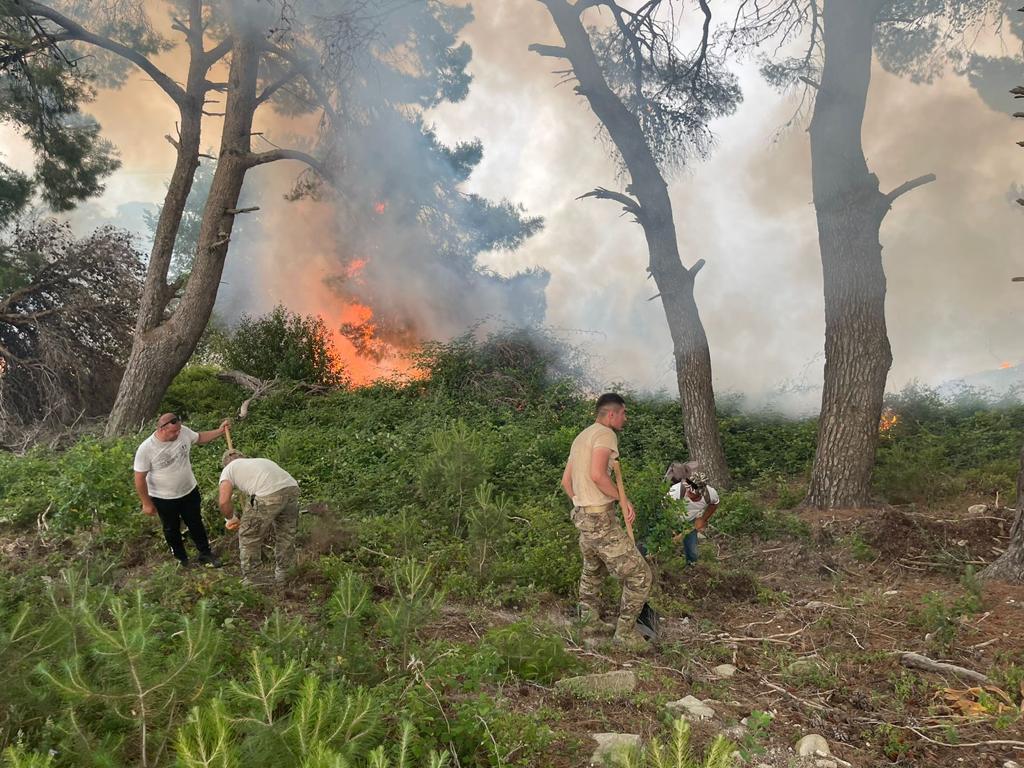
Chika Mountain has been unrecognizable for five days due to smoke clouds. The fires have become a difficult mission for the army, which has once again turned to circumstantial techniques. A call to neighbors for help from the air brought in two planes, but despite the efforts, attempts to put out the fire in time were in the hands of people who intervened on the ground. The scene seems to be repeated for the second summer in a row, where the quick reaction of the Ministry of Defense was not missing, which guarantees that the outbreaks are being brought under control and that Palasa is not at risk.
This summer's test against the Civil Defense Agency started immediately with the rising temperatures. On June 3, the fallout of the fire exposed the same problems with the same alarm, even the cacophony of unofficial first reports where one of the local firefighters was exposed likening him to a pyromaniac setting fires. In fact, the technique used by Luan Kapaj, head of the operational forces for fire and rescue in Vlora, was one of the most well-known in the world, which was actually aimed at extinguishing the flames.
" I went with some firefighting forces and some soldiers to the island of Sazan . I saw the situation, it was very alarming, I also spoke with civil emergencies that measures need to be taken because the fire is causing damage to the forests, meaning tall trees and some small trees or small pines that were as if they had been planted by hand. Plus then there were bushes and lots of other things," Kapaj tells Sinjalizo.

Decorated for his service and sacrifices after the November 26 earthquake in Albania, Kapaj does not leave without commenting on the video that disturbed his calm on the fire situation on the island of Sazan during the exercise of his duty.
" Normally, when I saw that video, I didn't like it, but in my soul I am pure of any kind of action that intervenes in a fire situation, because I consciously do every action to fight the fire," Kapaj tells Sinjalizo.
And when the control of the flames is carried out mostly through the sacrifice of firefighters like Kapaj or through soldiers who travel on foot in the mountains, the reporting of the fires remains even more disturbing when on average almost 9 thousand hectares of land are burned every year.
" Albania has been in a state of national emergency for about 30 years, especially the situation in the forests, returning to the massive fires that have been news for years in the summer season." This observation by REC Albania, in one of its newsletters, also adds that in 99% of cases of starting these fires, the cause is human.
But this is only the first problem related to fire emergencies in Albania. What is an even bigger problem is the inability of emergency structures to react and intervene to extinguish these fires. A source from Civil Emergencies who agreed to speak on the condition of anonymity told "SIGNAL" how the fire was actually fought on the ground. While a helicopter with the head of the agency was patrolling from the air for reasons that were not made clear and which were said to be to see the situation from the air, there on the ground soldiers and firefighters with shovels and boots faced the fury of the fire.
" First, the firefighters didn't even have the clothing to enter an area that was on fire. Now they're trying to lie to themselves, but the facts are facts, the firefighters don't have the tools, they didn't have the clothing, pants, jacket, shoes, cutting tools to open a lane to wait for the fire when it gets there," the source says. Earlier, another firefighter signaled on the platform about the state's indifference to protecting the ground troops, adding that " the situation is difficult, we need numerous ground forces. The current reality is that even those we have in cases of activation in the field cannot be supplied with food and water, " the citizen writes for Sinjalizo.
" Simply put, don't get too worked up, we can't supply the ground forces with the necessary means. This is the truth!", admits Sinjalizo's source.
Fire and prayer for help
But the impossibility of intervention to extinguish the fire was not seen only in Sazan, in Torovicë of Lezha, about 15 hectares were burned, while in Krujë another 20. Although the ministry would declare that the fire was extinguished, facts were broadcast in the media about how the active fire was consuming entire areas of land.
" Nothing has changed, there is no change from year to year," says the head of the Firefighters' Union, Bledar Bajrami. And as we enter the period with the highest temperatures of the summer, from everything that has happened at the beginning of the season, it is clear that this year too, Albanian firefighters will have their most effective tools: picks and shovels.
Civil emergencies in Albania are inoperable
The Ministry of Defense stated at the beginning of the fire season, such as the one on the island of Sazan, that " the Armed Forces have light helicopters on standby, but in the specifics of their use they have limitations to participate and fulfill tasks in cases of various types of emergencies." Regarding the Cougar helicopters, the Ministry of Defense stated that they are in service. " As a rule, they are subject to rigorous maintenance and repair requirements, based on periods of use and flight time. In this process, a part of the Cougar military helicopters, which for a long time have been active participants in numerous emergency operations in times of floods, fires, earthquakes, extreme weather conditions, in community assistance, participation in various exercises in the Armed Forces, as well as those with NATO conducted in our country, have gone through the maintenance process", But even though the ministry says a part, the rest of the Cougar helicopters were not engaged in the operation, which, just from the ministry's announcement, logically should have been on duty and active. Only after the intervention from the air through a firefighting aircraft coming from abroad, was it possible to extinguish the fire.

On the other hand, the National Civil Protection Agency, when asked by Sinjalizo how many aircraft Albania has available to extinguish the fires, stated that: " According to the response from the responsible structure, it turns out that there are 2 helicopters available to extinguish the fires". But from the observation carried out by Sinjalizo and the data collected on the ground, in this situation only one helicopter was seen that flew for a few minutes and that had the head of emergencies Haki Cako on board. It is unofficially accepted that these two helicopters did not intervene either in Sazan or in the fires that burned dozens of hectares in Lezha and Kruja.

Asked about the watercraft for extinguishing fires on the coast, AKMC says that Albania's capacity is zero. " The Navy has in its organization 4 ILIRIA class ships (42 meters) which have firefighting capacities and provide assistance at sea to ships on fire. These ships cannot be used for extinguishing fires on the coast," says AKMC in its official response to "Sinjalizo", adding that there are also 70 specialized search and rescue forces, 246 non-specialized search and rescue forces, 4 motorboats, 8 dinghies which, depending on the situation, can be engaged for this purpose.
Currently, according to official data published on the website of the Ministry of Defense, the fire service in Albania is composed of 150 firefighting vehicles, where 30 vehicles were purchased in recent years and about 15 more were donated by homologous firefighting Services. In 61 municipalities in the country, 70 fire stations have been installed, with 1250 employees.
But even though the figures express a good situation, on the ground it is a completely different picture. Fire extinguishers belong to the years of production starting from 1970, while firefighters are poorly equipped. This fact has also been evidenced by a World Bank report.
“ All key civil protection sectors suffer from a lack of equipment,” the report says, adding that: “ Firefighting equipment for all types of firefighting, training and rescue equipment for specific teams is extremely limited or in need of replacement .” The report says that investments in equipment should be made based on interoperability and European standards.
But in the World Bank's report, emphasis is also placed on the Operational Centers for Civil Emergencies, which do not meet the minimum operational requirements.
" Currently, there are several Central Operational Centers at the central level that operate 24 hours a day, 7 days a week. The National Emergency Operational Center and the Operational Centers at the regional level do not meet the minimum requirements to be operational," the report states, noting that the budget is insufficient for basic maintenance. The document further describes that there is a lack of equipment and professionally trained staff, and these centers also do not have statistical data that would support the decision-making process during the response to emergency situations. What is striking is the fact that in Albania there is no center for training firefighters, while countries in the region are equipped with them, starting from Montenegro, Greece and Kosovo.
Currently, a firefighter is paid 360 thousand old lek, and with the condition that he is always ready to face the constant danger.
" In peacetime, the only institution that is at war is the fire department, and we have the lowest salary, 36 thousand lek is the salary of a firefighter," says Bledar Bajrami, the head of the union. Meanwhile, the question that arises is why this service that is so vital to society, who often work with substandard equipment, risking their lives in every intervention they make, is not compensated for the sacrifices they make in monetary value, at a time when many sectors have seen salary increases.
KLSH critical, but no one listens
The Supreme State Audit Office , in a report published in 2022, highlights numerous violations in the National Civil Emergencies Agency, ranging from failure to draft plans to payments for helicopters.
"For the period from 2004 to 10.12.2021, when the audit was completed, the Republic of Albania does not have a National Strategy for Disaster Risk Reduction, and disaster risk assessment at the central level," the SAI report states.
Among others, KLSH evidences that at the central and local level AKMC does not have sufficient human and technical resources for responding to fire emergency situations.
"Out of 61 municipalities at the republic level, data has been received in 55 of them, in which 152 fire engines are reported. Of these, 131 are in working condition, 8 with minor defects, 3 with significant defects, 10 out of use and 36 unmarked (without documentation)."
But the SAI does not leave out the number of firefighters and their poor equipment. " The population of the Republic of Albania on January 1, 2021 is 2,829,741 inhabitants. The number of inhabitants/firefighters for 2021 is 2,185, exceeding 205 inhabitants per firefighter, in violation of Law 152/2015. Municipalities and administrative units lack personal protective equipment and external equipment for extinguishing fires, such as: fire suits, gas masks, fire boots, fire gloves, etc. A total of 243 backpack pumps, of which 221 are professional, 22 are ordinary, 568 are fixed with powder, 92 with CO2, 23 suction pumps and 55 are various pumps," the SAI further adds in its report.
Vulnerable
Vlora, Gjirokastra and Kukësi faced massive fires in their territory last year, but were unable to intervene. The mountain area of Gjirokstra currently counts 4 firefighting vehicles, of which three of them have no documentation, while one of them has only a donation deed as documentation. The newest fire engine belongs to 1992, while the oldest one belongs to 1984. On the other hand, the municipality of Gjirokastër announces that for 2022 it has planned to buy a fire engine, but even though we are in the most dangerous part of the year for fires, this fire extinguisher has not been purchased yet.

Even in Kukës, where last year the fire advanced to the entrance of the Kalimash tunnel, burning hundreds of hectares of land, the situation has not changed. Just like last year, the 36 fire service personnel in Kukës are divided into two stations, one for the city and another for the Thirrë-Kalimash tunnel. Each of these two stations has a fire truck at its disposal, with a capacity of 4000 liters of water each and manufactured in 2008. But to the official request for information regarding an inventory of the equipment available to the Kukës firefighters, the Kukës MZSH responded: “The equipment that the firefighting structure has for fighting fires: a- pipes, ladders…….., b- picks, shovels, fire-resistant clothing,……, c- hydraulic cutter for rescue operations ……, d- Ap 3 ……., …..others………..”.
In Vlorë, Sinjalizo learns that there are no improvements in the infrastructure against fires. In this municipality, there are 7 vehicles, but only 3 of them are of the autobote type that can carry water. Of these three, the newest vehicle belongs to 1990 and the oldest to 1987. Vlora, Gjirokastra and Kukësi are not the only ones that do not have a standard structure of firefighters. For years, municipalities in the country have been buying old fire engines. Between 2015 and 2019 alone, 25 municipalities across the country purchased old fire trucks.
What did we lose from the fires last year?
But in addition to the hundreds of damaged hectares, the fires are endangering the houses that are placed under the power of the flames or due to electrical sparks or other fire incidents. It is officially accepted that only for the first ten months of 2021, 165 fires were recorded in buildings, mostly apartments. The most affected city is Korça with 32 fires, followed by Fieri with 30 fires. Meanwhile, 7297 hectares of bushes, 18957 olive roots, and 17 hectares of land were burned in the forests. In total, from the fires in Albania last year, 9096 hectares of land were burned by the flames with an incalculable economic damage.