


Author: Dallandyshe Xhaferri
" It was a girl, so the mother was forced to abort her," Ilda begins her story for "Sinjalizo," telling how a few years ago her mother, faced with psychological pressure from family members, was forced to have an abortion immediately after learning the gender of the fetus.
" I aborted the child in the state hospital ," Luljeta, a resident of Divjaka, later claims, adding, " no medical commission met to see whether or not I could keep the child ." She admits that the abortion of the female fetus cost her about 150 thousand old lek, but "it enabled the continuation of the marriage."
This is just one of the cases of abortion performed on the basis of gender in the country, although selective abortion is still considered illegal and punishable by law. Through the official response to the request for information, the Institute of Public Health, admitted to “Sinjalizo” that “ there is no data on abortions performed on the basis of gender (male/female) or selective abortions ”, underlining the fact that “ selective abortions are considered illegal ”.
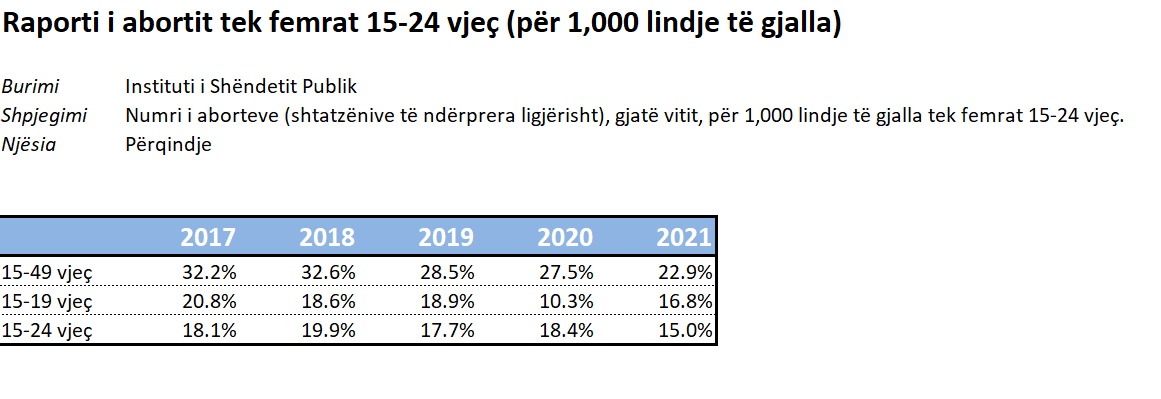
According to data made public by the Institute of Public Health, only in 2021, 100 voluntary and legal abortions were registered among women aged 15-24. Meanwhile, for the same year, for the 15-49 age group, 1000% abortions were registered for 22,9 births. In other words, for every 1000 births, 230 legal abortions were registered.
The natural boy-girl ratio has been broken for years
Elida Nuri, Advocacy and Communication Analyst at UNFPA in Albania, tells "Sinjalizo" that according to a study conducted by them based on official figures collected by the Ministry of Health and Social Protection and INSTAT, it results that 109 boys are born per year compared to 100 girls.
"What is being observed at the global, regional and national levels is what we call 'harmful practices of gender-based violence'. So, the phenomenon of 'gender based sex election' exists in Albania," says Nuri.
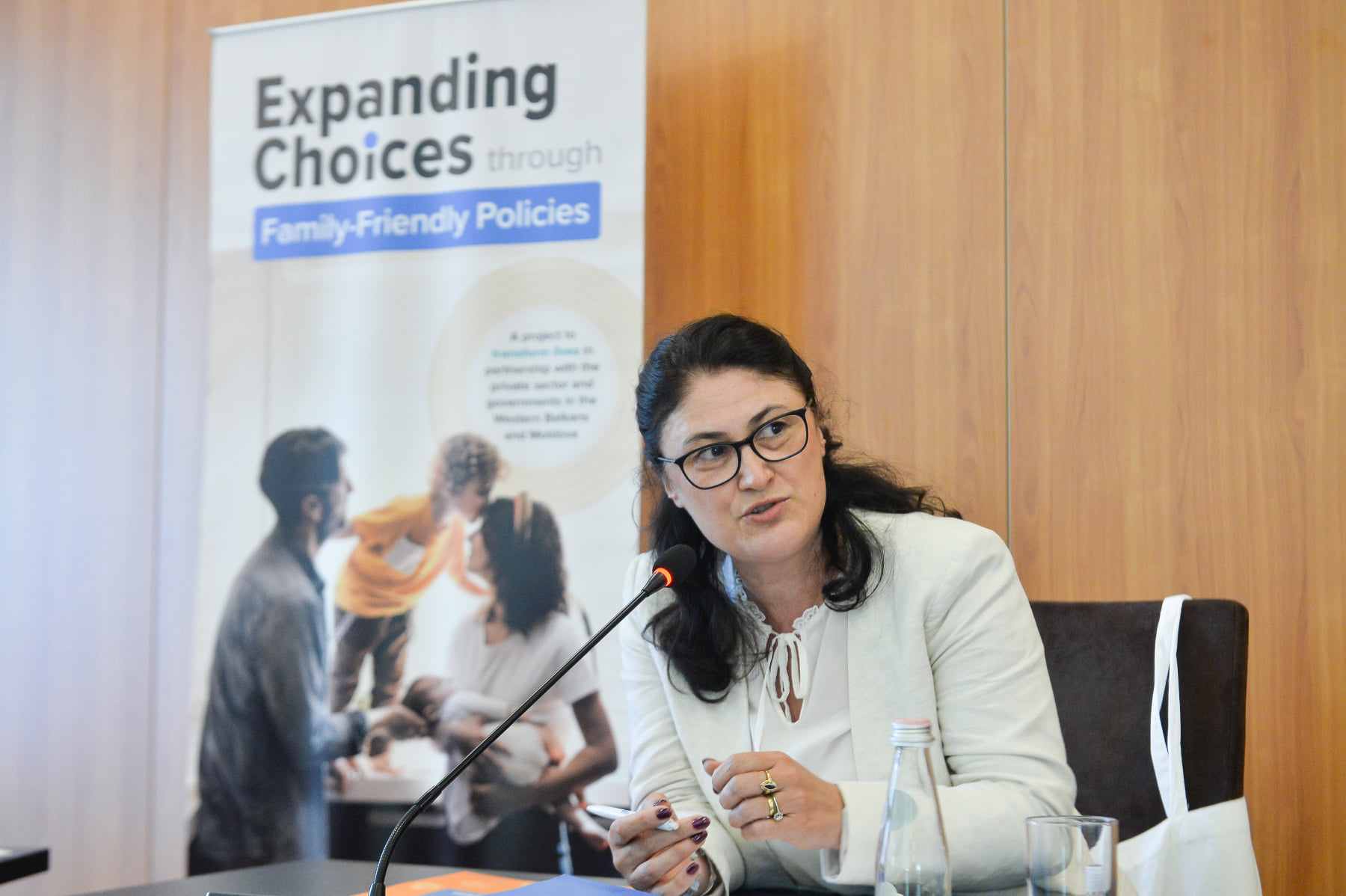
"Official statistics are collected by the Ministry and INSTAT, what we did was analyze official population data for the last two decades by two demographers. The figure itself published by INSTAT, that 109 boys are born per 100 girls per year, is very high, it should not be, because demographers all over the world say that the average could be 103,104, 105 boys per 100 girls", - says Nuri, underlining that in the case of our country "this ratio is exceeded and there is something wrong. There is something artificial that they have introduced intentionally or not. This people has something that is disrupting this balance", - she concludes.
Demographer Arjan Gjoncaj, participant in the UNFPA study, tells "Sinjalizo" that the phenomenon of imbalance in the natural ratio of boys and girls has been going on for years.
" According to INSTAT data, in 2017 this ratio was 111 boys per 100 girls, and in 2021 108 per 100. So, the phenomenon continues ," he concludes.
According to data published by UNFPA last year, during the last ten years, Albania lacks 21 girls aged 1-19, while our country ranks 11th in the world in terms of termination of pregnancy due to gender. the fetus.
Meanwhile, according to the study by " Together for Life ", the doctors surveyed admitted that: " when it comes to making the decision to perform an elective abortion, in most cases (59% confirmed this) the man decides. Only 26% said that it is the woman who decides on the elective abortion. And recently, 15% of them have highlighted another truth: it is the couple's relatives who make the decision on the abortion."
According to sociologist Gëzim Tushi, " this phenomenon is a sensational manifestation of male masculinity over women, considering them a burden on the family ." " Selective abortion is an expression of a cultural defect that is still strong in Albania and that has its basis, its 'inspiration' in the existence of norms that keep 'gender inequality' alive," he says.
Gynecologists: Exact statistics are lacking
For gynecologist Rustem Celami, the problem lies in educating society that abortion is a legal right up to the twelfth week.
"The problem with abortion clinics or hospitals, in my opinion, is not with informing and educating the population, as some still do not know that abortion is a legal right for women up to the 12th week in our country ," says Celmani, adding that the law on abortion has been in place since 1995 " and requires a review, because it was several decades ago and needs updating ."

The obstetrician-gynecologist, Ilta Bylykbashi, says that up to the 7th week of pregnancy, abortion is generally carried out with medication.
"Medical abortion mimics a menstrual cycle, but of course it is associated with more pain and bleeding and lasts a little longer ," she explains, adding that after the seventh week, the purge method is used to perform the abortion.
"An intervention that has an impact on reproductive health, because the older the pregnancy, the greater the risk of either hemorrhage during cleaning, or the curette, which is an instrument that provides cleaning, can cause what are called 'syneki', or 'adhesion', which women may have difficulty getting pregnant," explains Bylykbashki.
Celami adds that the lack of functional registers for abortion and diseases affects the lack of accurate statistics.
"We do not have a functional registry for abortion and for all diseases. So, we do not have a real registry of medical problems. This means that we do not have accurate statistics, accurate assessments and consequently we do not have accurate health policies because they are not based on real data, even the investments that are made ," he concludes.
Meanwhile, Bylykbashki tells "Sinjalizo" that "gender-based abortions are heading towards extinction."
"It's something that we, obstetricians, as colleagues, have discussed a lot from practice, experience. That mentality of 'we want a boy no matter what' is gone. Of course, the boy remains the reference for the Albanian population, but I'm noticing that there is quite a positive feedback when I say: girl," says Bylykbashi.
According to the sociologist Tushi, it is necessary to separate the abortion performed for health reasons or not.
"Abortion that is performed for health reasons (the woman's life or the health status of the fetus) must be distinguished from selective abortion that is performed for social reasons or the dictated sex identity of the female child," he says, asserting that "this phenomenon is encountered more and more frequently in poor families with many children."
Sociologists: What are the consequences of the lack of girls?
"The consequences of this criminal act are numerous and dramatic, with psychological, demographic and social effects. Overpopulation with men disrupts sexual balances and makes sexual relations difficult," says sociologist Tushi, according to whom "in the absence of a natural and organic quantity of women, society must find alternative forms to satisfy male sexual needs."

" Of course, accompanied by the emergence of the phenomena of polygamy, polyandry and the need for public institutions of sexuality. This may lead to the necessary legalization of prostitution (the provision of paid sex)," he continues, emphasizing that this type of 'deficit' "can affect the expansion of violence, sexual crime and trafficking of women for the purposes of prostitution."
What are the possible solutions?
Sociologist Gëzim Tushi emphasizes that it is necessary to educate society and strengthen legal measures regarding gender-based abortion. “We need cultural, educational and emancipatory interventions, on the one hand, but also to strengthen the legal measures of the state ,” he says, while for Elida Nuri, at a time when “infertility has increased and young couples are barely having a child, ” the approach to the visible part of society's influence must change.
" This thing is seen in culture, in music, in popular expressions, because it comes naturally to you: Come on with a boy! Or like the popular song 'Next time with a boy'. What does this mean? It's very beautiful, but what's inside? Is it a stereotype? Something that has been around for centuries? Is it right nowadays? No, it's not right ," concludes Nuri.