Author: Denis Tahiri
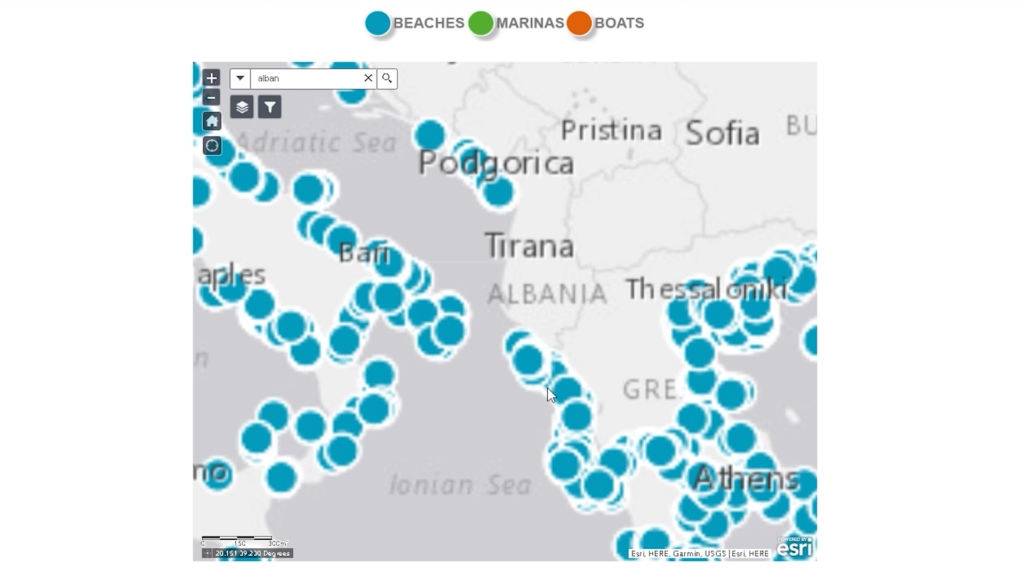
Not more than 3 kilometers as the crow flies between Velipoja and Montenegro is the nearest beach certified with the blue flag. But Albania is not found on the map of countries that have the "Blue flag" symbol, which is the ecological indicator for a coast with a high environmental standard.
Dozens of other countries have "seized" the flag, turning into the safest destinations for tourists.
In 2008, an article in “ Inter Press Agency ” warned that the quality of the unspoilt beaches of Southern Albania could receive recognition of the ecological standard. But the condition was “ if the government addresses the growing problems with the treatment of hard and dirty water in the region. The Blue Flag status is awarded by the Foundation for Environmental Education, an independent non-profit organization based in Copenhagen, Denmark, to beaches that respect strict water quality criteria on different continents. Albania is the only coastal country in Europe where no beach is marked with a blue flag”, it was written, among others, at the time. Although more than 15 years have passed, Albania still remains the only coastal country on the European continent without a single blue flag on its beaches.
In Albania, the Blue Flag was introduced in 2008 by the World Bank and the United Nations as part of the coastal tourism project. No Albanian government managed to implement this element to put Albania on the global map. "Sinjalizo" turned to the Ministry of Tourism with a request for a response, if it has included this certification in its programs for the promotion of tourism, but no response was given.
In 2020, the parent organization "Blue Flag" would certify the "Albanian Coast Lifeguards and Water Rescue Federation" as its representative in Albania and only three years later, the first application to receive the blue flag on a beach would be made Albanian.
To be certified, a beach must meet 33 non-negotiable criteria, which are divided into four main categories related to Environmental Education and Information, Water Quality, Environmental Management and Safety and Services.
"If a beach that has the Blue Flag certification does not meet the criteria, the flag may be permanently or temporarily withdrawn from the beach," states the "Blue Flag Albania" organization, adding that in all cases of non-compliance with the criteria, the National Operator must immediately inform the beach operator of the non-compliance criteria and that information about the reason for the flag withdrawal must be clearly posted on the beach.
"Some of the beaches are very rocky, they cannot meet the accessibility criteria, but others can meet the conditions," Eni Metaj, General Secretary of the Albanian Federation of Beach Lifeguards and Water Rescue, partner of "Blue Flag Albania", told "Sinjalizo". Metaj adds that information in the local tourism industry, which does not know what a "blue flag" is, remains a challenge today.
" From all the conversations that were held, it was understood that two or three resorts were interested. The problem we encountered was that none of these resorts, despite millions of euros invested, had ramps, and when they were told that ramps were needed, they said that they could not ruin the architecture of my beach," the expert says.
After three years, Albania could soon have its first “Blue Flag” certified beach. “ This year we have a beach in a resort that has submitted an application and has met all the criteria,” adds Eni Metaj, emphasizing that the Blue Flag certification is related to the readiness of beaches to meet the necessary conditions. “ It’s not that 100 have applied and none have been accepted, there is only one application this year,” explains Metaj.
For the expert, it is necessary that institutions, whether local or central, should support the awareness campaign that would bring about the spread of the "blue flag" in Albania. " In Italy, for example, the state, the ministry and the municipalities would gather and hold a one-day information meeting about the "Blue Flag" and this is what we need," concludes representative Metaj.
But "Blue Flag" does not deal with high pollution
On the beach behind the canal in Durrës, you can feel the pollution on the Adriatic coast with your senses. It is enough to look at the concrete channel and one can clearly understand the pollution that is discharged into the sea. Just a few meters away, during the hot summer months, hundreds of citizens relax and swim on this beach.
According to the National Environment Agency, at the monitoring station in Plepa after the canal, but also at the Rock of Kavaja, pollution has resulted in high values during 2022. In the report published in 2020 by KMA, it is said that on the beaches of Durrës, 90.5% theirs have excellent water quality, while 9.5% have very poor water quality.
The "Military Holiday Home" has not escaped the pollution on this coast either. The central laboratory of the Armed Forces has also monitored the pollution of the coastal bathing waters at the "Military Holiday Home in Durrës". " In its southern part, the waters of a canal flow directly into the sea, without prior treatment. Based on the measurements carried out during 2020, it resulted that the quality of the coastal bathing waters at this Holiday Home was 67% of category D - poor quality," the KTA report states.
The problem of coastal water quality is also widespread in other areas of the country. The city of Saranda is no exception to this problem.
"At monitoring station 6 (Çuka Channel), according to analytical results, microbial contamination was found in 4 sampling campaigns, while at monitoring point 3 (Plazhi i ri) microbial contamination was found in one sampling campaign ," the KTA mentions.
Even this year, "Lifeguard" is lacking on the Albanian coast
On the eve of the opening of the summer season, the problems with beach safety in Albania unfortunately seem to be present again. " To date, we have certified 1300 beach lifeguards, while there are 2990 beach stations, meaning we don't even have half of them, we are in short supply," says the Secretary General of the Albanian Federation of Beach Lifeguards and Water Rescue.