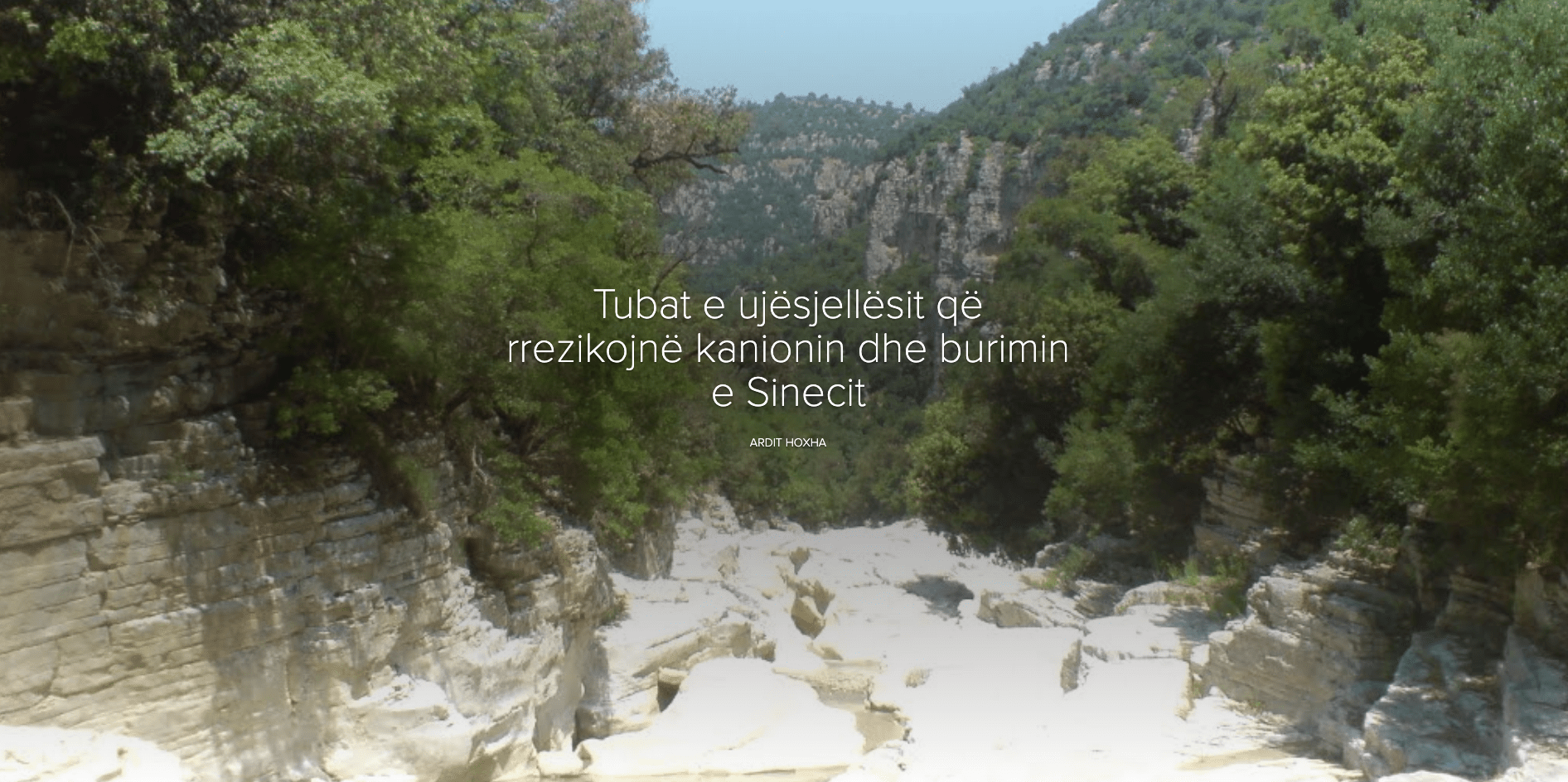
On the afternoon of May 30, a group of scientists from Austria, Germany, Albania and Italy headed to the Shushica River to collect multidisciplinary data on this branch of the Vjosa, which will serve to have a comprehensive overview of the values of the river. And as the group consisting of over 50 people organized the scientific week, their presence excited the residents of the area, who, although aware of the natural beauties, had never seen so many visitors at once. “ 50 Albanians and foreigners came to our village. They were very amazed by the climate, by the blue water, by the bridge, by everything ”, says Helidon Kamaj, a resident of the village of Brataj, in the Municipality of Selenica. “ We hope that after 100 years of suffering, we will become people, like everyone else ”, he adds, referring to the development of tourism in the area, after the construction of the road, an investment recently made by the government.

Like the 44-year-old, many other villagers are also talking about the scientists' visit and the possibility of using the natural beauties that the river offers for the tourist development of the area. " We also presented it to the scientists: We want the Vjosa, together with its branches, to be declared a National Park and for as many tourists to come as possible ," says Qemal Malaj, mayor of the village of Brataj.

But the residents' hopes for the development of tourism, after the construction of the road, are being questioned due to the government's plans for the development of hydropower projects. This is because, in 2017, the Ministry of Energy and Industry signed a concession contract with the company " Shusica Hydropower ", for the construction of a cascade of hydropower plants on this river. Part of the concession company are the companies "GR Albania', "Alb-Star" and "Trema Engineering 2", while the cascade includes 4 HPPs, more specifically those of Drashovica, Kote, Gjorm and Brataj, with a total installed power of 14.9 MW.

But, according to the Network of Environmental Associations, Vlora, the concession competition has a number of shortcomings, where among other things the entity “Trema Engineering 2” was entered into the tender with the financial status “Under the administration of the Tax Administration”, a procedure prohibited by law. Meanwhile, in 2018 and 2019 the consortium was “accused” by residents and local institutions for bypassing public hearings , a legal obligation before the approval of the Environmental Impact Assessment, which was finalized with the provision of the concession company with the Environmental Declaration, which paved the way for the development of the project. According to the document, dated September 3, 2018, the public hearings “were attended by representatives from the local community, representatives from the local government as well as from the Regional Directorate of Environment and representatives from the environmental studio” and “there was no concern from the community about the development of this activity”. But, the residents of the village of Brataj, 2 weeks before the signing of the document by the state authorities, organized protests, where they opposed the implementation of the project. According to Sotir Zahoaliaj, a resident of the village of Brataj, “the residents’ objections were also expressed during the hearing held in 2018,” but he adds that “the minutes were falsified.” “ We signed a document that says ‘these people participated,’ so we signed for participation, not for agreement with the HPPs ,” says Sotir.

Disagreement regarding the continuation of the procedures and the provision of the necessary documentation to develop this project, at that time was also expressed by the Municipality of Selenica, in 2 letters for giving opinions on the approval of the preliminary and in-depth EIA. Among other things, in these letters the lack of study of the minimum and maximum flows of the river was emphasized, which during the summer risked drying up, while at the time of the maximum flows, flooding of the lands due to the discharge of the dams.
Reactivating the concession…
About 3 years after being issued with the Environmental Declaration , the concession company has not yet started work. Meanwhile, according to the Law 'On Environmental Impact Assessment', if the activity does not begin implementation on the ground within 2 years from the date of approval of the EIA, then these documents are considered invalid and the EIA process starts from scratch. This means that this project cannot currently be developed, but a new application to the National Environment Agency in September 2020 has brought the construction of HPPs in the area back to attention. The consortium has filed an application to be re-equipped with the Environmental Declaration, also submitting the non-technical summary of the project. The National Environment Agency denied that the company has re-applied to be equipped with the necessary documentation, which would enable it to start implementing the project. " We would like to inform you that there is no application for the Environmental Impact Assessment procedures at the NEA, a process that is carried out online through the e-permit system," the NEA stated in a written response. But, in addition to the aforementioned documents, representatives of local institutions also claim that the procedures for providing documentation have continued. “I know that the documents have been brought to the municipality, but the mayor has refused to sign ,” says the deputy mayor of Selenica Municipality, Irfan Durmishi. The concessionaire itself was unavailable for comment.
"The river is gone, the river takes all of Labëria"

Meanwhile, the residents say they will oppose the construction of these hydroelectric power plants until the end. " I have land near the river and I irrigate it with mechanical lifting from the river. I cultivate it with corn and alfalfa for the cattle. With these I support my family: my wife, 2 young sons and 2 elderly parents. It is the main source of income ," says Helidon Kamaj. " The construction of hydroelectric power plants is as fixed as that word that is often used these days: Massacre. Now all this road was built to turn it into a tourist area and we start building hydroelectric power plants?! ", he adds. His fellow villager Nexhip Seraj is also on the same line. "If you built a road, it does not mean that you dried up a river. If the Shushica riverbed dries up, the heat of the gravel will be terrible. Then, when all the poisonous reptiles will develop, the vegetation will disappear," says Nexhipi. " If the river runs away, the river takes all of Labëria ," he adds.
The mayor of Brataj village, Qemal Malaj, says that the construction of hydroelectric power plants will affect all sources of income for residents. “ HPPs are catastrophic for us: We have lost the river and we no longer have vegetation, no microclimate, no livestock, no other resources, and not even for the tourism that we claim to develop ,” says Malaj. “ The residents live only with these resources, that river is the basis of life for our area, we have nothing else. Even the lands that we have in the fields, thanks to that river, we keep them, ” he adds. The residents of Brataj village are not the only ones who oppose the construction of hydroelectric power plants on Shushicë. According to a survey conducted by “Green Vision”, which is the Network of Environmental Organizations in Vlora, 97.7% of residents living in the villages that will be affected by the construction of these hydroelectric power plants are against the development of the projects.
The survey, which was carried out during the months of November-December 2018, included 520 residents of the villages of Brataj, Lepenicë, Gjorm, Kote, Lapardha, Vodicë, Mavrovë and Drashovicë, but of them, only 13 people, or 2.3% of the respondents expressed ' for the construction of hydropower plants. Meanwhile, even the current administration of the Municipality of Selenica stands by the side of these residents, opposing the HPPs. "Taking water through a pipe, as provided in the project from Brataj to the vicinity of Gjormi, bypasses 2-3 villages, which are put out of action because they remain without water", says the deputy mayor. "You see how much water the river has in this period we are in. We are in the month of June and the HPPs are supposed to be up and running. Then he realizes that there will be no more water there," he adds.
Conflicts with the community...
According to the environmental expert and Executive Director of the "EcoAlbania" organization, Olsi Nika, "these projects would irreversibly damage one of the most important branches of the Vjosa basin, bringing about an extraordinary loss of the biodiversity of the entire basin". "This is because branches such as Shushica are in fact the "maternity" of trout species, but they are also quite important for many other species", he further explains. For this reason, EcoAlbania has not excluded the judicial way as an alternative for opposing the construction of these HPPs. "We have been present in the area since 2018 and on, supporting the community in organizing their mobilization in all democratic forms: in the compilation of petitions, requests for administrative appeals and up to the joint commitment to objected to these projects in court", Nika informs.
Conflicts due to the approval of similar projects without consulting the community have not been few, while experts say that if the neglect of the residents' attitude continues, then this situation harms all parties. Ermelinda Mahumutaj, from the "Eden" environmental center, compares communities to a family that has its own development plans and invests for years to realize them. "For example, if I want to open a bakery, if I want to grow certain vegetables or invest in greenhouses, I will depend on natural resources. The moment a hydroelectric power plant comes, it completely changes the ecology of the area. It means that all the residents' rural development plans are shifted. In fact, all their investment goes to waste ," explains Mahmutaj.
"Here begins the first collision, which a responsible government should not allow. Therefore, the interests of the community should not be overlooked for small hydropower plants that are not even strategic investments. We should not protect the interests of a short-term business, but it should protect the interests of the community it serves", she adds further, stressing that "this will bring occasional conflicts, emptying of villages, bring poverty and dissatisfaction of the inhabitants". "At the same time, the business does not come out with profit in these types of situations because it does not receive opinions from different stakeholders, it means that it cannot analyze all the points of view in its business plans", he continues. further Mahmutaj. Even the professor of the Faculty of Engineering-Mining, at the University of Tirana, Klodian Skrame, says that the approval of these HPPs was done without any study on the sediments, which could turn into a problem for the state that will inherit these hydropower works shortly 35 years, but also for the investors themselves.
"We did the measurements with the professors of the universities of Trento and Bok, but we still don't have results. It will be the results of this study that will show whether these hydropower plants are stable or are at risk from the accumulation of sediments", says Skrame, who was part of the group of scientists who collected the data in Shusicë. "However, until now there is no such study. There is not even flow measurement there because the station that is there does not work. These types of studies that we do, they have not even done in basins like Vjosa, not in its branches. Thus, they simply build, without realizing that later they have big problems with the sediments", concludes Skrame.
But as residents, environmentalists and scientific researchers appeal for the preservation of Vjosa, in its entire watershed, where Shushica is also a part, 38 HPPs are planned to be built, 8 of which are in the main branch of the river.