


Author: Denis Tahiri
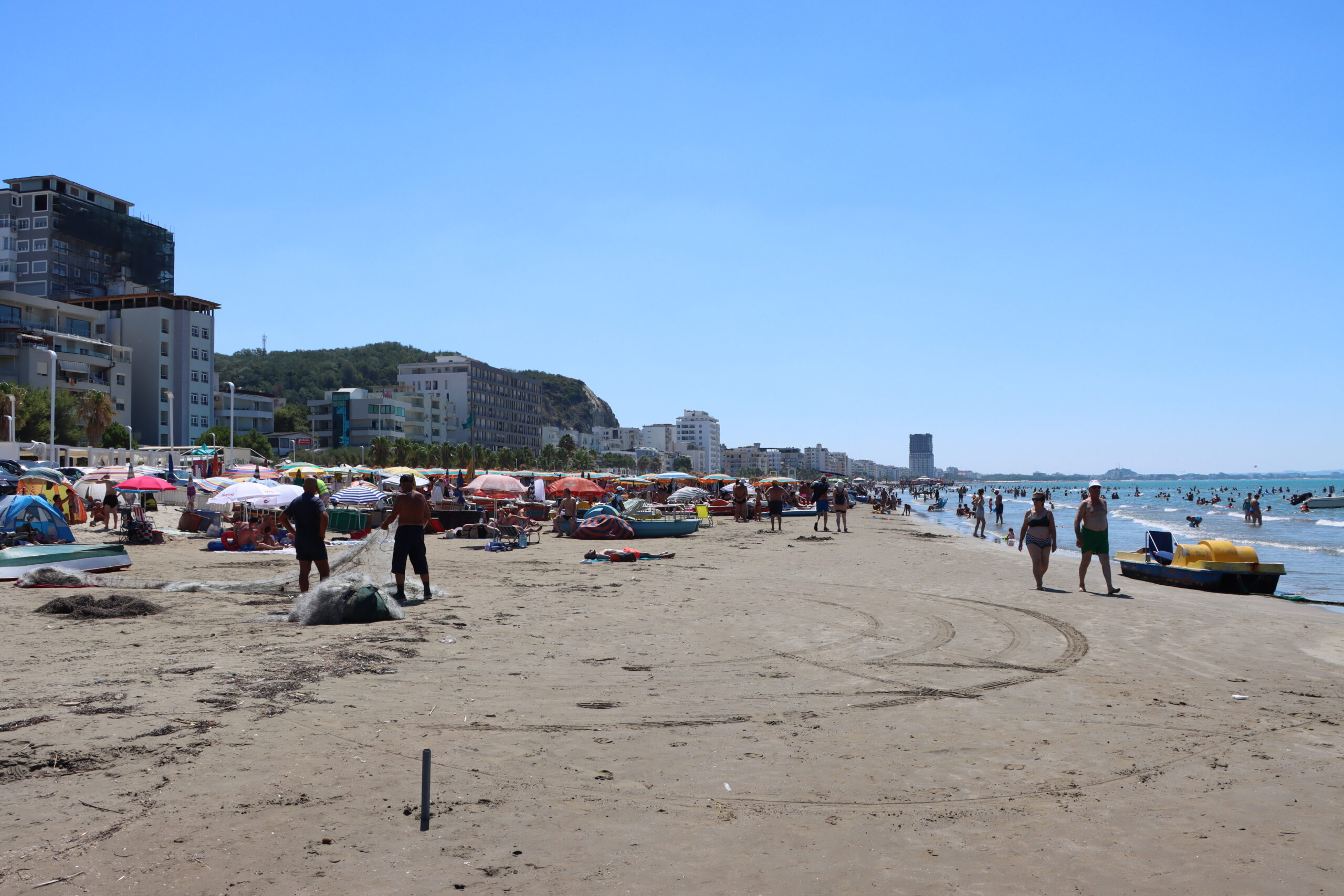
You don't have to look far to find the chaos on the Albanian coast that for this year was abandoned by local vacationers. It seems that not only the high prices but also the lack of hygienic conditions and other facilities had an effect on the decline of Riviera's visitors. It's peak summer season 2022. Loud music is another concern. Lack of parking spaces as well. The next challenge is mosquitoes.
August, the time is 11:20.
On the beach behind the canal in Plepa, without talking about the garbage, you can feel the pollution coming from the canal with your senses. But again, this beach is frequented by different citizens, among them two retired couples who share an umbrella.
" I'm from Mallakastra, these 10 days, we come here, but it's bad. But on the other hand, we have these financial conditions ," says the 72-year-old who speaks on condition of anonymity. " These days that we want to enjoy, we still can't enjoy them. If you want to get away from there, you can get sunbeds for 5 thousand lek, 7 thousand lek but it's still bad ," says the pensioner who also emphasizes the pollution from sewage. " The canals there are worse, the sewage from the buildings built there flows into the sea ," he says, pointing to the adjacent canal, which is officially a channel for rainwater. However, there you can find very simply with the naked eye, discarded garbage, as well as various dead and rotting animals.
Meanwhile, the elderly man's wife hints that the choice is dictated by economic conditions. " This channel is... but we don't know what to do, because we can't go anywhere else ," the woman tells "Sinjalizo," adding that " The conditions here are not good. The money makes the conditions here. You pay 70 euros for a room and then you stay like a lady, but we don't have these opportunities. We have this opportunity and we thank God, because there are others who don't go to the beach at all ," she says.


The same situation a few kilometers away
A panorama repeated as last year, for Vilbashtova beach. Vacationers are few in number, but remnants continue to be present. Even though individuals who have invested in beaches have cleaned the sand just a few tens of meters away from them, various types of garbage can be seen, starting with plastic cans and continuing with other waste.

Institutions see nothing!
While the National Environment Agency does not have any data on beach water pollution on its official website, it is the European Water Agency that provides data. The review made by the European Water Agency does not have any big difference from the situation in which the beaches were polluted from last year and that ACQJ did a full coverage, bringing the health risk to the frequenters of these beaches.

Pollution on the coastline of Albania is present in Durrës, in the area of Currila as well as in the Beach behind the Canal, but other cities are no exception. In Vlora, currently, according to the European Water Agency, the water for bathing is of bad quality, there are three beaches, two of which are next to the port of the city, while a third one is at the beginning of "Chameria" street. And while this summer, Pogradec with its lake turned into a favorite destination of citizens due to cheap prices and good quality of service, on two of the beaches of this city, the quality of the lake's water leaves much to be desired. . According to the identification made by AEU, the two beaches that do not meet the minimum criteria to be suitable for swimming in this city are near the "Gjokë Risto Kondakçi" promenade and at the beginning of the "Driloni" road.
Observers are missing again
There are 2900 beach stations along the entire coastline of Albania, but the number of beach watchers, or "lifeguards", is only 1200.
The coast line of Shengjin is the one which this year has had no serious water events, no loss of life due to drowning, and no accidents. But this is not a coincidence. According to Luciano Marku, who has been working as a beach watcher for 6 years, there has been an increase in the number of watchers on the Shengjin coastline compared to other coastal cities.
" So far we have had many rescue cases, but fortunately we have not had any loss of life due to quick and professional intervention and we hope that by the end of the season we will not have any ," he says, adding that from the 85 beach lifeguards that this coastline had a year ago, the number has currently increased to around 140-150 along the entire coastline of Lezha.
Marku adds that the beach lifeguard is also a safety element for the necessary signage. " On beaches that have lifeguards, they have managed to set up signage, creating a safe area for swimmers. On these beaches, it is categorical that no lifeguard allows jet skis or boats to enter the safe area, they have designated corridors ."
But even though there is a great awareness compared to a few years ago about the importance of beach watchers, tricks to pass the filter of state institutions to get the contract to use the beach are not lacking.
A source told "Sinjalizo" that many businessmen obtain certification as beach lifeguards to meet the criteria set by state institutions, but in reality do not perform that function. " This is also the reason that even when there is a watchtower on the beach, you see it empty ", he says, adding that it is precisely the state instances that continue to see the beach lifeguard as a procedural step and never check whether these certified persons are truly performing this life-saving task. " According to the law in force, if there were controls at the moment that even though they may have used this trick to obtain the contract for beach use, when the inspection is carried out and it is noticed that the beach lifeguard is not at his station, the contract should be terminated immediately, but there are no inspections, measures are only taken when an event occurs ", he concludes.
Sad news that was not shared with the summer in Albania
Lives lost on Albanian beaches have been present throughout the summer seasons. According to the data provided by the "Albanian Federation of Beach Watch and Water Rescue" during the summer of 2019, 12 deaths at sea were reported, of which 5 were caused by a heart attack, 1 for health reasons, 1 as a result of hitting with a boat, 1 as a result of motives related to criminal circumstances and 4 of them came as a result of drowning at sea.
Meanwhile, in 2018, according to the same source, 20 deaths at sea were recorded. But in 2017, 42 people lost their lives on the Albanian coast during the summer season. And while in 2020 12 deaths would be recorded, in 2021 the figure would go to 19.
Agencies without control over beach stations
The serious event that happened in Potam of Himara, where the 7-year-old girl lost her life highlighted the lack of coordination of state institutions with each other to guarantee safety at the beach stations on the coastline. And while the task of signaling is left to the local government, which often fails to perform this task, neither the Coastal Agency nor the police, the control of the beach stations is minimal.
" The state police cannot act alone, nor can they be solely responsible, if the inter-institutional links do not cooperate and enforce the law ," the Director General of the State Police, Gledis Nano, would write to the National Coastal Agency, municipalities, prefectures and ministries responsible after the Himara incident, with the aim of guaranteeing a tourist season.
But the fact that the State Police is seeking cooperation in the middle of the tourist season shows that this cooperation has been lacking. " To guarantee and secure the lives of citizens and vacationers, throughout the tourist season and not only, we are seeking the cooperation and commitment of all institutional links to monitor and control the implementation of the law and bylaws in the field of tourism ," he writes, among other things, adding that the State Police has not been informed, according to him, about the measures taken by institutions in any case. These words, addressed to institutions in the middle of the tourist season, after a serious event, clearly show that the Albanian state, the only control over beach safety, has that of dividing beach plots.
We took the tourists to Greece, but do they come to the beaches with mosquitoes?
The statement of the Minister of Tourism, Mirela Kumbaro that many tourists who went to Greece "have already returned to Albania" quickly became an object of ridicule on social networks and this for many reasons. Greece is one of the countries with one of the most developed tourism industries in Europe and this year it reached record numbers, having 80% of accommodation units fully booked, from which the country expects to benefit about 15 billion euros by the end of the tourist season. The southern neighbor of Albania has such a diverse tourist package that it offers tourist packages starting from 300 euros, up to luxury vacations. On the other hand, it seems difficult for Albania to take tens of thousands of tourists to Greece, at a time when the disinfection of the beaches has not been carried out due to bureaucratic blockages in the procurement system. The lack of disinfection in this summer season came as a result of the suspension of the tender organized by the Centralized Purchasing Agency. This is after the bidding entities complained to the Public Procurement Commission regarding the established criteria.