Author: Denis Tahiri
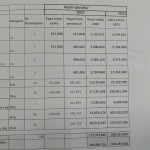
While Albanian and foreign experts have been trying for months to recover the damages caused by the continuous cyber attacks, (AKSHI) the National Agency of the Information Society demands an increase in salaries up to their quadruple. The proposals presented to the Public Administration suggest for the number one of the institution, a multiplication of the salary from 241,600 ALL to 517,068 ALL. In a letter dated 08.09.2022 sent to the Ministry of Finance and for the information of the Council of Ministers, the National Agency of the Information Society has requested an increase in the salary fund from the current 206,9 million ALL to 943 million ALL for the 2023 budget. The proposal comes not long after the Prime Minister's statement that promised salary increases that would bring higher employee engagement in the IT role.
The argument given by the AKSHI " continuous increase in the use of the online platform according to the typology government-government, government-citizen, government-business, while also appreciating the importance of the processes currently implemented through Information Technology programs that are developed and maintained by the AKSHI, as the responsible institution in this field, we consider it very important for you to review the salary increase for all central AKSHI employees, in parallel with the continuous increase in responsibilities, as well as the commitment needed to develop, maintain and mainly protect the infrastructure and systems from cyber attacks ", states the letter addressed to the Ministry of Finance.
According to the proposal of AKSHI, the salary of the deputy head, category II-b, which is currently 231,800 ALL, will become 482,005 ALL. On the other hand, for the cabinet director of category II, since the request sent seems to be an empty (or non-existent) position currently in ANA, the salary for 2023 is required to be 496,030 new ALL. Salaries over 4 million old have also been requested for directors and advisors.
The National Agency of the Information Society, in the last two years, was put at the center of the publication of the data of Albanian citizens. First, on the eve of the elections, there was the scandal of the patron Nazis, a case which ended up in the prosecutor's office making three people responsible for the release of nearly 900 data. Before this scandal was closed, another one broke out again, affecting the data of Albanians. Vehicle license plates and salaries of citizens, the list of secret service agents, the police according to their duties were released. This scandal raised questions about the efficiency and security of the systems. But one after the other, the scandals did not come to light until the months of July-August, where it is said that Iranian hackers are behind the attacks to take government Services. This file is also under investigation by the capital's prosecutor's office for four criminal offenses.
Experts are skeptical about the capabilities of AKSHI
"After the attacks organized by Iran, the AKSHI needs to increase human capacity and if we look at the official website, we have dozens of vacant positions both at the central AKSHI and at IT depending on various ministries and agencies," says Besmir Semanaj, an information technology engineer, who adds that it is not that easy for the AKSHI to recruit quality contingents because the payments that the AKSHI currently has are half of those paid in the private sector.
"But the demand for a salary increase at a time when we have not recovered from the consequences of the attack by Iran personally does not make much sense to me, because the AKSHI needs to be re-established," he adds.
Cybersecurity specialist Bledi Aristoteli is also against the increase in salaries without criteria, and he says that initially a filtering of people who can and have the capacity to manage these systems should be carried out. " Because there are indeed people there, but not everyone can deserve a salary increase," he says, adding that: " First of all, we need to see if there are systems and who are the people responsible for managing these systems, but you can't increase the salary of people who have no connection to these systems or how many people leave school and enter the AKSHI," he says, insisting that a division and categorization are necessary: " the risk, how much responsibility the person has, what systems are connected to this person, how key is this person, does he have training, how much training does he have, etc.," he says.
" There must be accountability, why did the attack happen? What were the reasons that the security of the state completely collapsed?", says Besmir Semanaj, who says that there must be an account of why there has been no investment in cybersecurity, although we see very high figures of over 200 million euros, these are investments made for the digitalization of Albania, adding that from the information he has in the security area, the investments have been very small. " Someone must be held responsible in this area because you cannot release online systems, systems for digital Services if all security procedures have not been followed for these systems before they are released and made public," he concludes.
Expert Besmir Semanaj, when asked why we failed with cybersecurity, answers that we succumbed to excessive confidence. " If we look at the statements of the leaders of the National Agency for Security and Defense and government leaders, while we were hacked, but we didn't know it, they declared that our systems were very secure and did not prefer to spend funds on "security". You have to keep in mind that investing in digitalization is something tangible for the citizen and advertising for the institution, while investing in "security" is something vital for the institution and for the citizen, but which is not visible to the public", he concludes.
Meanwhile, on the other hand, problems with the ability to manage systems have also been noticed by cyber security expert Bledi Aristoteli.
" I know that AKSHI has a system, but it does not have enough qualified staff to know how to use these systems, they do not have a standardization of the systems they have. I noticed this last time, so there were no updates, the firewall was turned off, the antivirus was turned off, etc. If we had a good system of updates and device configuration, but the device configuration is done by people, I do not see people there," he says, noting that Albania, despite numerous investments in the digitalization of Services, still does not have a centralized "Security Operation Center" system at the national level.
" Italy has it, Greece has it, Serbia is building it, we don't have it. It serves a bank, for example, that needs help, but when I need to ask for help, I ask a state institution that has the equipment, the assistance of NATO, the internationals, which is a centralized national system that even if it exceeds their capabilities, they have the opportunity to ask for help from their partners," he says.
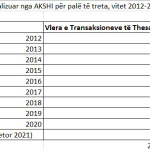
Despite the lack of investment in human resources, ANA from 2012 to December 24, 2021, according to data from Open Data Albania, has spent a total of ALL 20,016,382,436.00. This amount is the amount of treasury transactions from AKSHI to third parties.
The three years with the highest transactions are the years 2019,2020, 2021 and 3,712,871,083.00 with respective amounts of 3,558,397,994.00 ALL, 3,585,079,778.00 ALL and XNUMX ALL.
By normative act, AKSHI is subordinate to the Prime Minister
Since October 13, the National Agency of the Information Society has been subordinated to the Prime Minister, through a normative act which is expected to be approved in the parliament so as not to be repealed afterwards. But through the normative act, there are several changes made.
Now, “The employment relations of the Director General, civil servants and administrative employees of the Authority are regulated based on the Labor Code”, and no longer according to the procedure implemented so far provided for by Law No. 8549, dated 11.11.1999 “Status of Civil Servants”. Also, another point added through the normative act is that of remunerations which states that: “ The Director General and civil servants of the technical units of the Authority, in addition to the salary according to the salary categories determined by decision of the Council of Ministers, benefit from a supplement for a special nature of work, in the amount of up to 800,000 (eight hundred thousand) lek per month. The amount of the supplement for a special nature of work for each category is determined by decision of the Council of Ministers.”
"Sinjalizo" requested a response from the communications director of Prime Minister Rama, Mr. Endri Fuga, on the reasons for the emergency to change the law through a normative act, but has not yet received a response.