Author: Denis Tahiri
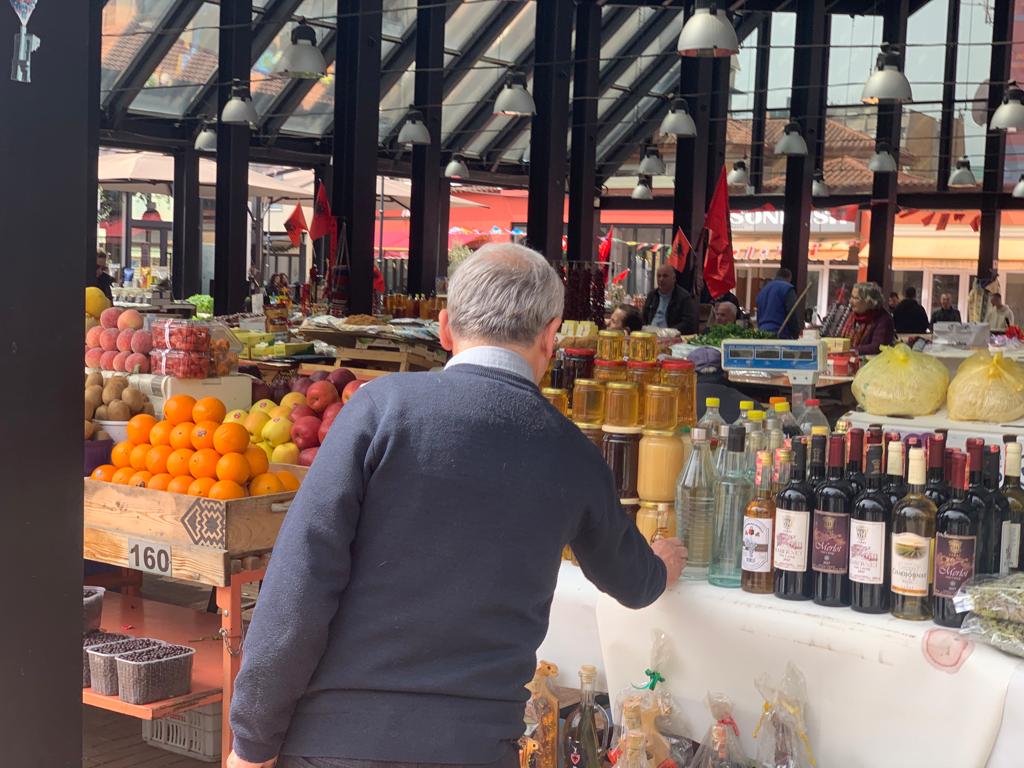
In the "New Market", we find 74-year-old Mersin Çaushi sitting on one of the public benches.
" I was an agronomist and I also worked in administration. I retired in 2012 and I have a pension of 240 thousand old lekë," says the pensioner, who says that his pension is not enough to make ends meet. " Without the help of my children, I can't make it, there are two of us, me and my wife," he says.
Even Fatima B, is one of the 668 thousand Albanian pensioners who are counted in the country. The 890-year-old mentions that the increase in prices has affected her daily life, bearing in mind that her pension is only 80 thousand old lek.
" Thank God I have children who help me. They are also immigrants abroad because if they were in Albania they would most likely not have anything to do with themselves, let alone help me," the elderly woman tells "Sinjalizo", adding that her pension is only enough to pay the electricity bill and buy medicine.
" It's not bad, no. Last month, I had 53 thousand lek just for electricity, I also bought blood pressure and heart medications, one of which is 21 thousand, the other 450 and the other 1600 that are not reimbursed, because the ones that are reimbursed I get with reimbursement. What's left for food?! 94 thousand are gone directly from that miserable pension, can you keep your breath alive with 7 thousand lek all month?", says the 80-year-old.
According to the data of the Social Insurance Institute, it turns out that from 2012 to 2021 the number of pensioners has been increasing every year. On average, in the city, an old-age pension according to Open Data Albania is 14,974 ALL, while the average of a rural pension is 8,410 ALL. On the other hand, the average pension for a disabled person in the city is 13,092 ALL and the family pension is 6722 ALL. Meanwhile, in rural areas, the disability pension is 6,659 ALL and 2,884 family pension.
During the official presentation of the Social Resistance Package, the Albanian Government said that the number of beneficiaries of the 3 ALL monthly aid is for 576 citizens. This is also based on the statement on a television show by the Minister of Finance and Economy, Delina Ibrahimi, who has also held the position of director of INSTAT, who said that if the income of an Albanian citizen is 140 euros, he is not considered poor, but if we count the fact that 576 thousand citizens in the country are reported to be pensioners and have 123 euros of income per month, then according to Ibrahim's stated view, they are at the level of poverty.
But for economist Aneida Bicaj, it is impossible to survive on such a level of income. " In this country, even 50 thousand lek can't survive anymore," she says, adding: " Two pensioners without the help of their children can't live . "
Albania has the highest salary taxes in the region
Mandatory Contributions and Tax go up to 40.9% of an average declared salary. Meanwhile, in Albania, no tax of 30% is paid for the first 13 lek, but 27.9% mandatory insurance is paid. The tax burden on the salary in Albania is higher than in Kosovo, the youngest country in Europe, where the burden on the salary is only 17%. In Kosovo, the payment of pensions is divided equally, 5% employer and 5% employee, while health insurance is paid at the rate of 7% by the employer of companies with an annual turnover over 50 thousand euros and 2 euros for the employer with an annual turnover below 50 thousand euros . On the other hand, in Montenegro, the highest contribution burden is borne by the employee, who pays 15% of the salary for pensions and disability, while the employer pays 5.5%. Unemployment insurance is divided between the two parties at the rate of 1%.
In North Macedonia, salaries up to 17530 Euro are taxed at 10% and above this level at 18%. On the other hand, in Kosovo, income up to 960 euros is not taxed, while salaries from 960-3000 euros per year are taxed at 4%. Salaries from 3000 to 54 euros per year are 6% and over 54 euros are 10%. In Montenegro, salaries between 701-1000 euros are taxed at 9%, as well as income from the enterprise in the amount of 8401-12000 euros. Salaries over 1000 euros are taxed at 15%. Meanwhile, in Albania, for the salary band of 30000 ALL, the salary tax is not applied, it is applied at 13% for salaries from 30.000 to 150 ALL and 000% in cases where the salary is 23 ALL.
Double-employed Albanians are increasingly preferring informal employment
The heavy burden placed on salaries has also led to problems with declaring salaries. " Even when you hire someone, there are many who ask to be paid in the black, so they prefer to be paid in the black to get a few more lek," says economic expert Aneida Bicaj from Balkans Capital.
This is also supported by economics professor Rezart Prifti, who says that people are now willingly not declaring their income because they are not receiving the benefits they pay for. " The perception of pensions is more difficult to notice, because they have to wait 30 years, since we are affected by healthcare more quickly, they say, wait a minute, what am I paying these obligations for," he says, adding that when you get sick, even though you have paid your healthcare obligations, you pay again.
The Economics Professor also talks about the minimum wage increases, by 20 thousand lek. " Currently, the market has distorted this minimum wage, there is no longer a salary of 300 thousand lek, but the step taken by the Albanian government is that the mandatory contribution measure is calculated on this wage, since they have seen that the pension scheme no longer collects it," he says, adding that this step is short-sighted since it solves the problem for the moment but is not a long-term solution.
The need for a private pension scheme and the lack of a living wage
In Albania, every citizen has the right to carry out a supplementary pension insurance, but this does not exclude him from mandatory payments for social security. Economic experts say that the time has come for this scheme to be reviewed, but a great political will is needed as it is a major reform and it will take 10 years for its effects to be felt.
" In the last 8 years, all indexations that have been made with the pension scheme according to INSTAT have had an undoing of the indexation since the increase in indexation has been eaten by inflation at twice the indexation, so the indexation has been smaller than inflation ," says professor Rezart Prifti, adding that our pension scheme has a problematic income base, since the number of contributors has decreased. " The losses have come from mismanagement, the loss of contributors and from the outdated insurance scheme, since insurance schemes in the world function with investments," he adds.
Aneida Bicaj, from Balkans Capital, considers it difficult to introduce private pension funds in Albania, removing the obligation for citizens to pay social security contributions to the state, but she believes it is something that needs to be discussed. "It is right to talk about this private scheme because in recent years the scheme has changed many times and this shows instability. When I am 70 years old, I do not know whether I will receive a pension or not," she says.
On the other hand, Albania is the only country in the Balkans and the region that does not have an official minimum wage. In 2021, according to a World Bank estimate, 40% of the population lives on the limits of the vital minimum. On the other hand, the Institution of the People's Advocate has made an assessment regarding the living minimum in Albania, which according to this institution is 17 thousand ALL. But does the Albanian state have a real chance to recognize and approve this vital minimum by law?
The answer for experts is simple. NO! This is due to the wide economic effects in every field. " Automatically, a trigger effect is created in all wage inflation, from the state to the private sector and all health insurance schemes, social assistance, pensions, economic assistance, etc. Projections would be needed of what would happen," says Professor Prifti, who says that currently, at the moment we are talking, it is impossible to realize it due to the large economic effects on the state budget.
The 2018 report of the People's Advocate states that: " In all Western Balkan countries that apply the minimum wage - Montenegro, Serbia, North Macedonia and Albania, its level is over 200 euros per month, which ensures good coverage of the living wage where this level is already defined", but it also adds that the differences in the living wage and the minimum wage in the Western Balkans compared to the European Union countries are visible and expected based on the different levels of economic and social development between them.