Author: Angela Ruci
Elisa Jakimi, is an 18-year-old from Dibra, who last school year had to close high school in order to continue her dream of higher education, a dream that was not realized due to a decision she and her family made. she received in October 2021, to leave for the neighboring country, Italy, followed by the school's decision to expel her.
Elisa stayed in Italy for about two months, with the aim of an important ophthalmological visit and the hope that she could enroll in school there. But things did not go according to plan and at the beginning of December, she returned to the gymnasium where she had studied for two years, this time to finish her last year, the one of graduation.
She says that after attending school for about three months and handing in all the projects, taking the back exams, at the end of the first semester (around March), one of the teachers refuses to give her a grade, thus burning her school year.
Despite efforts and complaints to the Ministry of Education and the Regional Directorate of Pre-University Education Durrës, Elisa says that nothing changed. Now, while her schoolmates finished their matura exams, she is waiting for the start of the next school year.
"In crisis for students, but they make exceptions, even graduates! When an immigrant returns to the banks of that school, excuses are collected from the most varied, such as the number of absences, crossing the border to abroad, denying you as a student of that school. But the moment an immigrant is added to those banks, they are given an exemption letter as a gift, justifying it by completing the absences. I am very disappointed, but also happy that I left for a better life, and when the door was closed to me by a foreign country, I was also slammed in the face by my school, to which I would throw my hat today. of graduation", says Elisa Jakimi.
Emigration is one of the main factors of the significant decrease in the number of students in pre-university education, consequently the shrinking of schools and the decrease in the number of teachers in both basic and secondary education. According to education experts and INSTAT figures, other factors are the decrease in fertility and the decrease in interest in attending school.
From the statistics of the General Directorate of Pre-University Education in the school year 2021-2022 compared to the year 2018-2019 at the national level, the number of students has decreased by over 38 thousand and about 103 educational institutions (public and private) have been closed, where the leadership is held by the institutions in rural areas.

The decrease in the number of students and the closure of educational institutions has also affected the decrease in the number of teachers, where in the last four years 1181 teachers have remained outside the teaching system.

In this article, data has also been collected from the 4 Regional Directorates of Pre-University Education (DRAP), more specifically of Durrës, Korça, Lezha and Fier, to see in more detail which region has the largest depopulation of schools, specifically for 4 years 2018-2021, both for public and private institutions. At the end of the collection of statistics, it turns out that the district of Elbasan has the largest drop in students.
Regional Directorate of Pre-University Education Korça
DRAP Korçë includes the following educational offices: Ura Vajgurore, Kuçovo, Cërrik, Belsh, Peqin, Gramsh, Librazhd, Përrenjas, Maliq, Kolonje, Devoll, Skrapar-Poliçan, Berat, Korçë-Pustec, Pogradec and Elbasan.
From the statistics made available by this directorate as well as compared to other regional directorates of pre-university education, DRAP Korçë has the largest decrease in students from 2018-2021.
A number of local offices in this directorate have a decrease in the number of students by over 1000 from the school year 2018, in 2021. Elbasani is on the list with the most students leaving, with 6848, followed by Korçë-Pustec with 5873, Berati with 5241. , Librazhdi 4194.
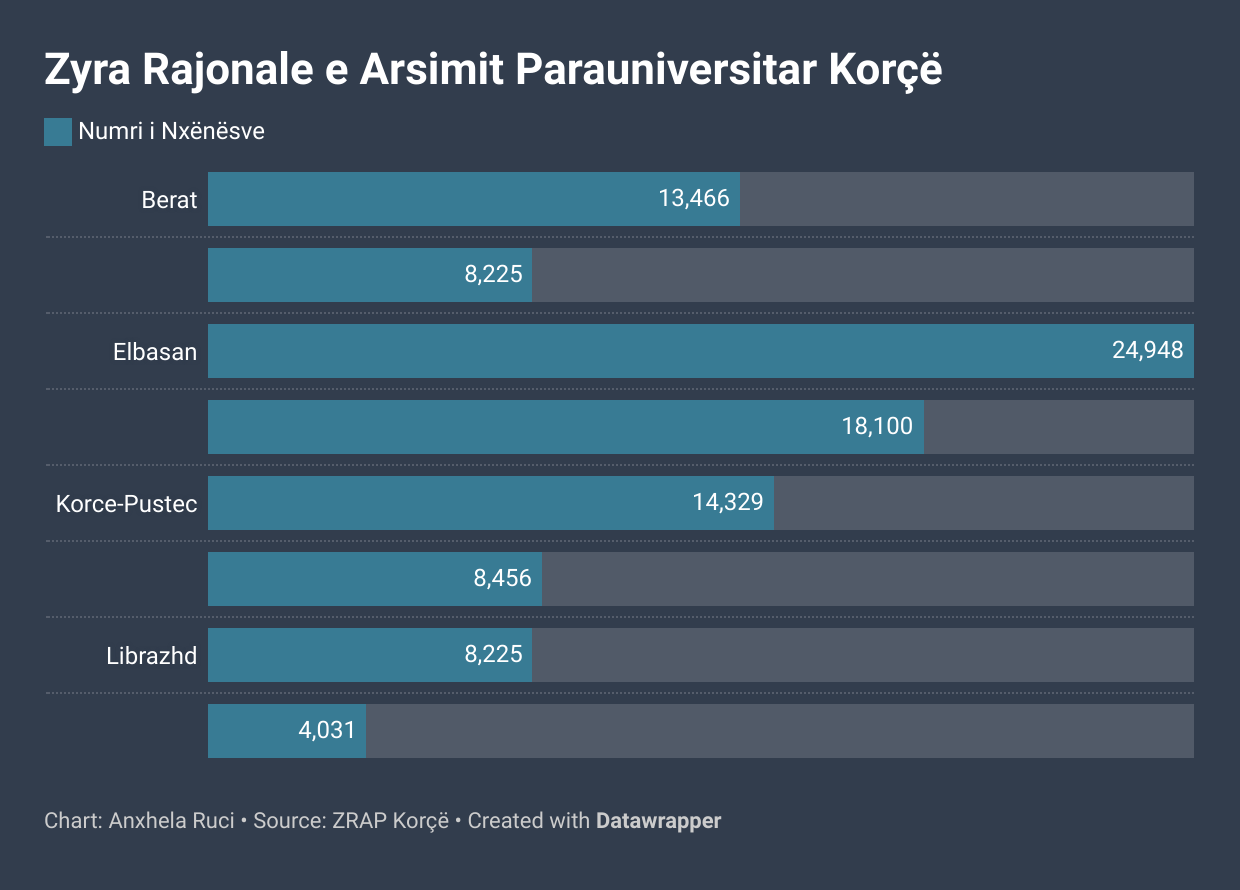
In this regional Directorate, even though there is a decrease in the number of students, a local office has a positive record, since from 2018 to 2021 there is an increase in the number of students. Such is Pogradeci, which in 4 years has increased the number of students by 1417 more students.
Regarding the number of schools and teachers in this regional directorate, the data available are not complete.
The statistical data of DRAP Korça states that "The total number of students in pre-university education, including children in preschool education, has decreased by 9,6 %, compared to 2020. In Preschool Education, the decrease is 11%; In basic education (compulsory education, grades 1-9), the decrease is 7%; In upper secondary education (grades 10-13), the decrease is 14%. The largest number of students decreased is in rural areas.
Durrës Regional Directorate of Pre-University Education
DRAP Durrës is among the main directorates of our country, which includes 12 educational offices: Bulqizë, Dibër, Durrës, Kamëz, Kavajë, Klos, Krujë, Mat, Rrogozhinë, Shijak, Tirana and Vorë.
The local education office of Kavaja, Kamza, Krujë, Mati and Durrës have the highest number of student dropouts, ranging from 5310 in Durrës to 2288 in Krujë, while the number of students in other local offices is below 1000.
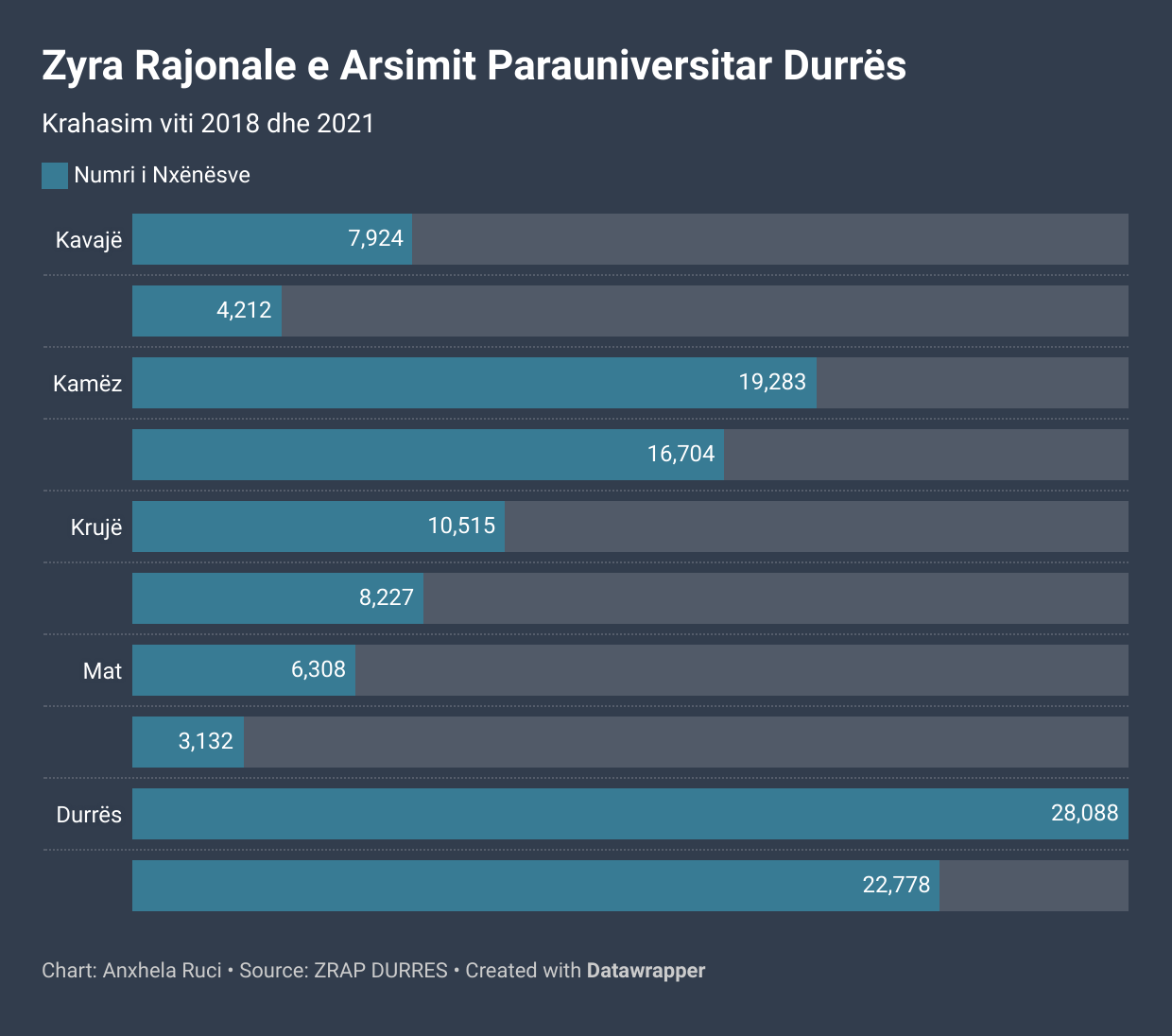
But this educational office, among other things, also has a positive factor, which was expected since the capital, Tirana, is part of it. The Tirana education office has a positive record for the years 2018-2021, since unlike other directorates, the number has increased by 7788 more students.
Regional Directorate of Pre-University Education Lezhë
DRAP Lezhë is the next directorate after Korça and Durrës, which has the biggest drop in students, teachers and the closure of educational institutions. The regional directorate of Lezha includes: Lezha, Kurbin, Mirditë, Shkodër, Malësi e Madhe, Vau i Dejës, Pukë-Fushë-Arrëz, Kukës, Has and Tropojë.
Even this directorate has recognized a large depopulation of schools, where the biggest consequences are observed in Shkodër, Kurbin and Kukës. In these local educational offices, the number of students registered from the 2021-2022 school year is several thousand lower compared to the 2018-2019 school year, where Shkodra holds the lead with 2173 less students.
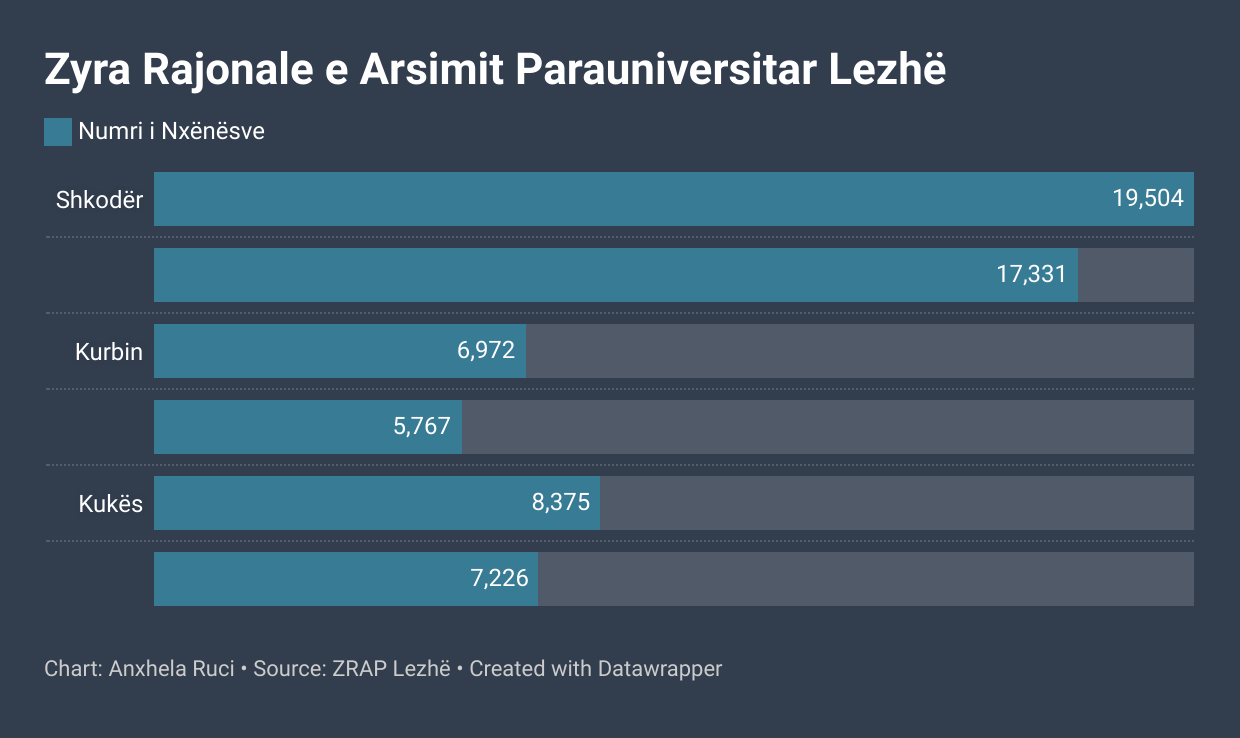
A phenomenon that can be noticed from the data made available by DRAP Lezhë is that although in some local offices such as Lezhë, Kukës, Has and Malësi e Madhe there has been a decrease in the number of students, the number of teachers has increased.
According to information made available by DRAP Lezhë, it cannot be specified whether the drop in the number of students is in 9-year schools or in gymnasiums, as these statistics vary depending on the local offices.
Regional Directorate of Pre-University Education Fier
DRAP Fier, on its map, includes 13 local educational units: Fier, Lushnje, Vlorë-Himarë, Divjakë, Patos, Roskovec, Mallakastër, Selenicë, Përmet-Kelcyre, Tepelënë-Memaliaj, Gjirokastër-Libohovë, Sarandë-Delvinë-Konispol and Dropull - Phoenix.
This regional directorate also has a decrease in the number of students in pre-university education, where the most affected local offices are Lushnja with 2166 fewer students in 2021 compared to 2018, followed by the Vlorë-Himarë local office with 1078 fewer students.

During the 4 years in DRAP Fier, about 78 educational institutions have been closed, but unlike other local offices, even though Vlorë-Himarë has a decrease in students from 2018-2021 (1078 students less), the number of schools has not decreased.
This phenomenon also has an explanation from DRAP Fier, collective classes. " In rural areas of some municipalities, schools operate with a very low number of students, who study in combined classes or otherwise called collective classes. Due to the concentration of such schools in larger schools, providing a quality education in separate classes for their students, some schools have continued to operate only with a preschool cycle. These schools and others that have not had any students, are not considered officially closed ," it is stated in the response of this office.
The reasons that have led to the decline of students and worries about the future
The President of the Independent Education Union of Albania, Mr. Nevrus Kaptelli, explains that the decrease in the number of students remains one of the main concerns of this union, which were also raised in the meetings that this union held with the Ministry of Education.
"From the information of our basic structures, we have been informed that from year to year the number of students who register in the first grades is constantly decreasing, where in some ZVA, less than 50% of those who appear in the registers of civil registers are registered. The phenomenon of depopulation of schools in recent years is also observed in Tirana, where classes are closed every year. Since our requests for increasing the education budget from 3% of GDP to 5%, made repeatedly since 9 years ago, have not been taken into consideration by the government, solving the problem has become more difficult now. Due to insufficient investments in education, equipping schools with modern tools, increasing teachers' salaries, etc., the teaching profession has become one of the most undemanding professions among students. An indication of this is the continuous decrease in the number of students in teaching branches and in some faculties their closure", says Kaptelli.
He clarifies that the decreasing number of students in pre-university education is also accompanied by the remaining out of the system of teachers who, in order to cope with the significant decrease in students, have to shorten the teaching hours or are forced to move from one school to another to complete the schedule of work.
As we mentioned at the beginning of this article, one of the main phenomena of the decrease in the number of students in pre-university education is the emigration of Albanian families abroad, but according to the education expert, Irsa Ruçi, there are also several other factors that have influenced reducing the number of students.
"I believe that there are causes that are directly related to the quality of education, this is reflected because knowledge is increasingly devalued and the "card" is gaining value as a certification instrument. Parents feel insecure to send their children to preschool education institutions with unqualified, untrained and lack of knowledge graduates, even more so after several disasters that have appeared in the media, which prove the lack of preparation of the educational staff with the necessary components for manage difficult situations. The lack of educational institutions in rural areas is problematic, as a family may have to walk several hours to send their child to the nearest kindergarten,' she says.
Ruçi says that there are also social causes that influence and for this, she suggests, there should be a coordination between state institutions, to help with the education of children in those families that have economic difficulties and the inability to provide children with the tools required education.
Among other things, a main problem in pre-university education is the closing of institutions in rural areas and the concentration of students in urban areas.
Even this phenomenon, according to teacher Arjola Alla, is associated with lower performance of students coming from rural areas, who often find it difficult to adapt to the new environment.
"Students coming from rural areas reflect economic difficulties, a good part work to cover school expenses, difficulty in adapting the first months. Some show up late for the first class because they live far away and have no way to come, they express low self-esteem compared to other students", she explains.
2021 thousand graduates took part in the state matura exams of the school year 2022-33. What was evident at the end of the exams was the low number of graduates with the highest grade (4 excellents in the language-literature exam; 234 excellents in the math exam, 611 excellents in the foreign language exam) and the high number of dropouts. at least one of the four compulsory exams.
The Minister of Education, Evis Kushi, proposed that next year, for the first time, the re-evaluation of state matura exams be introduced as a practice, while high school graduates who aim for medicine and dentistry will undergo an electronic test in Tirana.