


Author: Denis TAHIRI and Aurora SHPATAJ
Earlier this year, Health Minister Orgerta Manastirliu had a different opinion about doctors. “The free movement of doctors is not only an isolated phenomenon for Albania but for all countries in the region as a whole. Free movement has also brought vacancies. Dealing with this phenomenon is a daily battle,” the minister insisted at the time, adding that they had not yet found a solution to the phenomenon. But six months later, the formula offered for the situation was put forward by another institution, which implies a ban on doctors leaving Albania. The Ministry of Education and Sports proposed the draft law “On the special treatment of students following the integrated second-cycle study program “General Medicine” in public institutions of higher education.”
The draft law was presented by Prime Minister Edi Rama, Minister of Education Evis Kushi and Minister of Health Ogerta Manastirliu after the government meeting at noon on July 5, 2023, and a few hours later it was submitted to the Assembly, where at the request of the Council of Ministers it was requested to is passed with an accelerated procedure.
But what does this bill provide? The draft law, which is expected to become law within July, provides that students who sign the agreement at the time of registration, after completing their studies, must work as doctors in Albania for no less than 5 years. After the end of these 5 years, the doctor has the right to withdraw the diploma. But affected by this law are also students who are currently studying general medicine, who after completing their studies, if they choose to sign the agreement, must work for 2-5 years at Albanian health institutions, without specifying whether they are public or private. The only case in which students do not have this obligation is if they do not sign the contract and pay the full cost of their studies, which cost has not been made public.
Scenarios to doctors
The Ministry of Education and Sports has also listed several scenarios, but the most realistic is the one where 50% of students will agree to sign the agreement with the Ministries of Education, Health and Higher Education Institutions.
" The financial effect for students who will agree to sign the agreement (except for those who already benefit from the exemption) because they will sign the agreement for a 2-5 year stay in Albania is calculated: 325 additional students * 45.000/2 lekë = 7.312.500 lekë funds needed from the state budget to cover the exemption from the fee. This category of students is assumed to pay 50% of the fee (45.000/2 lekë)," the draft law states.
Medical students: It will have the opposite effect
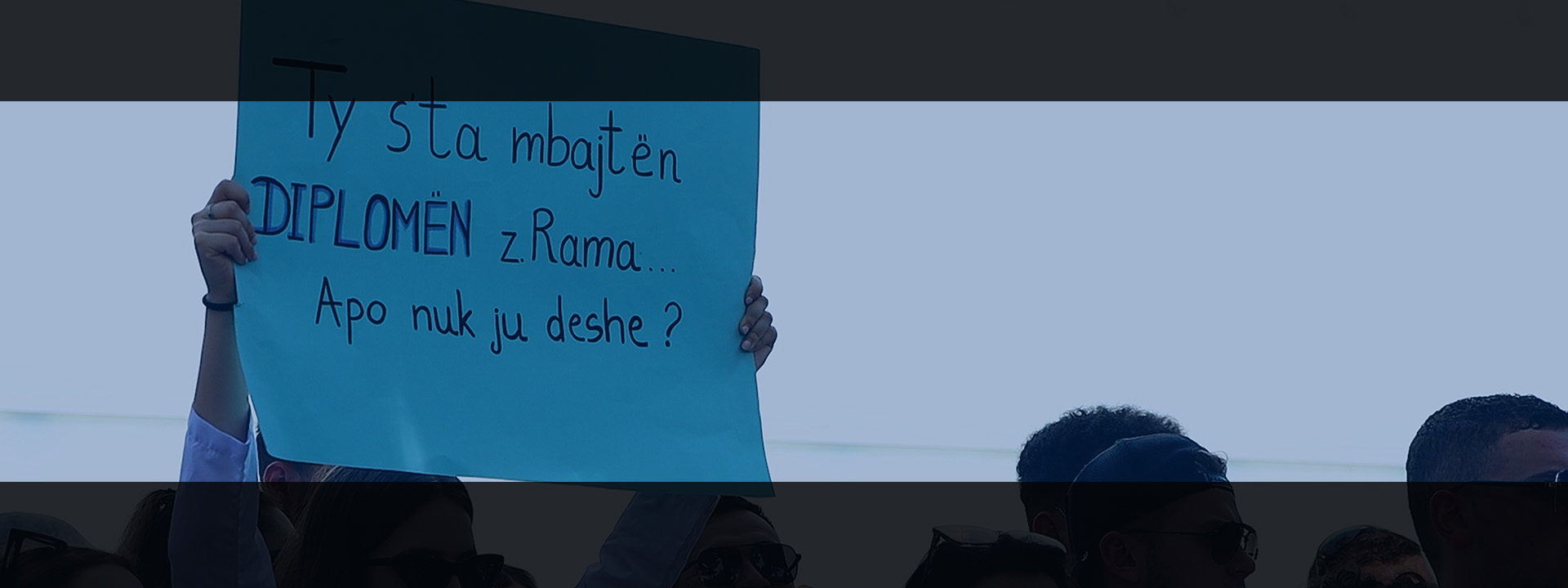
On Thursday (06.07.2023), while the accelerated passage of this bill was being discussed in the Assembly, hundreds of students protested in front of the Assembly Hall. Among them was Mikel Seferi, a first-year student. " The doctor should be invited to Albania, he should not be forced to work. We are all affected by this law, working under duress," says the young man, who still needs 5 years to complete the University of Medicine. Among other things, he says that this bill is not a solution, but an impetus to the problem, which will bring a boomerang effect. " We will go to work in the districts, we will see the scandalous conditions, we will work for years under duress and we will get our diploma and leave," he says, adding that: " No one wants to leave their home, if the conditions are there, no one leaves, this is guaranteed" - the student concludes his story for "Sinjalizo".
" This is a stab in the back," says second-year medical student Mateo Shehari. " A few days ago they appeared to be holding constructive meetings, they appeared without a draft, they appeared to be simply meetings, and today they presented us with a draft law," says the young man, not hiding his disappointment. For Mateo too, this law will have the opposite effect. " A drop in interest, especially for graduates, 5 years is a lot, 6 years of general medicine, 5 years of compulsory work, 4 years of specialization, 3 years of compulsory work again after specialization, it's really tiring," he says.
" I have to stay for 2 years and if I don't stay for two years, I will have to pay a fee that I don't know how much it will be for the two years I will study here," says fourth-year medical student Fabiola Kamberi, who adds that, as medical students, they have not had any information and have not been told anything specific to be clearer and calmer.
" It has been discussed. We have asked the ministry for a draft, and they have told us that we do not have a draft, it has been put forward as an idea. We thought it would take time, even further discussions to reach a decision, even a compromise with us, but this did not happen, they reached a decision," she concludes.
Experts: Nonsense measure
Migen Qiriaxhi from Qëndresa Qytetare states that the country reformed 8 years ago and today we are in a situation where we need to see the results of the reform. He also raises questions about why a reform was needed when today we have students who are paid to go to school. “We have the case of medical students who are closed to the border so that they cannot leave the country if they are educated here. Why would we want a reform when 8 years later we have a situation that has become so bad when we admit that we have no doctors in the health system and no teachers in the education system ,” he says.
He also dwells on the rhetoric that the country pays a lot for a medical student but that the latter do not give back to the country. " The Prime Minister must first answer a simple question. How much does it pay? I can tell you with conviction that there are a number of other professions in our country that can be more costly than graduating a doctor. The point is, graduating a veterinarian at the Agricultural University is created with the intention of graduating this student, while a medical student who uses the established structure that is hospitals, is not created with the student in mind," says Migen Qiriaxhi, who recalls the report of the Supreme State Audit Office (2019) in which it was assessed that universities set a fee without conducting a cost analysis.
" We have always talked about what the main challenges of the medical university are, where the main challenge is that it is not well managed in terms of finances. A university that is not well managed in terms of nepotism within it, the wards within the hospitals have pronounced nepotism and are with the fingers of the hand, the families that control the hospitals. We have seen the reports of the Supreme Audit Office, what is being done with the quality of medicines, how tenders are managed, what are the conditions of regional and municipal hospitals, but also central ones", he says. For Migen Qiriaxhi, the lack of will to deal with the system has led to this type of reaction and of course it is not just a matter of some students who are having some rights restricted.
" Hoxha's system did not justify anything greater than that when it banned Albanians from crossing the border. And where are we in rhetoric today and in public communication? The Prime Minister says that we will condition the lives of these young people, because they refuse to build the country and give back to the country," he concludes.
For the president of the Federation of Albanian Doctors in Europe, Aurora Dollenberg, the government's measures to stop the brain drain are to be commended, but on the other hand, she says that the reaction of medical students is understandable. " This bill provides for more service, in an area that the student or young doctor has no opportunity to choose, and this bill does not provide for either the salary that will be received during this period or the opportunity for specialization during this time. And it is quite understandable that the reaction will be protest, since a public university cannot raise the fee to 5 thousand euros and if this tax is not paid, the diploma is not awarded," she says.
" Albania cannot force students to sign contracts. The student is directed towards European countries, rather than entering into a binding contract which ultimately grants an Albanian diploma, which is not even recognized in Europe," she says.
Also, the president of the Federation of Albanian Doctors in Europe, also brought examples of countries that have previously tried the binding contract but failed.
" Italy and Germany have also had this problem for 20 years, the lack of doctors. They came up with a strategy with contracts to keep doctors connected to the country's hospitals, but through student protests, the taxes imposed on universities were removed, as well as these mandatory measures," Dollenberg tells "Sinjalizo".
Jurists: There was no external consultation, interest groups were ignored
The introduction of draft laws with an accelerated procedure in the parliamentary agenda of Albania is not something new and does not constitute a violation of the law. According to jurisprudence experts, even the draft law for medical students does not have any legal violation regarding its review with an accelerated procedure, since the applicant is the Council of Ministers.
Lawyer Gylsen Zhllima states that we should bear in mind that our legislator has not foreseen a preliminary Constitutional Court that examines how draft laws are drafted, but has delegated this task to the proposers and various interest groups to begin drafting the legislative process. Asked about the specific case, the draft law for medical students, he states that the government has not conducted an external consultation. “ In the end, laws must provide a sustainable solution, which must be in accordance with the Constitution, in accordance with ratified international agreements and with the commitments arising from Albania's participation in international organizations, in accordance with the basic notions of reason and logic, practical and with as few undesirable side effects as possible,” he says. Lawyer Zhllima is convinced that if this draft law becomes law, in addition to compliance with the Constitution, all other points, depending on how they will be interpreted and misinterpreted by each party, will reveal many shortcomings over time, from which the losers will be the students, not the government.
The lawyer Brizida Gjikondi says that this law cannot be canceled out of the way, but by proceeding judicially.
" I know that Italy is doing the same thing. I also know that these students have the opportunity to file an expedited lawsuit with the Constitutional Court, which is the only constitutional institution that sees whether this law is in harmony with the Constitution and the Law 'On Higher Education' or is a flagrant violation of human rights and a violation of the rights of the Albanian student ," she concludes.