The high costs of infertility treatments in Albania, often carried out in private clinics, are a significant financial burden for couples, ranging from 4500 to 5500 Euros per IVF procedure.
Author: Ina Allkanjari
Infertility is a challenging reality for many couples today. In Albania, every year, a significant number of individuals and couples encounter this problem, looking for ways and solutions to realize their dream of having children.
Anisa, the 37-year-old from Tirana talks about the difficulties and challenges encountered on the difficult and expensive path to having children.
At the age of 35, in May 2021, Anisa began her journey with infertility. After a series of general tests and doctor's advice, she started the easy procedures like IUI (Intra-Uterine Insemination) and then the long-awaited In Vitro Fertilization (IVF) procedures. However, the results of the procedures were negative.
"These treatments were carried out in Albania, in private clinics, including the high costs of medications and procedures necessary for treatment. Since based on the information received at the Women's Center (Kico Glozheni Maternity Hospital), these procedures are not performed in public hospitals ," says Anisa.
Before this challenge, they have tried to seek help in specialized clinics in Turkey, following additional IVF procedures, but without a positive result.
The costs of infertility treatment are considerable in Albania. Couples facing this problem face high costs for medications, tests and various procedures, estimated at 4,500-5,500 Euros for an IVF procedure.
" Medicines are expensive and range from 150.000-200.000 lek, plus preliminary tests for the woman and the man, plus periodic ultrasound checks and procedures that cost 2,500 Euros. In the state, these Services are not offered, neither medications, nor procedures, nothing. If it were the opposite, it would be perfect. At most, you can do some types of tests at the maternity hospital, such as transvaginal ultrasounds."
The situation is almost the same for many other couples who face this difficult challenge. Public Services in Albania do not provide help for infertility, leaving couples in a difficult situation.
"A support from the state would be necessary," Anisa emphasizes. "Nowadays, infertility is a problem that has fallen to the masses, and we need help to overcome this great challenge. Moreover, even the insurance company does not provide any coverage for these treatment expenses.”
However, her challenge is not only financial. “ My problem is inexplicable, ” Anisa says sadly, “ because the tests have shown that my husband and I are fine, but I still haven’t managed to conceive .”
Until now, experts and doctors have not been able to find the exact cause of Anisa and her husband's infertility.
The odyssey of promises to achieve free In Vitro Fertilization
Infertility is not only a personal challenge, but also a social problem in Albania. Access to infertility treatment Services in public hospitals continues to be difficult.
In 2012, a project worth 25 million ALL was signed between the Albanian Government and the European Union to enable the realization of In Vitro Fertilization in state structures. This initiative aimed for citizens with health insurance to benefit from this method of assisted reproduction for free.
However, the challenges in the implementation of this program have prevented the achievement of the objectives, since the Center planned to carry out this project remained closed, never becoming functional, for reasons that are still unknown.
In the 2021-2025 Government Program, one of the promises included is support for this category, specifically the point "We finance the free fertility package starting in 2022" is presented.
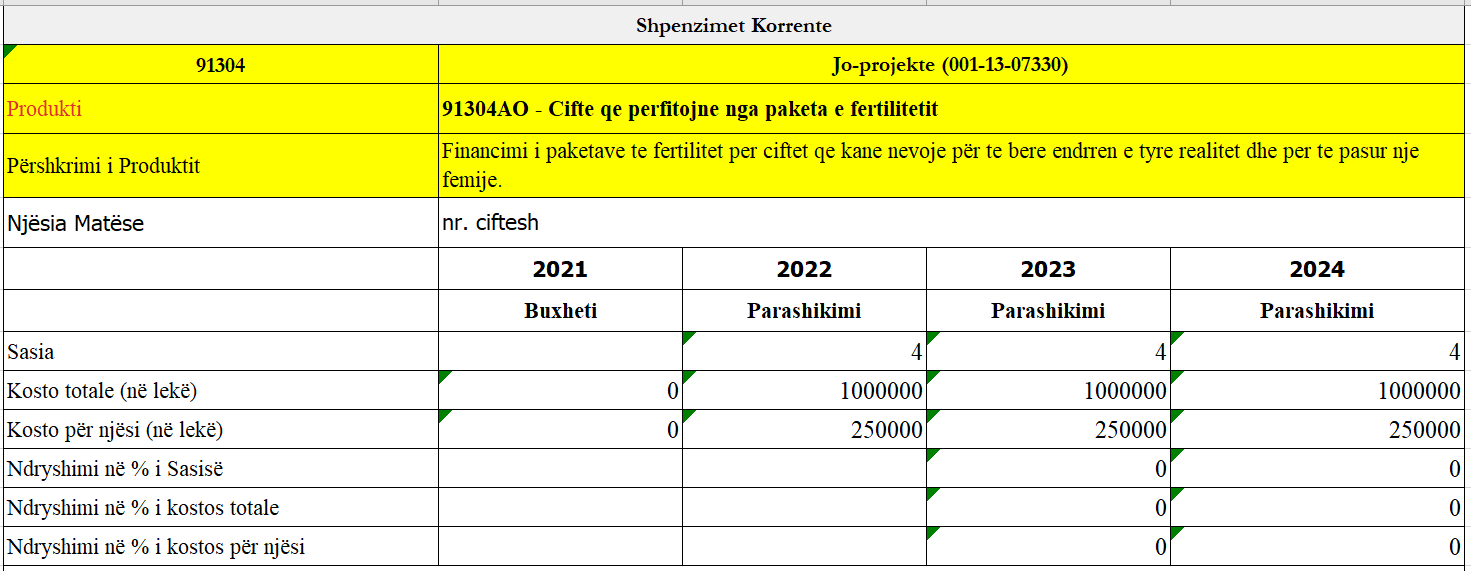
In 2022, a total fund of 1 million ALL was reflected in the budget of the Ministry of Health, for the product called "Couples who benefit from the fertility package". However, no concrete action was taken that year, followed by the removal of this product from the list of funding in the 2023 budget.
In May 2023 , the Ministry of Health announced on social networks the start of the implementation of new projects at the "Koço Gliozheni" Maternity Hospital for the construction and equipment of the 1st public Assisted Reproduction (IVF) Center.
The Minister of Health, Manastirliu, underlined that this center would offer for the first time in Albania the In Vitro reproduction procedure for free."
" We are working intensively to invest in the infrastructure and bio-medical equipment necessary to start this new procedure in public hospitals ," she emphasized.
The goal is for this assisted reproduction program to be free, with an initial projection of 100 cases per year.
According to INSTAT, the population of Albania on January 1, 2022 was 2.793.592 inhabitants, suffering a decrease of 1,3%, compared to January 1, 2021. Likewise, the birth rate has suffered a decrease of 2,8% for the year 2021, bringing the number of births to 27,284 children, compared to the previous year.
Meanwhile, according to Eurostat , in 2021 Albania had the lowest fertility rate among the Western Balkans and Turkey with 1.31 children per woman. The fertility rate in the EU in 2021 was 1.53 children per woman.
These figures indicate the need for support and supportive initiatives in the field of assisted reproduction to help increase fertility rates and address infertility challenges in the country.
Infertility problems, costs and treatment
At a time when couples are facing the challenges of infertility, doctors specializing in assisted reproduction offer important explanations and instructions for the procedures followed and the steps before In Vitro Fertilization. Doctor Marsel Haxhia, an embryologist certified by the European Society of Human Embryology and Reproduction (ESHRE) and the American Society for Reproductive Medicine (ASRM), describes the main steps and procedures that are followed when a couple seeks help for infertility. He emphasizes that a couple who has had about 1 year of unprotected intercourse and has not had a pregnancy should be referred to an infertility specialist.
"A detailed medical history is taken from the couple. The recommended examinations include a transvaginal ultrasound for the woman to assess the anatomy of the uterus and ovaries, and a hormonal analysis to determine the functionality of the ovaries. A spermogram is recommended for the partner, which determines whether there is a problem or not," explains Dr. Haxhia.
Dr. Ilta Bylykbashi, a gynecologist, explains the factors of infertility, emphasizing that "1/3 of infertility cases remain unexplained where the cause/factor is unknown or we have multiple factors (many causes), 1/3 belong to the male factor, while 1/3 belong to the female factor."
"The reason for infertility can be due to problems of the woman in 40% of cases, due to problems of the man in 40% of cases, 10% of cases it is from both partners and in 10% it is unexplained", it says. Pilgrimage.
Focusing on In Vitro Fertilization, embryologist Haxhia shows that the state does not cover any costs in this procedure, as he points out that the cost of In Vitro Fertilization is approximately 5000 euros, including the procedure's medications.
" My opinion is that In Vitro Fertilization is very specific and the success rate varies from one clinic to another all over the world. The patient should be given a certain coverage that he can use in any clinic in the country, whether private or public ," says the doctor.
Doctor Bylukbashi says that in recent years, a significant increase in infertility cases has been observed as a result of " the mother's older age at the time of conception (there are many cases > 35 years old), increased incidence of STDs (sexually transmitted diseases), use of drugs, alcohol, tobacco, etc., environmental and nutritional factors, increased pathologies at younger ages such as autoimmune diseases, diabetes, etc. as a result of increased stress factors in recent years, etc."
Meanwhile, embryologist Haxhia emphasizes that it is estimated that 1 in 6 couples suffer from infertility. " There are several ways to solve this, not just In Vitro Fertilization. Assisted reproduction techniques have advanced greatly and it is estimated that around 12 million babies in the world have been born solely through In Vitro Fertilization. This is a common disease for several reasons, the main ones being poor lifestyle and delaying couples' attempts to conceive ."
As Anisa and dozens of other couples face the challenge of infertility, there is a glimmer of hope on the horizon. The dream of parenthood may be within reach, provided the promise of free IVF procedures, as outlined in the government's 2021-2025 programme, is kept.
This article was created based on input provided by individuals who have chosen to speak up. Share your story, empower others and be an agent for change. Visit the website: www.acqj.al/sinjalizo-dhe-ti/