


Author: Dallandyshe Xhaferri
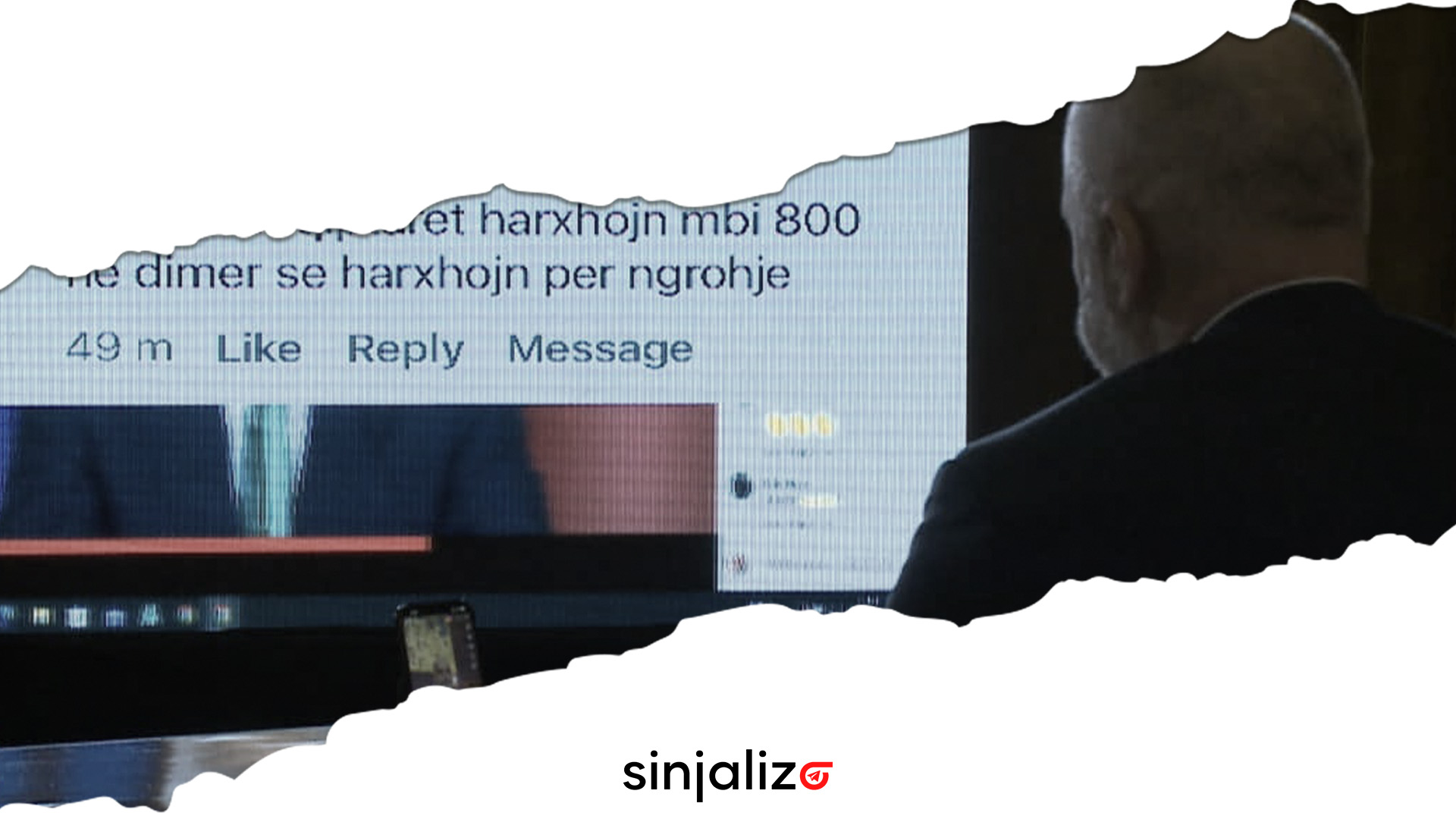
Prime Minister Edi Rama's personal Facebook has 1.6 million followers, some of whom are constant protagonists, commenting on every status, supporting it, but also opposing it. The number of virtual supporters is almost half of the country's population if we were to refer to the current figures published in INSTAT. But during the observations that "Sinjalizo" has made on the personal page of Prime Minister Rama on the social network Facebook, it turns out that his daily publications are 2 to 3 times more than on the official website of the institution of the Prime Minister's Office on the same platform.
In relation to the followers of the prime minister, the followers of the prime minister as an institution are significantly fewer. There are 4300 followers, in other words about 74% less than on the Prime Minister's personal page.
The Prime Minister works on Facebook, the Prime Minister less!
During the observations carried out by "Sinjalizo" it turns out that 15 posts were posted on the personal page of Prime Minister Rama between November 22 and November 76 of this year. Meanwhile, 39 posts, almost half, have been published in the institutional one. In other words, on average, about 8 to 9 posts are posted on Rama's personal profile per day, while on the official profile there are about 4 such posts. In addition to the lowest activity, we noticed that on November 19, on the official website of the institution of the Prime Minister's Office, no no information about the followers has been published, while 5 posts have been published on the Prime Minister's page.
Are the virtual "clutterers" real?
"How good that our name is now mentioned for good and admirable things. This is thanks to the work and policies that you, Mr. Rama, are doing in the right way," - this is just one of hundreds of comments that, in addition to congratulating Prime Minister Rama, define him as the only possibility for improving the country. Specifically, the profile that made this comment is Sonja Krashi , whose profile photo "Sinjalizo" during the investigation managed to find through the Yandex program that it was taken in Colosseo, Rome. From the weak activity, friends with fake profiles, with fake or Arabic names, the lack of interaction with male profiles that write in the comments and the publication of a photo of a child, whose image can also be found on the site This person doesn't exist (This person does not exist) are some of the indicators that reinforce the fact that this profile is not used by users who intend to use it to share activities from their daily lives.


Just a month ago, ACQJ published an investigation, according to which 470 comments out of 1000 published by the Prime Minister's followers on five video posts were found to have been written by fake profiles used by Socialist Party trolls to enable online fandom for a fee.
To produce this article, the profiles of 100 random commenters from the Prime Minister's video post on November 21, where Albania is congratulated by FIFA for welcoming the footballers and people of Afghanistan, were analyzed. What was understood during the analysis and observation is that Rama's personal page is still supported and fueled by fake profiles. Out of one hundred (100) comments, forty-six (46) of them were published by fake profiles.


Meanwhile, during the month of September, BIRN published the investigative article, in which it was emphasized that "over the course of a year, the personal pages of Rama and the ministers together posted a total of 8801 posts, while the official pages of the institutions posted 5342 posts; in a ratio of 62 to 38 percent".
"According to data analyzed by BIRN (Balkan Investigative Reporting Network), the government page has very low interaction compared to the Prime Minister's personal profile ( edirama.al ), at a ratio of 98 to 2 in interactions on Facebook," journalist Besar Likmeta tells "Sinjalizo", adding that this is due to the more frequent use of the personal page by the Prime Minister's staff to communicate about government activities compared to the government page "Prime Minister".

"The question that arises in this case is: Is it appropriate for public resources to be used by state officials to inflate followers and distribute information and propaganda on social media? Does this type of misuse give an advantage to the prime minister and ministers in the elections?", continues Likmeta, underlining that the posts of the private pages of the prime minister and ministers are redistributed on various social networks such as Facebook and Instagram from the pages of institutions and employees, "in appearing often in a coordinated manner, making these posts highly interactive and favored by social platform algorithms," he concludes.
Government: We only have three
The Director of the Media and Information Agency (MIA), also the spokesperson of Prime Minister Rama, Endri Fuga, explains to "Sinjalizo" the number of people who are responsible for the distribution of posts on the website of the Prime Minister and the ministers. Fuga says that "there are no such specific tasks". Meanwhile, he then claims that there are only 3 (three) people from MIA, who deal with the distribution of posts on these pages.
According to the head of the MIA, during the past week, 58 posts were registered on the Prime Minister's personal Facebook page. While 29 statuses have been posted on the official website of the Prime Minister's Office and 30 posts have been registered on the MIA website.
But Bashkim Tuda and Denis Jace are two other fake profiles, who comment with messages of political support on average 3 (three) times out of 100 comments on the Prime Minister's personal profile. In addition to weak activity, few publications which are mainly related to the publication of post-videos attacking the government's political opponents, these profiles have (friend requests) almost only with users from the Middle East.


During the research of "Sinjalizo" it was noted that there have been many cases where users of fake profiles have been careless in selecting the photo that would define their new identity. Specifically, the profile of user Greta Merturi initially had the same photo as that of user Ilirjana Ylli, who a month ago represented one of the most active profiles (top fans) in terms of comments written and published on Rama's page. During the investigation published a month ago, the same photo taken by "This person doesn't exist" represented the identity of Ilirjana Ylli, but during the investigation it was realized that if this profile is searched for on Facebook, it cannot be found. This profile is closed, to make way for another fake profile with the same image.


Eriola Daku is another fake profile, which does not spare positive comments towards the Prime Minister. Although presented on her account as an educator in Fier, her weak activity, the profiles of friends from the Middle East, the lack of interaction claimed by them in the comments and the different photos that identify the same person with two different images, are some of the indicators that raise doubts about the authenticity of this profile.


Endri Harizi is another fake profile, who, although he only has 5 friends in total, only one of whom has an Albanian name, and is not at all active in publishing statuses, remains one of the most frequent followers and commenters on the prime minister's page.


Support from fake profiles, is reality being distorted?
Edlira Çepani, Human Rights activist and national coordinator of the "Equality in Decision-Making" network, emphasizes to "Sinjalizo" that "the distortion of reality, even when it is intentionally improved, even when it is intentionally worsened, is an unfair communication."

"Propaganda of a virtual reality, different from the real one, is a distorted communication with the public, which further distances citizens from politics, but also creates deliberate disinformation", says Çepani, who emphasizes that although social networks are a very good opportunity to create direct relations between citizens and decision-makers, they are often misused for propaganda, "which is a danger to democracy and must be rejected, fought in all ways".
"The use of hate speech, bullying, incitement to violence, fraud or slander, disinformation, and others that are in violation of the law, are on the other hand morally punishable in terms of distorting reality and obstructing communication channels. proper communication," she concludes.