


Denada Jushi
Weak institutions, lack of transparency, and pressure on democratic control mechanisms continue to remain the main challenges for the countries of Eastern Europe and Central Asia in the fight against corruption.
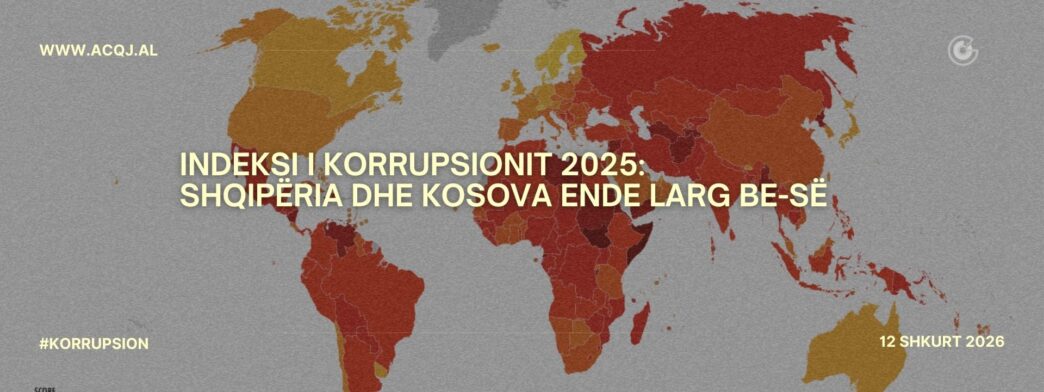
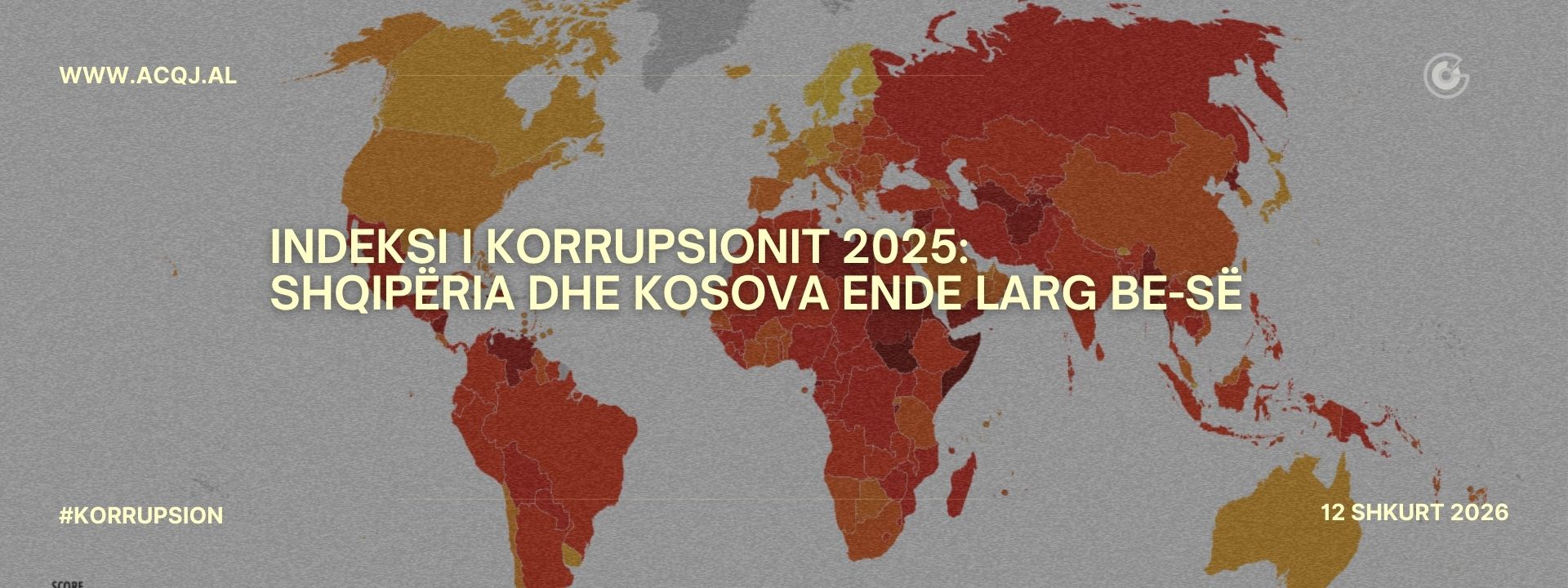
This is how the situation is reflected in Corruption Perceptions Index 2025, published by Transparency International, a report that places the Western Balkan countries, including Albania and Kosovo, at the center of the analysis, as two countries that are still in a fragile phase of institutional reforms.
But is Albania alone in this situation?
In fact, the data shows that the region as a whole continues to lag below the global average, with a score of only 34 points out of 100, which according to the report indicates a “stagnation” of reforms and continued weakness of institutions. In this context, Albania ranks with 39 points, reflecting limited progress and structural problems mainly related to transparency in decision-making, management of public funds and the lack of strength of supervisory institutions.
One of the main concerns highlighted in the report is the lack of transparency in large investment projects and the widespread use of non-competitive procedures.
Transparency International notes that in the Western Balkans, decisions on high-value projects are often made with limited transparency, increasing the risk of corruption and reducing public trust in institutions. In the case of Albania, the report cites the risk of environmental degradation related to planned developments on the island of Sazan, linking this to a lack of clarity in decision-making processes.
At the same time, the report highlights that one of the biggest obstacles in the fight against corruption remains the still insufficient response of the justice system. Although the justice reform in Albania has been considered an important step towards strengthening institutions, challenges remain numerous, especially in guaranteeing the full independence of judges and prosecutors and in avoiding political pressures. For a country that has built high expectations on the results of the justice reform, the public perception of corruption remains a direct test of its real effectiveness.
On the other hand, Kosovo, although not extensively covered in the regional report, remains part of the same panorama of challenges. Problems with the rule of law, perceptions of political influence over institutions, and difficulties in punishing high-level corruption continue to influence international assessments. Anti-corruption experts have emphasized for years that the lack of tangible results in high-profile cases undermines public trust and creates a perception of impunity, a key factor that fuels corruption.
The Transparency International report also highlights that democratic regression and the concentration of power are factors that increase the risk of corruption in the region. The weakening of institutional control, pressure on the media and the restriction of civic space create an environment where the abuse of power becomes easier and less punishable. Although Albania and Kosovo are not mentioned as extreme cases, the problems of transparency and political tensions continue to affect the general perception of institutional integrity.
In parallel, the report brings as positive examples countries like Ukraine and Moldova, where pressure from civil society, the media and independent institutions has influenced the advancement of anti-corruption reforms, despite major political and geopolitical challenges. This comparison is important for the Western Balkans, as it shows that progress is not only related to legal changes, but to the real functioning of accountability mechanisms.
For Albania and Kosovo, the challenge remains the same: moving from loudly promised reforms to tangible results. In both countries, the integration processes towards the European Union have put the fight against corruption at the center of the political agenda, but the report suggests that progress is measured not only by the adoption of laws, but by their implementation and by strengthening the institutions that guarantee control and transparency.
Ultimately, the message of the report is that corruption is not an inevitable phenomenon. It thrives where institutions are weak, where justice is vulnerable, and where civic space is limited. For Albania and Kosovo, the challenge in the coming years will be to strengthen these elements, turning the fight against corruption not just into rhetoric or a political promise, but into a real hope for improvement.
Otherwise, the perception of corruption will continue to remain one of the main obstacles in building public trust and on the path towards the EU.acqj.al