




Ida Ismail
The institutional reorganization of the justice system in Albania was conceived as a response to a prolonged crisis of public trust and concerns over politicization, lack of transparency, and weaknesses in accountability mechanisms.
The creation of the High Prosecutorial Council was considered one of the fundamental pillars for guaranteeing the functional independence of prosecutors and for transforming the governance of the prosecutorial system.
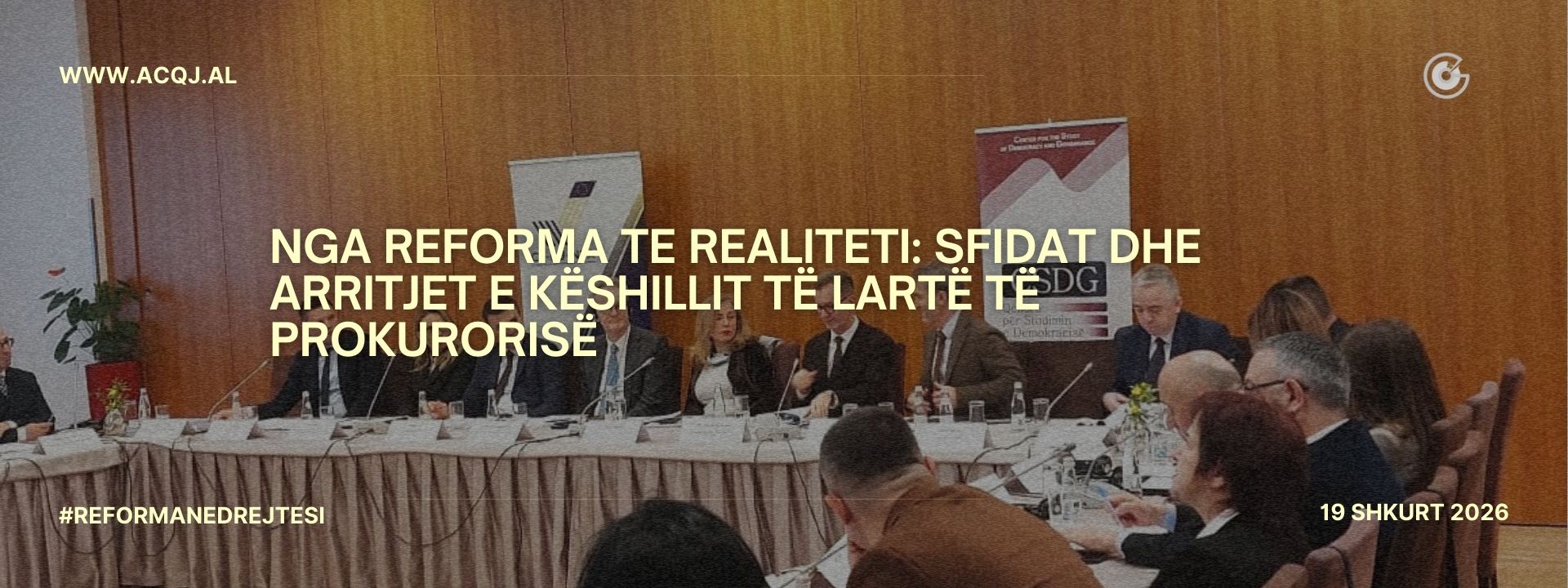
After 6 years of operation, an evaluation report prepared by the Center for the Study of Democracy and Governance, through a roundtable with actors from the justice system, civil society, representatives of central institutions but also international representatives, offered an analysis of the institutional performance of the High Prosecutorial Council, aiming to measure independence, professionalism and accountability in the prosecution system. The presentation of the report was conceived as a space for reflection and professional discussion on the role and functioning of the High Prosecutorial Council.
The Director of the Center for the Study of Democracy and Governance, Arjan Dyrmishi, stated that "The report aims to provide an analysis of the performance of the KLP and to highlight the key dimensions of its functioning, for measuring independence, professionalism and accountability in the prosecution scheme. This report helps institutions and policymakers, on the challenges and achievements."
Researcher Miranda Hallunaj presented the main results of the assessment, emphasizing that the institutions are "at a good level of performance," but the main challenge remains maintaining and consolidating this level in the coming years.
According to the report's findings, the performance of the KLP appears generally positive, with several areas achieving relatively high levels of assessment. Institutional and functional independence, along with transparency and public communication, are assessed with 74 points out of 100, reflecting a gradual stabilization of the institution's role.
Institutional capacities reach 72 points, while career management and institutional integrity with ethics score 68 points each. Meanwhile, ensuring accountability remains among the most challenging indicators, with 66 points, signaling the need for further improvements in accountability mechanisms.
Beyond numerical indicators, the report highlighted that some of the challenges are related to the pace of practical consolidation of the reform, where standards exist at a normative level, but their impact on daily decision-making is still in the process of being shaped.
The analysis also highlighted the dependence of some processes on limited administrative and analytical capacities, as well as on still partly manual procedures that affect institutional efficiency. Another finding relates to the need for more explanatory and proactive communication towards the public, so that transparency does not remain just in the publication of documents, but becomes a real instrument of building trust.
The report also noted that some disciplinary and ethical mechanisms have been institutionalized, but their use in practice remains uneven and requires stronger standardization. It also highlighted that the pressure of vacancies and structural changes in the system continues to affect the long-term management of prosecutors' careers and institutional predictability.
Representatives of international partners also participated in the event. The Ambassador of the Kingdom of the Netherlands to Albania, Reinout Vos, emphasized the importance of joint engagement in the framework of European integration and open professional debate.
He appreciated the contribution of institutional, parliamentary and civil society actors, underlining the continuity of initiatives and the need for a comprehensive and informal discussion on current issues of the system.
For his part, the European Union Ambassador, Silvio Gonzato, underlined the importance of further specialization of prosecutors, exchange of professional experiences during their careers, and strong institutional coordination, linking this to increased public trust.
Prosecutor General Olsian Çela, while assessing the report, raised direct reservations:
"Any analysis that is done cannot be done outside the context of the relationship that the KLP has with the Attorney General," he said.
Çela noted the significant institutional improvement over the years and the efforts to create a spirit of cooperation, but highlighted several important issues, including the numerous vacancies in the system, which have created serious functional difficulties; the need to improve inter-institutional coordination and the challenges in accountability mechanisms under the conditions of a decentralized system.
The Justice Reform has produced new structures and standards, but their sustainability in recent years has depended in part on deepening institutional coordination, strengthening accountability, and managing human capacities.acqj.al