1.4 million square meters of construction permits granted in Tirana only during 2022. Experts talk about how black money manages to get into Albania from organized crime and how it manages to invest in real estate.
Authors: Xhoana Çallaku and Ermal Spahiu
If you have cash today and want to invest in the country and then buy an apartment, this goal can be achieved very easily, although legally it is impossible due to the restrictions on allowed cash payments. ACQJ journalists were infiltrated as interested in buying an apartment worth 200 thousand euros through cash payment, the source of which was from abroad.
By questioning various actors, from police officers at border points to builders and real estate agents, several schemes were discovered that are used to bring money into the country and then buy an apartment in the central area of the capital.
The introduction of cash in Albania, or as it is otherwise known by the term cleaning of black money, goes through several stages and processes.
In the scheme set up for the transport of cash within the borders of Albania, persons who have large sums to pass, often from unjustified sources, establish contacts with persons who have a direct or indirect connection with border police officers.
Based on the law on the prevention of money laundering, all persons who enter/or leave the territory of the Republic of Albania are obliged to declare the amounts in cash, starting from the amount of 10 euros, or its equivalent in other currencies, the purpose of their holding, as well as to present the relevant justifying documents on this amount.
However, this prohibition often remains on paper, since the established scheme guarantees in most cases the transfer of money without significant problems for the sender. The person who creates the connections with the border police officers is the responsible person who has on his shoulder the entire chain of cash transfer on land. This same person, through negotiations and agreement with members of the police authorities at the border, manages to pass the sums of cash, without encountering legal restrictions or problems with other police officers.
It is these two links which, in compromise and through the payment of a percentage for this "service", agree on the transfer of money through loot bags or other goods that arrive at the border customs.
This form of cash movement across land borders, used by criminal drug trafficking networks, has also been cited by the European Monitoring Centre for Drugs and Drug Addiction in a recent report on Drug-related health and security threats in the Western Balkans. According to the report, money generated by drug trafficking groups in Western Europe and laundered in the Western Balkans is often smuggled across borders in hidden compartments of cars and trucks.
Truck drivers interviewed, through yet another scheme, say for this report and other previous reports published by the Global Initiative Against Transnational Organized Crime , as cash couriers regularly travel between Albania and EU countries, as well as the United Kingdom, carrying relatively small amounts (less than 10,000 euros) to avoid suspicion.
The proceeds of crime are also transferred through the financial system, fast money transfer companies and hawala operators , a system based on informal transfers through illegal underground networks. This system involves the deposit of funds by the originator with an “office” in the country of origin, and the latter notifying its “branch” in the host country that the deposit has been made, paving the way for the delivery of an equivalent amount of cash to the recipient of the funds.
According to the official statistics of the Customs Directorate, in 2021 the number of dictated cases that tried to pass undeclared "cash" over the limit recognized by the legislation was 36. The land route was the one that had the most cases of passing money, while the border point with the most cases dictated by the authorities has been Rinas Airport. In the figures provided by the Customs Directorate, money was attempted to be transferred by land in 20 cases, by sea in 4 and by air in 11. In total, 391,780 British pounds, 1,218,695 euros, 33,100 dollars and 424,500 Lek were seized.
However, despite the official figures of the amounts intercepted, a person involved in the scheme of passing cash at land border points, contacted by ACQJ reporters, admits that the practice of passing cash at the border is very common, and only a few transactions manage to be discovered.
Former officials of anti-money laundering agencies, under the condition of anonymity, mentioned another form of introduction of black money in Albania. According to them, this is done through tools, used furniture, expensive for buyers coming from Belgium, England, etc., where they also mentioned the case of "Toyota Yaris with 3.5 million euros in the interior".
"There are several ways to bring black money into Albania in cash, such as through furniture inside and used vehicles. It is no coincidence that the Toyota Yaris was worth 3.5 million euros at once, but there are other cases where individuals are used as transporters, who are given the appropriate amounts for passage, and after being collected in Albania, they are distributed among different people in amounts that do not attract attention and are deposited in bank accounts," they said.
From informal money, now part of the formal economy
But what happens after the money reaches Albanian territory? After the money arrives in our country, the person who owns these amounts tries to contact construction companies or real estate agencies to purchase one or more apartments, a form of money laundering that has found widespread application in recent years.
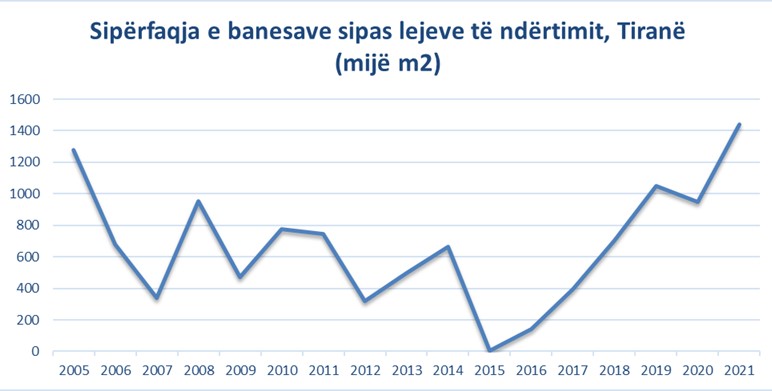
The supply of apartments has increased in recent years due to the significant increase in building permits in the capital. According to INSTAT data, in 2021, the area of construction permits granted by the Municipality of Tirana reached 1.4 million square meters, the highest level on record, at least since 2005, the year in which INSTAT started keeping data.
Money laundering officials further point to the fact that the imported money is mainly invested in construction, through new, newly formed companies, which would be practically impossible to develop the investments for which they received construction permits, given the initial capital theirs.
"The second moment of integration of black money is to hide the money, they accumulate it. They do this through construction companies, both large construction companies, as well as new companies that have recently entered the market. You see that companies have entered the market that have had no previous income, no history in construction, etc. In the middle of the day they have income and start building towers, etc. So these companies are not controlled by the state, but they allow them themselves and start building with that money," they add.
Further, in terms of money laundering in this sector, they point out that the practice is not only seen in shell companies, but they list a number of components of the entire industry, from iron and concrete to gas stations, which have pushed the creation of shell companies in extremely high numbers for a country as small as ours.
"In every country, not only those who produce iron or concrete, but from iron, concrete to those who produce refineries, plaster, curtains, shutters, etc., if you look at them, there are many times more enterprises or points of sale than our country needs. Just like there are road fuels, there are fuels that the entire Balkans would probably need, and in fact what are they for? If we had a legal economic account, they would not even deduct their expenses. So someone gives them dirty money and they benefit from the value, a percentage of that money and then return it to them through turnover." - they conclude.
Buying apartments in cash
But what happens after a person has managed to put his money in Albania? How can he invest 200.000 Euros in buying an apartment in Tirana? A real estate agent, on condition of anonymity, explains to ACQJ.
In most cases, 50% of the undeclared money is distributed to relatives in such amounts that it can be declared as savings and included in the banking system without raising red flags. These funds are then transferred by family members to the person, in the form of donations or ordinary transfers with family justifications or small loans.
"The remaining amount is given in cash to the real estate agency," he says.
The agency in turn transfers a large part of the amount received, about 30% of the initial funds, to its account in the form of capital for investment.
"The remaining funds, after being deposited into the agency's account, are agreed upon between the real estate agency administrator, the bank director, and persons at the General Directorate for the Prevention of Money Laundering, on how to administer them so that the amount does not attract attention from third parties," he concludes.
At the moment when the money has already been entered into the system, the only thing left is the conclusion of the contract between the buyer, the agency as a mediator and the seller of the apartment, in the presence of a notary, who formalizes the contract and everyone goes their own way.
Moneyval, the mechanism of the European Commission for the prevention of money laundering, in its reports on Albania, has consistently found that real estate is the most vulnerable sector to money laundering.
In February 2020, the Financial Action Task Force – FAFT, a mechanism of Moneyval, re-included Albania on the money laundering grey list, initially established in 2015. Until the last review in October 2022, Albania still remained on this list , along with Turkey, the only two European countries on the list.
"For the real estate sector, the problems are compounded by the lack of complete registration of titles and in many cases by the lack of reliable evidence of ownership, especially for new buildings, which constitutes a vulnerability that could enable money laundering," Moneyval emphasizes.
In the 3rd consecutive report of " Measures against money laundering and terrorist financing " for Albania, May 2022, it is noted that despite numerous positive developments in various sectors in the fight against money laundering, the real estate agency sector was the one that suffered the most from the lack of a regulatory framework for various issues, or its non-implementation.
A report by the Geneva-based Global Initiative Against Organized Crime found that “the construction sector is particularly vulnerable to money laundering, due to the way it is structured. First, new construction sales generally operate on a pre-payment basis, with sales occurring before construction begins. The industry is largely cash-based, with real estate agents in Albania reporting that 40-50% of all sales are made exclusively in cash.” According to the report, around 1.6 billion euros were laundered in the country between 2017 and 2019.
For economy expert Pano Soko, political and public figures make the biggest impression on the purchase of apartments or real estate, followed by immigrants who work illegally abroad.
According to him, banks come into play in this form, justifying the income since they enable the granting of loans for debt repayment through monthly installments.
"Another scheme is when things are more complicated. How more complicated? In these cases we are talking about people who are more public; a politician, or a director. If I don't know the guy from London at all and he bought 3 apartments, it may not impress me at all. I know the customs director, the public knows him, and it impresses you that for example he, with a salary of 1 million and a half lek, has the opportunity to buy 3 apartments. So they have to be a little more sophisticated and this is where the bank comes into play. Banks have generally been helpful, operational, they are part of it. How do banks come into play? I don't go and give the construction company money, but I go and get a loan from the bank with collateral," says Soko.
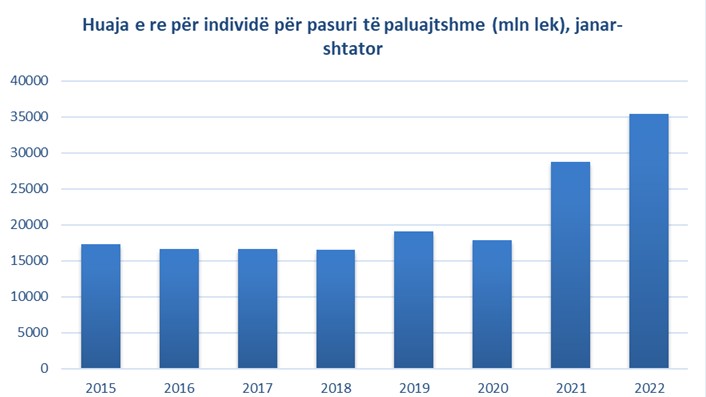
Data from the Bank of Albania show that new loans for real estate have increased significantly in recent years. For the 9th month of 2022, the loan granted by banks to individuals for the purchase of real estate reached 35 billion ALL (almost 300 million euros), twice as high as in 2020.
Money laundering in the eyes of legal experts
Legal expert and lawyer, Redi Ramaj, tells ACQJ that most apartment purchases in our country are made with cash.
"Most transactions in Real Estate are made in cash lek because it is evident from the low value that is declared in the contract for an apartment, although every day it has become more and more difficult to buy an apartment in Tirana, whether in the suburbs or in the center. In the center, prices have gone to extremes and some declared contracts that we have seen during processes or in court or other institutions, we have noticed that the transaction value is low, which means that part has been liquidated in the bank and the rest in cash," he said.
Despite this, Ramaj raises another concern where he states that the commercial loans received in the bank are at low levels.
"It's been a few years now and construction is at an all-time high, which means that builders have found other sources of financing for their construction beyond banks and loans, which means it's black money," he emphasizes.
Another aspect that is evident is the increase in prices, even though the average personal income is low, the price of apartments increases every day.
"There is a demand for buying because the price increases demand and supply, and the demand for buying comes only from the money that comes into the black market, because there is no possibility for the price to increase at this rate, so I think it is problematic," he concludes.
According to the Fischer Index of Housing Prices, calculated by the Bank of Albania, the average price of housing sold during the first six months of 6 has increased by 2022% compared to the previous six months and by 28.4% compared to a year ago.
Compared to 2013, when the Bank of Albania started calculating this index, prices have increased by about 110%. In the center of Tirana, prices fluctuate from 4000-5000 euros per square meter, within the yellow line 1200-2500 euros, and in the outskirts of Tirana it is no cheaper than 700-800 euros per square meter.
Ramaj 'accuses' the state as the main actor that has allowed the phenomenon of money laundering over the years. "The state itself and the government itself have tolerated the fact that these actions are carried out, whether by agencies or by individuals because there is an interest in this will to keep the economy alive and functioning, to allow actions that are understandable as tax evasion, that is, as a criminal offense. The economy is in a critical state and black money and I believe it helps the state at the moment and this is short-term, and in the long term this damages it because black money channels are created that will bring long-term damage to Albanian society", - Ramaj said to ACQJ.
Despite the situation documented by experts, national law enforcement agencies, international institutions, or even reports from organizations that monitor money laundering, for more than two years the government has been insisting on implementing a new initiative , which envisages the formalization of money of emigrants from abroad, through the implementation of a fiscal and criminal amnesty. This initiative has been opposed not only by economic experts, but also by international financial institutions , as too dangerous, and which paves the way for criminal money to be induced into the formal market.