Regina Pope
Every citizen in the Republic of Albania has the right to be aware of information and documents of any kind, excluding secret documents, personal data and trade secrets. This right is made possible through requests for information and the transparency program that must be found on the official websites of state institutions. The Transparency Program means that the institutions themselves make the documentation public without anyone asking for it.
The law, adopted 12 years ago, in 2014, aims to provide documents/information within a maximum of 10 days.
The law also provides for financial sanctions for officials who refuse or delay providing information.
However, according to data obtained from the Commissioner for the Right to Information and Personal Data, during 2025 the institution received a total of 897 complaints and issued only 33 decisions on 34 complaints. Of these, 20 decisions ordering the provision of information were issued, 11 decisions dismissing the complaint and 2 decisions with an administrative sanction, a fine.
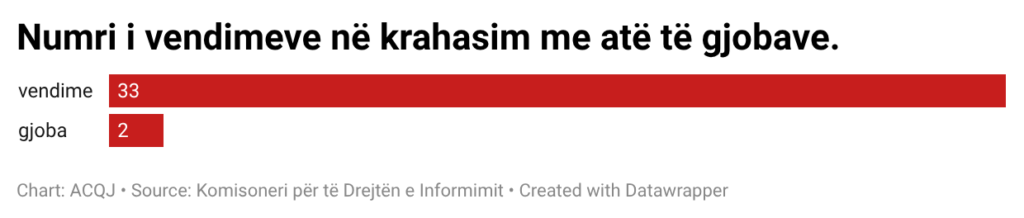
It seems that this new "weapon" of fines is not as effective in punishing cases of violation of the law.
Institutions are stubborn in implementing the law; delays, partial information, or lack of information...
Law No. 119/2014 requires that all information must be made transparent. From the monitoring conducted by ACQJ, 91 key institutions in the country, 61 municipalities, ministries and key agencies were taken into consideration.
From the observation made on their web pages, it results that:
Only 64% have a contact number displayed. And this is not always easy to find.
Email addresses are equally problematic and in 7 cases they were non-functional.
20% of institutions did not have a request register (as required by law) and only 38 of them had the responses posted there. And in those registers that were marked as written or downloadable, the responses were truncated and there were requests for which the response was not made transparent.
10 of the institutions lacked a budget completely. 1/3 of the other institutions had an incomplete budget, sometimes only recent years were available, and sometimes they were missing in order to have old documents published.
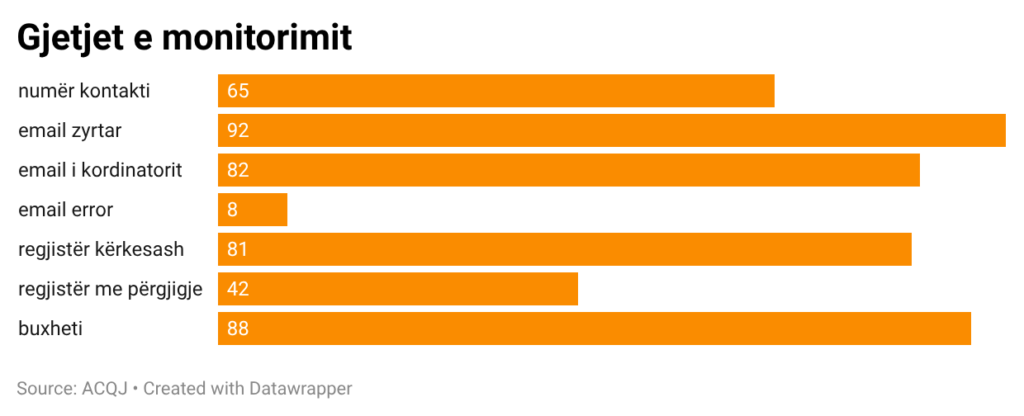
7 sites resulted without a transparency program. And many of them still have documents posted on their sites indicating that the program is expected to be launched soon…
The institution's email was in 92% of cases and the coordinator's in 82%.
Journalists face lack of transparency
Esmeralda Cenollari, a journalist at Faktoje.al, states that institutions, even when they respond, provide partial answers or without concrete content.
“In the case of Faktoje, our methodology requires that any information be based on the official position of the institution. During 2025, Faktoje.al has sent over 200 requests for information. Of the 183 requests addressed to Albanian institutions, most of the responses were partial, general or avoided the specific question. In 42 cases, journalists were forced to turn to the Commissioner for the Right to Information, testifying to the high level of institutional refusal.”
These delays harm the quality of reporting. Information that is received late loses its value.
The law guarantees public access, but the problem lies in implementation. Institutional practice shows systematic delays, lack of transparency, and repeated failure to provide information.
Regarding the transparency program, Cenollari says that in some cases it is functional, but often encounters problems: email addresses that do not work, lack of timely official responses to the program. Most institutions have the program published, but not always updated.
"The more sensitive the information, the more institutions refuse. We have often had to send requests for data that should normally have been published in the Transparency Program," says Cenollari.
It seems that the program is implemented more as a formal obligation than as a real instrument for informing the public.
Jessica Tollia, a journalist at Shteg.org, shares the same concerns, adding that there is a lack of willingness to provide information that is of public interest.
"From my experience, deadlines are partially respected. Responses come late, or after reminders, i.e. another email to "remind" the institution of the legal deadlines. The very fact that you have to complain to receive information that the law guarantees shows that there are problems in its implementation."
Regarding the effectiveness of the transparency program, Jessica says that the published documents are old, important data is missing, or the information is difficult to find.
Esmeralda Keta, a journalist for Top Channel, presents the same issues, proving that all journalists face the same obstacles regardless of the media they work in, whether online or traditional media.
"I can't tell you if there is an institution that truly respects deadlines and responds to the questions you have sent. Even in those cases when there are responses from institutions, it is difficult to find valuable information inside."
The transparency program, according to her experience, is completely fictitious and does not fulfill any obligation, leaving journalists in a difficult position to receive what the law guarantees them.
What do the numbers show?
Ilda Londo, research coordinator from the Media Institute, argues that the law is generally good, but the weakest link is the practices of the institutions.
"There are institutions that are more scrupulous and publish more complete information, mainly independent institutions. While there are other institutions that publish the minimum information required, or that do not update it," says Londo.
According to the latest monitoring published by the Media Institute on the “Implementation of the Right to Information in State Institutions”, out of 145 requests for information sent to various levels of institutions in the capital, responses were received in 90 cases, while in another 55 cases, the response was either refused or there was no response from the administration. So, we have 38% of requests that have not received any response. Results almost the same as in 2012, where only 60% of applicants received a response.
According to Londo, strengthening of implementation mechanisms and a more active role for the Commissioner are required, as well as more stringent measures against institutions that refuse to respond.
"I think transparency is a problem that goes beyond the media and relations with public institutions; it is a reflection of the lack of transparency in society on the part of institutions, the lack of accountability to the public, also strengthened by the culture of impunity built over the years," she says.
Lawyer Irena Dule from Res Publica, calls Law No. 119/2014 "On the Right to Information" on paper, one of the most advanced legal frameworks in the region.
"The main problem that remains is implementation. We are talking about a well-conceived law that functions poorly because the Albanian political and cultural context does not support it with the necessary institutional will."
Sanctions are foreseen, but rarely applied. When an institution refuses to implement even the Commissioner's own decision, the only option left for the citizen or organization is to initiate legal proceedings that can last over a decade!
The lawyer also points out another, delicate problem. The exceptions provided for in Article 17 of the law (classified information, internal decision-making process, etc.) are often used in an extensive manner, without carrying out the true “harm against the public interest” test that the law itself requires. This turns the exception from a narrow rule into a broad practice.
The Transparency Program, for him, is where the gap between norm and practice becomes palpable.
"In the vast majority of cases we have monitored, it functions as a formal obligation, not as a living practice. Our latest monitoring brings this inequality into concrete figures: only 13% of public authorities currently have a complete and updated register of requests according to the legal standard, while in local government this figure drops to almost zero. This clearly shows that the problem is not resource or technical, but institutional will and that the closer the institution is to the citizen, the weaker the real transparency is."
The greatest concern occurs under the citizen's nose, where he pays out of his own pocket and vital decisions are made for him.
On a formal and numerical level, Dule says the program has improved, and this in itself is significant. “Our latest monitoring shows that around 65% of information requests now receive a full response.
But this statistical improvement does not automatically translate into real transparency. Institutions have learned to fill in the boxes of formal obligations, they have a coordinator, they have a register of requests, they have a transparency program, but this does not necessarily mean that the information that circulates is in-depth, up-to-date or useful. And it is precisely in the “hot” areas, where the interest in transparency clashes with economic or political interests, that we face institutional resistance.”
The ResPublica report highlights several contradictions between what is officially reported and what is encountered on the ground. Dule interprets the decline in requests for information as a discouragement of the users themselves; journalists and activists in particular, who are tired of long and often ineffective processes.
The program is minimally complied with to avoid sanctions, not because it is seen as a means of building trust with the public. Last year's figures from ResPublica confirm this. Of the 861 complaints filed with the Commissioner, only 33 decisions were made, and of these only 2 ended with sanctions for refusal of information, compared to 13 fines imposed for mere formal non-compliance with the transparency program. The supervisory institution punishes much more often the form (have you published the program) than the substance (are you actually providing the information when requested).
“This becomes even more pronounced when it comes to “sensitive” information, where transparency would highlight economic or political interests involved in decision-making. This is quite topical today. We are in the third month of the “Flamingo Revolution” movement protests, and the main local institutions continue to fail to provide information on the projects in Zvërnec, precisely the ones that sparked the protests. If the law were implemented properly, these projects would have been made public from the beginning through the Transparency Program itself, without the need for protests or formal requests for information. The fact that even today, after two months of public pressure, basic information is missing clearly shows that the Transparency Program does not function as a conflict prevention instrument, it functions only as a formality for “peaceful” cases, and it completely disintegrates precisely where the public interest in having the information is highest,” the lawyer says.
Lawyer Dule suggests that sanctions in case of refusal should be applied automatically and systematically. She emphasizes that an end should be put to the extra-legal practice of the Commissioner himself, who today, in many cases, closes complaints without issuing a formal decision, despite the fact that Article 24 of the law obliges him to do so in every case of complaint for refusal of information.
Regarding delays, Dule proposes that court cases arising from failure to provide information should be tried in a single instance and with an expedited procedure. So that what the law promises actually happens in practice.”
When the right to information is protected only in form and alienated in content, the culture of accountability is replaced by that of concealment. If the Commissioner and the judiciary do not act as real guarantors of this law, the Transparency Program will remain a defensive wall for the administration and a dead letter for journalists and citizens. Public information is not a privilege granted by an official, but a right granted by law and guaranteed by the Constitution./ acqj.al