



Regina Pope
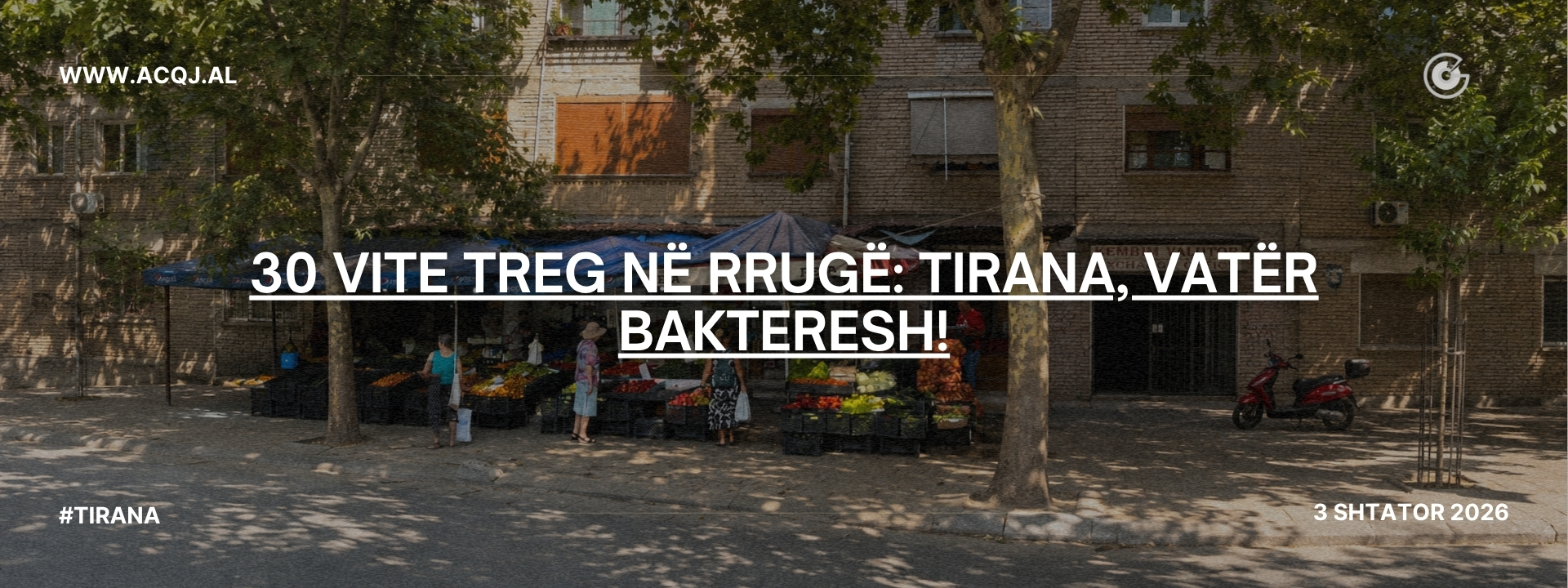
Milk under the sun, eggs without labels, fish without ice, and food products amidst dust and car fumes. This is still the reality in some of Tirana's food markets, some of which have been operating for about 30 years.
Many of them lack refrigeration conditions and basic hygiene standards, while products of animal origin remain among the most dangerous for the consumer. In the midst of this situation, responsibility seems to be shifting from one institution to another.
What should a market be like and what is it like here?
Milk shouldn't sit for hours at room temperature. But in some of Tirana's markets, it's sold just like that: on the sidewalk, under the sun, amidst dust, car exhaust, and street dirt.
In the Petro Nini Luarasi area, from the early hours of the morning, the sidewalks are filled with street vendors. In addition to fruits and vegetables, they sell milk, eggs and open olives in buckets. A few meters away there are garbage cans, parked cars and a constant stream of people passing by the food on display.
For food safety expert Granit Sokoli, from the ALERT Center, this is a battle that institutions have long lost.
According to him, the problem is not just the way these products are sold. In some cases, the questions start with the way they are produced and processed.
There have been attempts, Sokoli explains, to have the products of farmers and small traders collected and passed through factories, so that they could enter a more controlled chain.
"This failed because that small trader with little product sells a liter of milk on the sidewalk for a little more than when he takes it to the factory."
The other problem is that the consumer often knows almost nothing about the product they are buying.
"They are products without any kind of traceability, we don't know where that egg came from, if there are antibiotics, if the chicken was sick and was treated. They are animals that are uncontrolled, the product is uncontrolled, without origin, without a label. Those bottles do not meet any hygiene and food safety standards, so they are a bomb for the consumer."
But who should control them?
The National Food Authority does not intervene against informal vendors who do not have a NIPT. In these cases, responsibility passes to the Municipal Police. In the meantime, the vendors continue to be there.
"Who has the authority to control them? Because those people violate food safety and pose an absolutely serious risk to consumers," says Sokoli, who advises that especially products of animal origin should not be purchased under these conditions.
Then ask the simplest question:
"If tomorrow a consumer has a problem from that milk, who will be held responsible?"
Even for consumers, the appearance speaks for itself.
"You just have to look, there's garbage everywhere," says a woman who shops in the Petro Nin area, speaking on condition of anonymity.
But the situation doesn't end with street vendors.
At the Hamdi Pepo Street market, food products are sold in an almost entirely open space, without proper refrigeration or air conditioning. The temperature of the products depends largely on the temperature outside.
The market resembles a covered tunnel, which is partly in the shade. But the shops are open and many of the products are placed near the feet of the customers, exposed to dust and fumes.
"When it rains, the square fills with water," says Era, a resident of Selita who frequents the market.
Even the toilets are in poor hygienic and sanitary conditions and their smell is felt throughout a large part of the market.
In one corner, several buckets of chocolate cream stand on a shelf in direct sunlight. Below them are croissants, cakes, and other packaged sweets.
Professor Kapllan Sulaj, from the Department of Food Sciences and Biotechnology, says that exposure to the sun and dust is not simply an appearance problem.
"At the moment they do not seem to cause poisoning due to the high percentage of sugar, but we must bear in mind that sugars are a favorable environment for the growth of pathogens and microorganisms that require an environment with a high percentage of carbohydrates. Various processes may occur such as uncontrolled fermentation of these sweets or the production of various toxins."
Water and soda are also sold in cartons, one on top of the other. On one side of the sidewalk are glass bottles of alcoholic beverages. In another shop, a cardboard box of assorted cookies lies open on the counter.
Temperature, explains Sokoli, is one of the main elements that determines whether a product remains safe.
"Every food product has a certain temperature to be kept. Frequent changes in temperature also change their physical condition. Depending on the composition, there may be bacterial loads, various microbes, from time to time we see mold in some products. Temperature changes, humidity, sweat, water bubbles inside, and even the packaging, which is usually plastic, cause mold, larvae, flies or worms to start."
But these markets don't just supply citizens who buy directly there.
They also supply small neighborhood shops and supermarkets. The product may then end up on a clean, bright shelf, but the question remains: where did it stay before and in what conditions?
"Neither the storage conditions, nor the trade, nor the transportation are appropriate. Legally it is intolerable. We do not suffer because of the law, but because of structures that are problematic in our country, with limited resources of will and spirit to discipline the market," says Sokoli.
The problem continues even during transportation.
A product may have been well preserved at origin, but if it is then transported without the necessary temperature, the security chain is broken.
And milk is one of the most delicate products.
"Milk is the most delicate product because from the moment of milking, if it is not stored at 4 degrees Celsius, which is the standard for cold storage, it can change the microflora very quickly, it can increase the microbial load depending on the increase in temperatures. So, with its increase, the number of bacteria present in milk also increases progressively."
According to Sulaj, the cold chain must accompany milk all the way, from production to the consumer.
"Milk can carry many risks from pathogenic agents, but we can also have increased risks of a chemical nature, because milk remains one of the foods where there are many residues, antibiotics and hormones, of veterinary medications used in the treatment of animal diseases."
The same goes for eggs.
Sulaj says they are one of the main products that can expose consumers to salmonella, as poultry is one of its main reservoirs. When eggs are stored in inappropriate conditions, the risk increases.
In the Dinamo market, the problem is visible from the entrance.
On a counter there is chicken, sausages and fish. On a day when the temperature outside exceeds 35 degrees Celsius at lunchtime, the fish sits on a table, unfrozen and uncovered.
Next to it, unlabeled products are also sold, such as farm eggs or vinegar poured into small water bottles.
Mira, a woman who shops at the market, says she avoids such products.
"I don't buy these kinds of products. Logically, they keep them in the sun and are most likely spoiled. People buy eggs, for example, based on the idea that they are fresh and not from the chicken coop."
The problem is that storage conditions vary greatly from one product to another and the consumer is not always aware of them.
"Fresh fish should be stored on ice and its temperature should be 0 degrees Celsius and this should only be for a few hours, then it should be put at -18 degrees Celsius for longer-term storage," explains Sulaj.
Even meat, according to him, can only remain on the counter under controlled conditions.
"Meat on the counter can be exposed for 1-2 days at 4 degrees Celsius, then it must be put in -18 because it starts to spoil, changes color, smell and loses nutritional value. There it begins to compromise safety, decompose, and the meat load increases, along with the number of pathogens that may be present."
The same temperature requirement applies to dairy products and sausages, which should be stored at around 4-5 degrees Celsius.
But temperature is not the only problem.
"Air and dust pollution can also bring risks in the form of increased chemical contaminants, because the air can be polluted with heavy metals and other toxic agents that we are unable to detect with the naked eye," says Sulaj.
Only laboratory tests, he adds, can show what contaminants or risks a product carries that has been sitting for hours in inappropriate conditions.
And the consequences are not just theoretical.
Infectious disease physician Valbona Gashi says that during the summer, the consumption of poorly preserved meat, eggs, milk, and by-products is among the frequent causes of food poisoning and stomach and intestinal infections.
In more severe cases, the consequences can also affect other organs.
"Patients may experience fever, chills, dizziness, vomiting, abdominal pain, and diarrhea, which can be very watery and cause significant loss of fluids and blood salts."
Severe fluid loss can also affect kidney and heart function. According to Gashi, correcting electrolyte loss is crucial, especially in the most vulnerable patients.
"During the summer season, these cases are more frequent, due to high temperatures and poor hygiene and sanitation conditions. The most problematic patients are the elderly, babies, as well as patients with chronic diseases or those with immune impairments."
Checks: most only in one year
The appearance in the markets is one side of the problem. Data from the National Food Authority shows another.
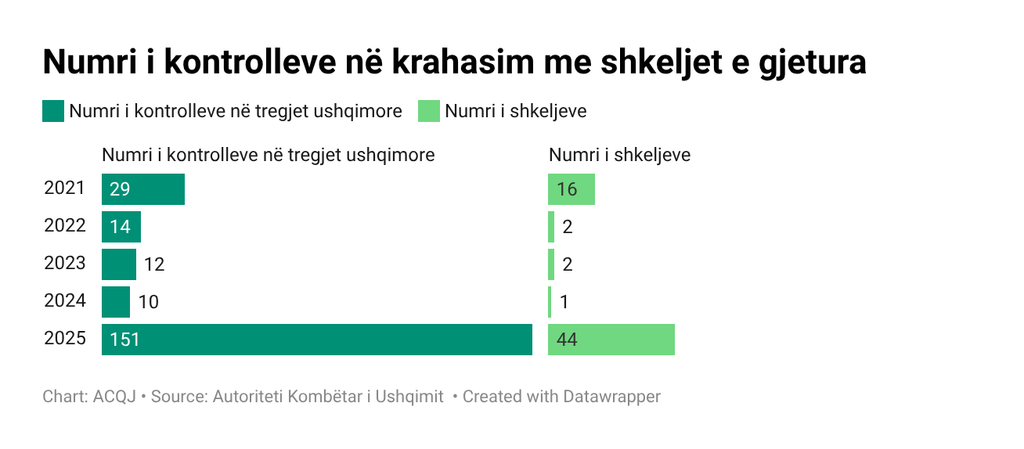
A request for information shows that during the years 2021-2025, a total of 216 inspections were carried out in the fruit, vegetable and food markets in Tirana.
But 151 of them were carried out during 2025 alone.
In other words, about three-quarters of all reported inspections over five years were conducted within a single year.
The violations found also follow the same rhythm.
Of the 65 violations found throughout the entire period 2021-2025, 44 were found in 2025 alone.
Among them are a lack of traceability, products without labels in Albanian, meat without a seal and veterinary certificate, lack of hygienic and sanitary conditions, problems with water analysis and health booklets.
Violations were found at the Agro-Food Market, the Kavaja City Market, the market at the former "Dinamo Factory", the market on "Hamdi Pepa" Street and the one on "Vasil Shanto" Street.
Warnings and fines have been issued to the entities, while in some cases products have also been blocked.
But for Sokol, interventions remain sporadic.
"There have been some very rare sporadic interventions, when there has been an alert, but the market, the company that administers the entire space, has never been fined for the conditions. The measures are never sufficient."
Who is responsible?
Here begins another problem: even institutions do not always give a clear answer as to who is responsible for what.
Asked about food markets, the Municipality of Tirana delegated the request to the Market Administration Agency.
The agency listed seven food markets: Petro Nini, 1 Maji, Food Market, Mixed Market of the Combine, 4 Dëshmorët, New Bazaar and the market on Pandi Dardha Street.
But then she stated that their certification was outside her competence.
In another response, the agency described them as markets with a plan approved by it and added Shkoza and Selita to the list, while Petro Nini was no longer listed.
For Sulaj, this ambiguity is part of the problem itself.
He says that there is a vacuum in the control of markets, where powers are sometimes attributed to the municipality and sometimes to the National Food Authority.
Meanwhile, the markets continue to function.
What should a market be like?
According to Sulaj, the basic requirements are not complicated.
"To license a market, there are several conditions. They must be built in open spaces, mainly in places that are not close to residential centers, they must be isolated from polluting factors, in green places where there is less pollution, in environments where there is less smoke."
A market must be covered, have appropriate counters and stalls, and, above all, refrigerators for products that need them.
"What we don't find," he says.
But Sulaj also sees a problem in the way traders are licensed.
The licenses are general and allow for "food trade," while the requirements for selling meat, fish, dairy, or dry goods are quite different.
"In many countries around the world, licenses are granted with restrictions because the natural person must first meet a series of standards for the marketing of those products that are specified in the license, which does not happen in Albania because the law has left it free."
For him, markets should be regularly inspected not only visually, but also for microbiological load, chemical residues and other hazards that cannot be distinguished without analysis.
Asked about the administration of the markets, the Municipality of Tirana delegated the request to the Market Administration Agency. The latter listed seven official markets in the capital (Petro Nini, 1 Maji, Tregu Ushqimor, Kombinati, 4 Dëshmorët, Pazari i Ri and Pandi Dardha Street), but stated that their certification is outside its competence.
She then described these markets as markets with a plan approved by her, adding the Shkoza and Selita markets, but without mentioning Petro Nini's./ acqj.al