


Regina Pope
14 protesters arrested on September 4 were released by the Court of First Instance of General Jurisdiction without bail. A large number of people are being taken without reason and the justice system finds no reason to keep them behind bars.
The scene that unfolded on Mine Peza Street during one of the last days of the protest was clear to any passerby: a young man was not fighting, not pushing the protective fence, nor throwing objects at the police. He was just standing close enough to document what was happening with his mobile phone. Suddenly, he became the target of a police officer, who approached him from behind, snatched the device from his hand and, within seconds, was helped by three other officers to forcefully drag him towards the escort car.
This footage, shot during the September 1 rally, is not an isolated incident. It represents a recurring pattern of behavior and proves that citizen gatherings during the so-called “Flamingo Protest” have exceeded all legal and professional norms.
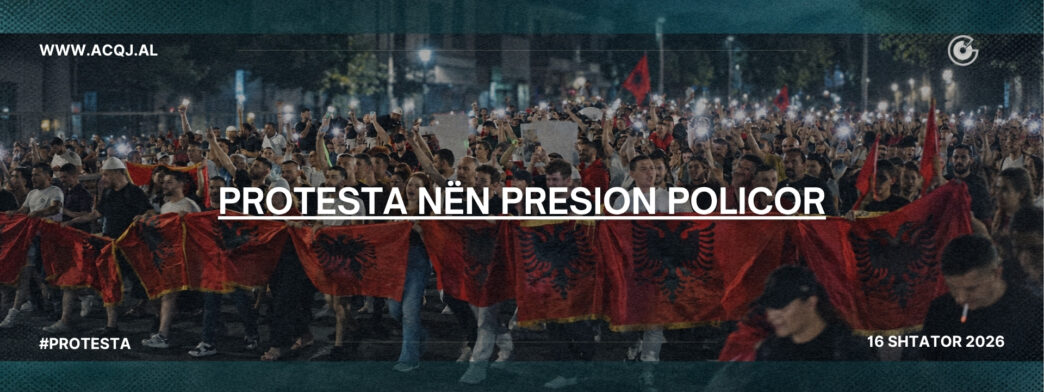
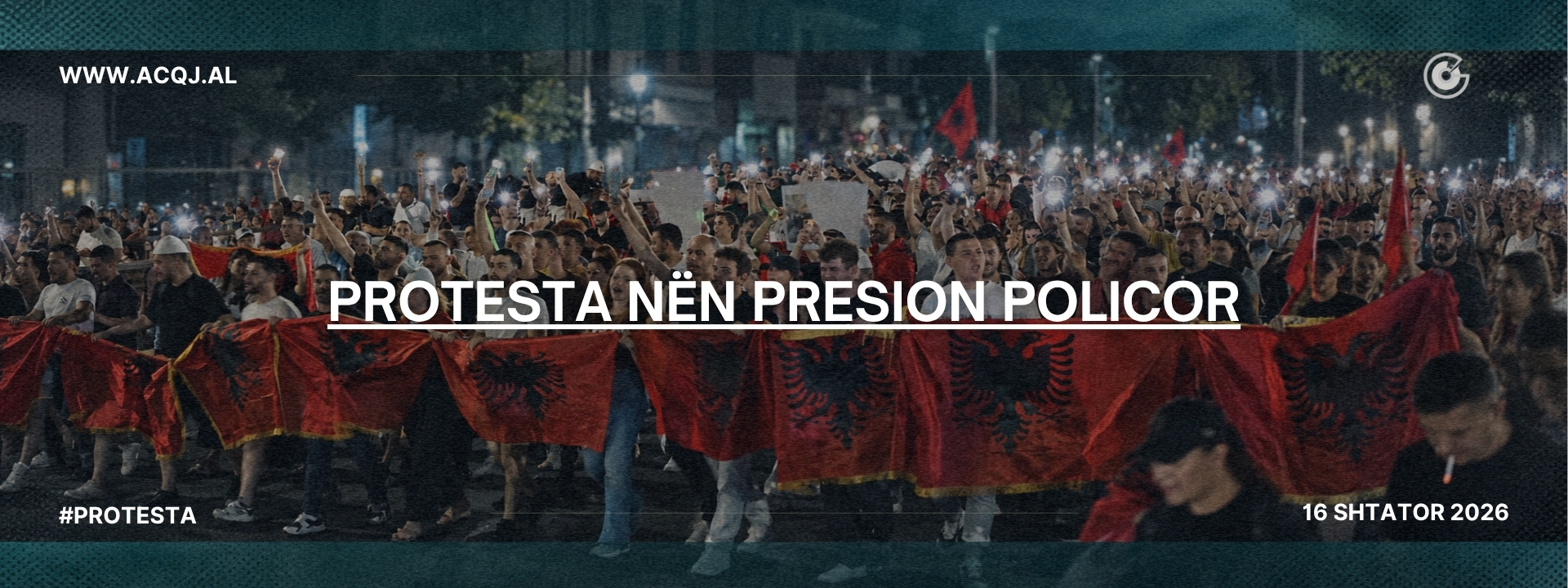
The daily protest, which came to life after the violence against a protester in Zvërnec three months ago, served as the initial spark that ignited this wave of civic reaction. Beyond its massiveness, this movement stood out as one of the most peaceful resistances developed in the country in recent years. However, what this long clash with the institutions proved, in addition to the determination of the protesters, was a bitter confirmation of practices that question the professionalism and impartiality of the police forces.
During this period, protest participants faced a disproportionate response. There were documented cases where citizens were dragged through the streets, physically beaten by police officers, sprayed with high-pressure water and pepper spray directly in the face, and escorted en masse to police stations without any clear legal justification.
Escorts as a form of punishment: Physical and psychological violence
Tensions escalated significantly in the days when the civic action moved to the Albanian Parliament building. The protesters' symbolic goal was to block the entrance for MPs and pelt them with eggs, as an act of civil disobedience against political decision-making.
Enes Keta, a 25-year-old who joined the protest near the Toptani promenade, recalls the moment when the situation degenerated into clashes with the police. According to him, it was the police officers who provoked the tension, aggressively pushing the crowd to free the passage.
Suddenly, Enes found himself facing an officer, who removed the protective mask from his face, which he had put on to protect himself from irritants, and emptied a bottle of pepper spray directly into his eyes and then into his body.
"I had terrible back pain. When I took off my shirt after a few minutes, I saw that I had burns on my skin. I was almost about to faint. I had to buy my own burn cream and eye medicine at the pharmacy, because the ambulance that was there did not have any kind of first aid for such cases," says the 25-year-old.
Although he was taken to the hospital in critical condition, his ordeal did not end with medical assistance. Five police officers waited for him outside the hospital to escort him to the police station, with the usual pretense that they were conducting a "routine check."
"The only person they took from the hospital was me. Two police officers grabbed me by the arms, while I couldn't even walk on my own, let alone run or pose a danger. At the police station they read me a list of 9 articles of the Criminal Code that, according to them, I had violated. I am currently under investigation at large, but without any concrete evidence. That day I didn't even have an egg in my hand," he testifies.
The scale of the charges against the young man was absurd. The police listed criminal offenses against him ranging from “resisting law enforcement” and “blocking traffic signals” to the serious charge of “organizing acts with terrorist intent.”
"Every time I asked for explanations, they deflected my questions. To this day I don't know the exact reason why I was detained," Enesi concludes.
This practice shows that the State Police, in many cases, have had no reasonable suspicion to detain individuals. Without making the violation clear at the time of handcuffing and using physical and verbal violence, the officers have kept protesters in cells for hours, simply to release them later without any measures or formal charges.
Activist Arnen Sula was also escorted to the police station by the "Eagle" unit, while peacefully protesting near the Namazgja Mosque.
"There was no specific motive. I simply heard one of the chiefs say 'take this person' and they put me in the car. All the way to the police station, the officers used abusive language towards me, even though I did not put up any resistance during the escort," says Sula.
In another case, Edison Likaj, an activist known for his presence in civic movements, was arrested in surreal conditions while giving a live interview for News 24 television.
"The protest was almost over. It was approaching 15:00 PM and we were leaving. At one point I heard the director of Police Station No. 1 say to his colleagues: 'Arrest this one too, take him with you.' My arrest was totally absurd, because I was outside any security perimeter and had nothing to do with the tensions of that moment," says Likaj.
The rape of journalists and inactive citizens constitutes another dark page of this operation. Journalist Loreta Koleci recalls the events of May 30 during the protest in Zvërnec, the day when a protester was dragged away by guards from a private security company, while the State Police remained passive.
During those moments, unidentified individuals from the private company tried to take the footage from Kolec's hand and then sprayed pepper spray in his face.
"I spent 3 days with a temperature of 39 degrees and severe burns on my face," she recalls.
Surprisingly, the same police who claimed they had no authority to intervene against the private guards in Zvërnec acted swiftly against the journalist herself a few days later. Koleci was arrested near Rinia Park after a protest in front of the Parliament.
"I was just hanging out in the park with some friends after work. They accompanied me to Police Station No. 2, even though I hadn't been to the protest at all that day due to my professional commitments," the journalist says.
The attempt to control the protests through violent means is also confirmed by the testimony of Jurgen Shperdhe, a young man who actively participated in the square.
"On July 23, we were in front of the Parliament, protesting demonstratively with eggs. After a few seconds of pushing against the police fence, the police started the water cannon. The water contained irritating chemicals. My eyes burned for about 20 minutes, until some protesters helped me by washing my face with milk," says Shpërdhea, insisting that force was used against the protesters even when there was no real danger to the lives of the officers.
Crowd Management: International Standards versus Albanian Reality
Security expert Fatjon Softa explains that modern crowd management protocols are not aimed at violently dispersing protesters, but at ensuring safety and managing the situation through communication. According to him, the use of improvised means, such as water cannons, constitutes a last resort and requires full transparency on the chemicals added to the water.
"Such means cannot be used collectively against an entire crowd, especially when only a small group of individuals commit provocative or violent acts," says Softa.
Regarding the use of pepper spray, the expert underlines that this tool should only serve to neutralize aggressive individuals and should never be used at close range, directly in the face, against peaceful citizens, journalists or people with health problems.
"The professional standard is clear: force is used in a proportionate manner against the individual who poses a direct threat and not as a form of collective punishment against the crowd. In a democratic state, protest is not a security problem that must be suppressed, but a constitutional right that must be guaranteed," Softa adds.
On the other hand, Citizens media journalist Erisa Kryeziu, who has followed every development of this movement step by step, notes that the move of the protest towards plenary sessions came as a need to hold MPs accountable in the face of citizen demands.
"The protesters' action was largely symbolic, but the police response was disproportionate. The number of officers deployed often exceeded the number of protesters themselves. The big jump was noticed when the police began to carry out aggressive escorts even in completely calm moments," says Kryeziu.
It shows that the police have not spared the elderly or children, using tear gas and pepper spray in confined spaces, as well as violently arresting citizens as they returned to their homes.
"The way these interventions were carried out raises major legal questions. The escorts were clearly used as a psychological tool to sow fear and repel popular reaction," the journalist concludes.
Legal basis and balance of arrests: What do the official figures say?
Statistics officially provided by the State Police reveal alarming figures regarding the police's approach to the right to protest in the capital.
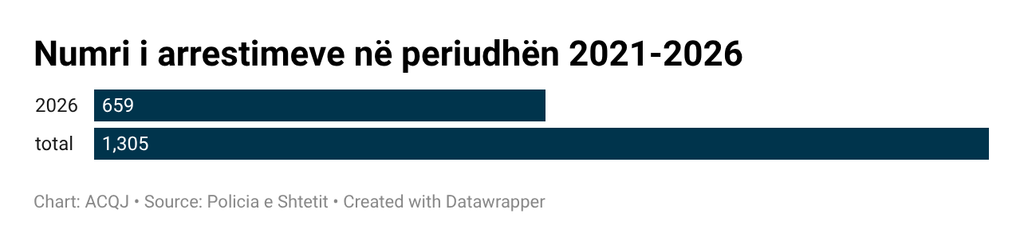
During the five-year period 2021–2026, a total of 118 protests were recorded in Tirana, during which 1,305 arrests or escorts were made.
What is striking is the fact that the highest number of rallies was recorded during 2026, with 52 protests held until the official response was returned. However, the number of arrests during this year constitutes more than half of the entire five-year balance, with 659 citizens detained.
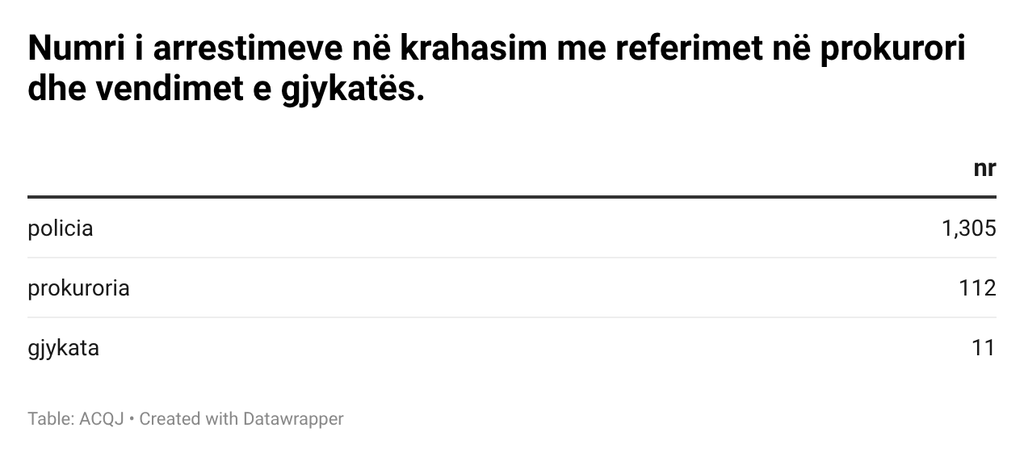
While the State Police reports over a thousand detainees, data from the justice system shows a completely different reality.
The prosecution responded that there were 112 referrals in the same period, 55 of which were made in 2026.
While the First Instance Court of General Jurisdiction in Tirana has issued only 11 final decisions for all these arrests.
Of these 11 decisions, 6 of them were absolute acquittals. All cases were related to Article 262 of the Criminal Code (“Organization and participation in illegal gatherings and demonstrations”). Meanwhile, for the arrests carried out specifically during the “Flamingo Protest”, the Court has not yet issued any final convictions.
Lawyer Gentian Serjani, who has taken on the legal defense of dozens of protesters, explains that in the hearings evaluating security measures, the Court has dismissed almost all the charges brought by the police.
"The court has dismissed the charge of 'participating in an illegal protest' for most of the protesters. The only charge that temporarily remains standing is that of 'resisting law enforcement', which is based exclusively on the statements of the police officers themselves and on no other evidence," the lawyer explains.
Serjani underlines that none of the protests held can be considered illegal, as the organizers have sent the relevant notifications to the police according to the law.
"In no case did the police use the megaphone to warn the crowd that the gathering was becoming illegal, as required by the regulation. Moreover, the reaction of citizens came only after the situation was provoked by violent police interventions," he says.
This list of violations was also confirmed by the Albanian Helsinki Committee (AHC) in its official statement dated July 24. After observations and interviews conducted with the detainees at Police Station No. 1, AHC found that the majority of citizens were escorted while they stood peacefully on the sidewalk, without blocking the road or engaging in any kind of violence.
"Keeping citizens in police stations for more than five hours without being informed of the charges constitutes a blatant violation of human rights. The law is being violated by the very bodies that are tasked with enforcing it," concludes lawyer Serjani.
In a system where protest is treated as a public threat and not as a constitutional right, the main tool of power remains fear. But the balance of the "Flamingo Protest" shows that arrests without evidence, spray paint in the face and arbitrary escorts have failed to deter the protest./ acqj.al