


Ida Ismail
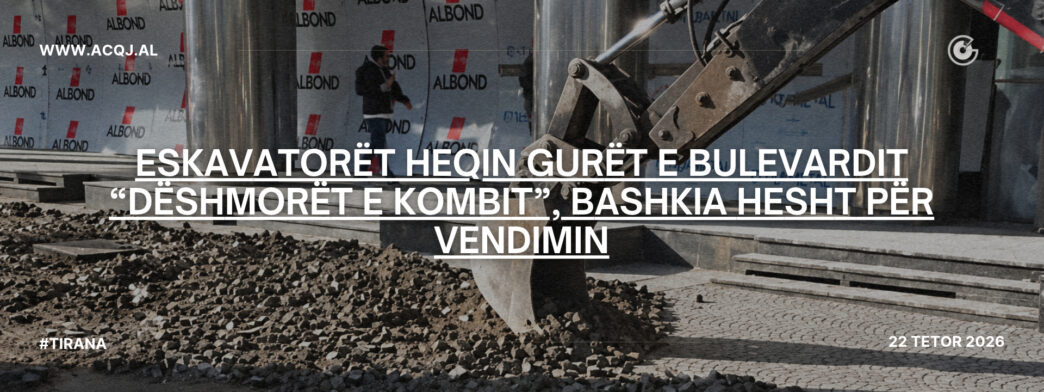
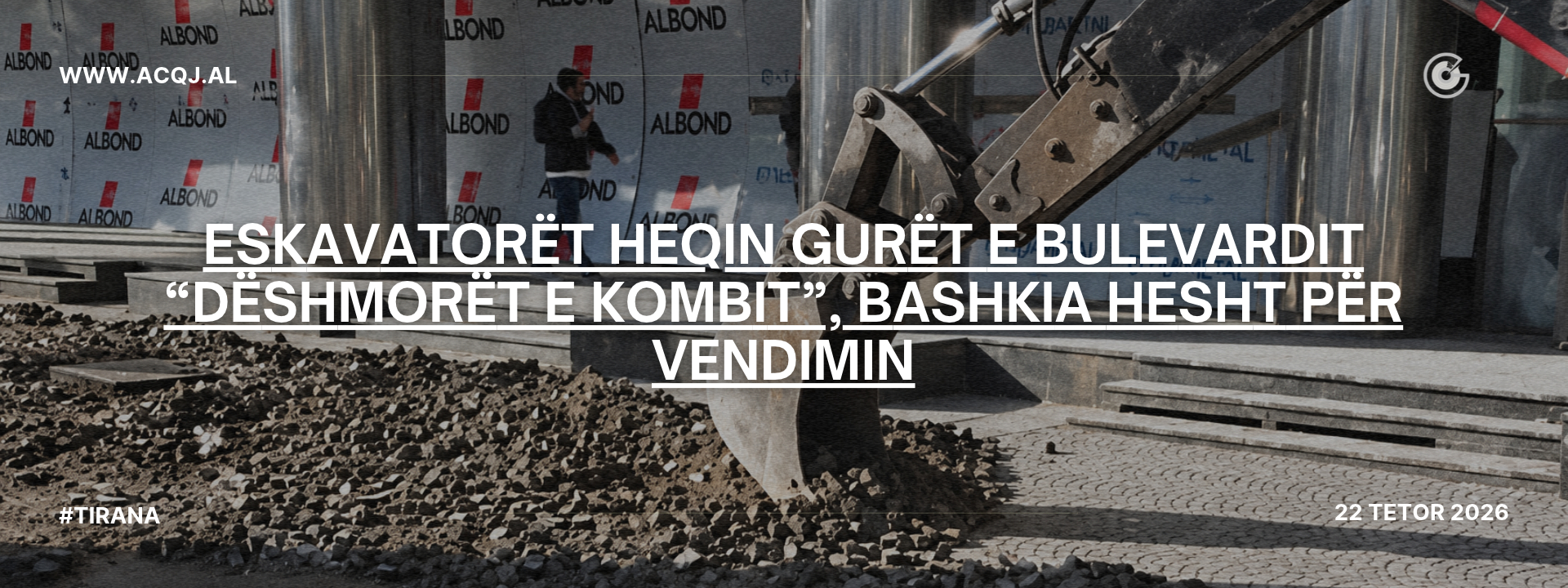
The paving stones of the “Dëshmorët e Kombit” boulevard, which were once laid as a symbol of respect for cultural heritage, were removed with an excavator. These pavements, which Edi Rama once defended with harsh political tones when he headed the Municipality of Tirana, were subjected to an intervention that raises questions about the way a protected monumental ensemble is treated. The reason was the protests, during which some of the stones were used to hit the police. But does this justify their removal and are the legal criteria for the protection of cultural heritage being respected?
The excavator collects the stones, while municipal workers remove the rest by hand. Footage from the “Martyrs of the Nation” boulevard on October 18 shows the encroachment on the sidewalks from which protesters had pulled stones to hit the police.
But the work was not limited to collecting stones thrown during the clashes. According to Euronews Albania, parts of the pavement that remained on the site were also removed to prevent their use in further protests.
Here begins the issue that the Municipality of Tirana has not yet clarified: how far does the cleanup after the protests go and where does the dismantling of a sidewalk within the city's Historic Center begin?
The municipality has not provided any clarifications for the article about who ordered the intervention and on what legal basis it was carried out. Questions about the affected area, the location where the stones were sent, and whether they will be re-placed also remain unanswered.
Protection that extends to sidewalks
The boulevard is part of a space for which the state has established special protection rules. The history of this status is related to various decisions in the history of this boulevard, the most recent of which is the decision of the Council of Ministers no. 582, dated 3.10.2018.
That year, the government approved the boundaries and the preservation plan of the Historical Center, expressly including the ensemble of the “Martyrs of the Nation” boulevard. The decision bears the signature of Prime Minister Edi Rama.
The plan allows for the rehabilitation of roads, but requires the preservation of the urban composition. For intervention projects in the road network, it foresees the involvement of heritage institutions, licensed designers and approval by the National Council of Material Cultural Heritage.
This makes it necessary to know what is being done with the sidewalks: are the damaged parts being temporarily removed, is the pavement being dismantled, or is its replacement being prepared? Each answer would also help to understand what procedure should be followed.
Footage of the excavators shows the manner of the intervention: quickly, at night and at sunrise, while the city sleeps.
Even emergencies have a procedure.
Clashes during the protests created danger to people and damage to sidewalks. But even in cases where a cultural asset is at risk of damage and urgent intervention is required, the law provides steps to be followed.
Article 78 of the Law “On Cultural Heritage and Museums” allows for temporary or preventive measures in exceptional cases. The owner or possessor must immediately notify the Regional Directorate of Cultural Heritage and, within 48 hours, submit the project and estimate or request for the final intervention. This provision is related to the risk of damage to cultural property.
In the case of the boulevard, it remains to be clarified whether this path was followed, whether heritage institutions were notified, and what they requested for the protection of the pavement.
ACQJ reached out to the Municipality of Tirana with a request for comment on this matter, but the response received up until the time of publication of this article was silence and the need for a longer time to communicate with the relevant structures, "due to the emergency situation."
The money that was raised for the boulevard
In September 2006, when Rama headed the Municipality of Tirana, the Municipal Council approved an additional 51.3 million lek for the reconstruction of the "Martyrs of the Nation" boulevard.
The money was taken from another public work: the fund for the reconstruction of the Zogu i Zi junction, including the underpass, was reduced by the same amount. Decision no. 52, of September 11, 2006, was approved on the proposal of the mayor, following a report from the General Directorate of Public Works.
The amount was additional for the reconstruction of the boulevard. The document does not show the full cost of the works, nor how much of it went solely for the paving stones.
It does, however, demonstrate a clear budgetary choice: The city shifted money from another project to invest in the boulevard. Today, the removal of the paving raises new questions about that investment and the costs that will be needed to restore the sidewalk to use.
What about excavators??
Some of the stones were uprooted during the protests. Others were removed during the municipal intervention. To understand what has been lost and what can be restored, it is necessary to know how much material was damaged, how much was preserved, and where it is located.
Even urgent intervention has obligations: Article 78 requires immediate notification to the DRTK and the submission of documentation for the final intervention within 48 hours. Works that exceed emergency needs and do not have approval are considered illegal. In these cases, the law also provides for the return to the previous state, at the expense of the person responsible and under the supervision of the DRTK.
If the removal of the stones was an urgent measure, were the heritage institutions notified and were they presented with documentation within 48 hours that determines what will be done next with the sidewalks? The municipality did not respond to this or to the question of returning them to their original state.
If the stones are to be restored, the municipality needs to clarify when and how. If they are to be replaced, questions lie with the new project, its approvals and cost.
Until now, beyond the silence, there is no answer: neither about who made the decision to intervene and partially destroy the "Martyrs of the Nation" boulevard, nor about the mandatory procedures to be followed, nor about what will happen in the future with this work declared on paper as a "protected monumental ensemble"./ acqj.al