


Author: Denis Tahiri
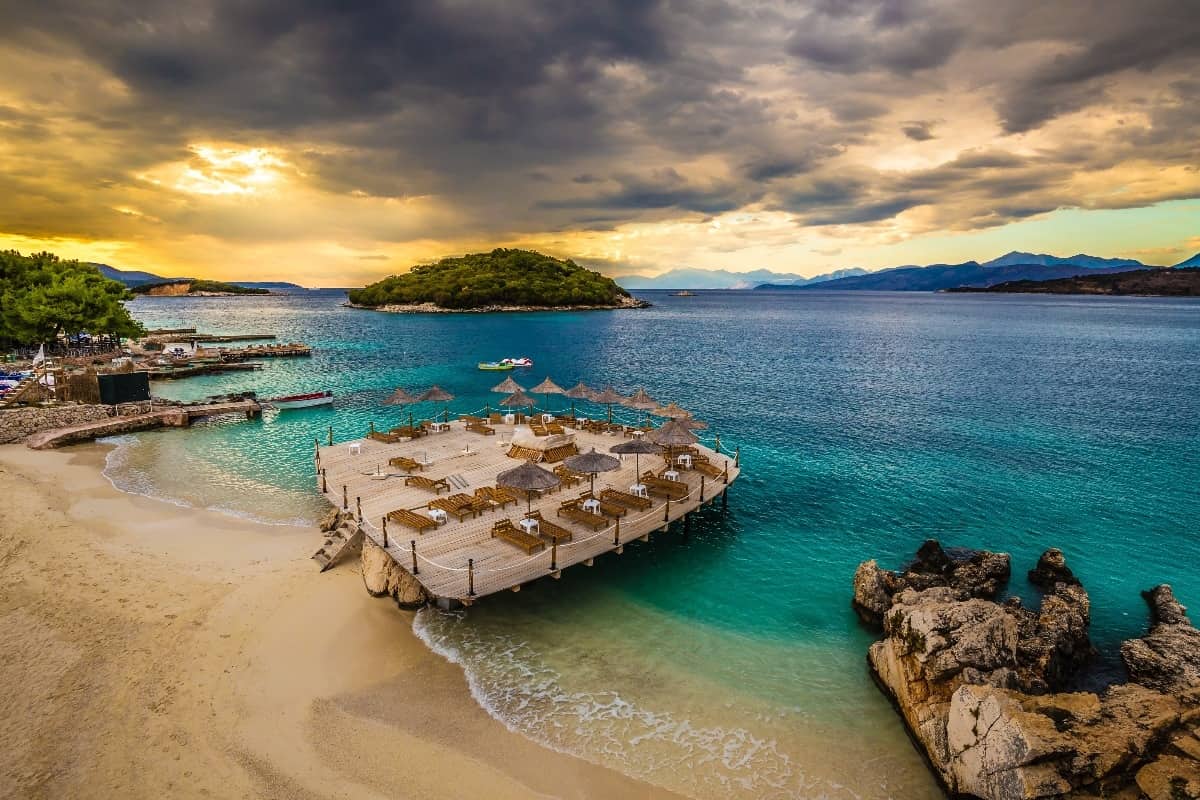
On July 1, 2017, Prime Minister Edi Rama would post a photo of the beaches of Ksamil, describing the southern town as one of the most favorite destinations.
" I wish you a good day with this fantastic view from the beach of Ksamil, one of the most favorite destinations of domestic and foreign tourists ," Rama greeted four years ago. But for Ksamil, it's not all good. While the tourism industry, which is the center of attention in this town, is facing numerous difficulties due to Covid-19, the beauties that attract tourists to the southern town are in danger and could disappear at any moment. Inert materials have been dumped in Lake Butrint, which have been sorted out, but the perpetrators of this act remain unknown. The same thing is happening with the beaches of Ksamil, where the fight to gain as much coastline as possible is also having a negative impact.
The lake is filling up!
Soraldo Nebo, a graduate of the Faculty of Foreign Languages, 31 years old, is one of the many young men and women of Ksamil who, after completing their higher studies in the capital, have chosen to return to their hometown to practice their profession. The first step he took was to unite young people in the enterprise of preserving Ksamil.
Association for the Movement for the Development of Tourism in Ksamil, opened its doors in 2016, engaging young people from different professions, but united by the goal of a sustainable tourism that helps Ksamil and the residents of the area.
" Regarding the association, we have clearly defined in the statute that the association will deal with any environmental problem in the Ksamil area. And for this reason we had a project, where we had two areas, that of Pallavraq and that of the islands. We signed a contract where we assigned an additional ranger to the AKZM", says Soraldo. In one of his observations, the ranger found that in the Pallavraq area of Lake Butrint, parts of the lake were being filled. The Ksamil Youth Association informed the National Agency for Protected Areas, which monitors the Butrint National Park, which also includes Lake Butrint. The filling of the lake with inert materials, which is located in a protected area, their arrangement and compaction were later described in the AKZM reports.
In the inspection report from the Vlora Regional Administration of Protected Areas, it is stated that on 13.03.2021 "We conducted an inspection in the Pallavraq area, where open and compacted urban inert dumping was found, where several trees were also planted throughout the area. This is located within the PK (Butrinti) protected area within the yellow line ." The alarm in the inspection report maintained by the Vlora AKZM specialists is further reinforced as the specialists admit that they contacted the local police who have not yet discovered the perpetrators since, according to their suspicions, the inerts were dumped at night.
Ping-pong for finding authors
Officially asked what steps have been taken regarding this issue, the National Agency for Protected Areas, the Directorate of Management, Projects and Monitoring at the Ministry of Tourism and Environment, states that it has communicated with the responsible institutions specialized in taking measures. " Given that the area where the intervention was carried out is outside the pasture and forest fund and is located within the urban area of the town of Ksamil, specifically with letter no. protocol 91, dated 02.04.2021 "Request for cooperation and taking measures", the National Agency for Protected Areas Vlora has addressed respectively: Mr. Ardian Gurma, in the capacity of Mayor of Saranda Municipality, Mr. Simbol Pazaj, Regional Director of the Regional IKMT and the Saranda Police Commissariat for cooperation in investigating the case with the aim of identifying the perpetrator and taking measures according to the legislation", states the official response of the National Agency for Protected Areas.
Meanwhile, in the documents owned by the Albanian Center for Quality Journalism, the Inspectorate of Territory Protection in the Municipality of Saranda, after an inspection of an unidentified subject, decided not only to demolish the illegal object and return the land to its previous state, but also to punish unidentified person. The decision turns out to have been signed on March 15, 2021.
A day later, another decision numbered 25 was issued by this institution, imposing a fine of 500.000 lek to an unknown address and an unknown offender, who it is noted could not be identified. “In the absence of an address and personal data on the offender where this fine will be executed, it is automatically invalid and unenforceable. This is a procedural fine ,” a lawyer told ACQJ.
AKZM, for its part, informs that the Municipality of Saranda has announced in the official letter-exchange that this case would be referred to the Prosecutor's Office of the Court of First Instance of Saranda.
Experts: The law has been violated, it should be taken seriously
"There was an occupation there, after the bases were laid, they were settled and trees were planted ," is how Olsi Nika, head of Ecoalbania, begins his description when asked about the laying of bases on Lake Butrint.
"It is within the protected area and the Butrint National Park has become a park apart from the lagoon, because it was an archaeological park and the coastline is also included ," says Nika, adding that with the recent decisions that changed the boundaries of the protected areas, the coastline has been halved by removing it from the map of protected areas.
"The very laying of the foundations creates concern about the imbalance of the lagoon's balance. Lagoons are very fragile ecosystems, the slightest impact of which can lead to total destruction. The integrity of the Park itself is destroyed. Therefore, the coastline is left and not interfered with at all. The ecological limiting factor of lagoons is the water exchange with the sea and fresh water, otherwise it is completely destroyed. And when you go and create even a small amount of pressure, creating other water flows, even more polluted water, imagine what can happen," insists Nika, emphasizing that the integrity of the park is destroyed.
Even for Shkëlqim Hajno, Executive Director of the Ionian Agency for Environment, Media and Information, the filling of parts of the lake will negatively impact the ecosystems in Lake Butrint.
" The ecosystems in Lake Butrint, as much as they are, are at risk due to insufficient oxygenation since a former flow that came from the Bistrica River has not been functioning continuously over the past few decades. So, living things are directly threatened, not just mussels. Lake Butrint is also a storehouse of other living things, such as crabs, various types of fish and various types of eels," Hajno declares.
In addition to this problem, even the beaches of Ksamil, enviable by thousands of tourists, are at risk.
"The beaches in Ksamil, what they are today, 90% of them are created beaches. So they were rented from the municipalities and then they were systematized, so they were dug up to increase the surface and ground sand was thrown, which impacts the entire area of the coastline and is noticeable to the naked eye, as they are usually thrown away during the day, considering the increased sensitivity, but also the tightening of the legal framework for environmental crimes. But this practice continues, since so far there has been no rigorous control by the government structure, such as the Coastal Agency, etc. ," underlines Shkëlqim Hajno, who points out that there is a total lack of signage in these areas. The expert emphasizes that awareness is not enough.
On the other hand, Olsi Nika shows that two very important Mediterranean ecosystems of rocky beaches in Ksamil have already been lost.
"The sea is divided into several layers, so the layer that we call the ticalittoral and the infralittoral have been completely transformed. The ticalittoral is the area between the sea and the land and is wetted only by the waves and there is a very interesting living world there and it is generally found only on the rocky coast. It has been lost. But the infralittoral, which is the part of the rocky coast that is covered and uncovered based on the waves and the ebb and flow, has also been practically lost," he says, noting that although it can be claimed that a layer of sandy fauna has been gained, it is not true since the thrown sand is not natural sand but obtained from limestone rocks.
"This sand, thrown into the sea, whenever it is under the effect of the waves creates a milky white turbidity, which reduces the penetration of sunlight, reduces oxygen and does not allow life to settle there. But also from the point of view of the beaches, you bathe in a calcareous sludge that has an alkaline effect even for your skin, which only corrodes it ," he concludes.
On May 14, 2021, Prime Minister Rama asked the State Police for an immediate launch of an action against illegal constructions, for the police and every responsible institution in the Ksamil area, the statement of the head of government has not yet arrived.