


Mira Aliu, a resident of the Roma community in Shkoza, tells about the difficult living conditions of her family. The lack of food, unemployment and the lack of the most basic things for daily needs have made these families turn to illegal work and not only adults, but also minors, who have left school banks and turned to garbage cans. This is due to the lack of support Services, which should be provided by the social center in Shkoza, but for this community they are non-existent.
For the residents, the biggest difficulty is the lack of canteen service, employment, enrollment of children in school and the lack of monthly assistance for families.
Mira is one of the many residents of this community, who talks about the lack of Services from the social center. She says that she benefits from nothing but threats from the center, where, among other things, she is told that if she goes out to beg, she will be arrested. Even when she asks for a solution, it is not given to her.
"I get nothing from that center. I take any of those meals any day, I don't take that every day either. Monday to Friday only, two bags for the whole house. Even those two bags are only two meals, which are not enough for us, there are 6 of us in the house, but there are days when they don't even bring us bags, when we go to the canteen, they tell us: "Go away, because we are coming to we bring you." And when they don't bring them to us, we go back to the canteen and they tell us: "There is no more food for today, it's over."
I have my eldest granddaughter with diabetes, and every time I ask for some medicine or diapers for the children, they tell me: "Go, work!", but I can't work, I'm sick myself, so what do I do? I go out and beg, but even to beg they don't let me, the police van follows me from behind and they take pictures of us. This director of the center comes to me with the photo and says: "Get out, you will be arrested!".

The Roma community in Shkoza is one of the few in the city of Tirana, where various Services are offered by the social center, relevant to these communities. These Services are offered by the Municipality of Tirana for the increase of social well-being and easier integration into the population of this community. In November of last year, the mayor, Erion Veliaj, declared that the Community Center, Shkoze serves more than 500 families through various Services. This service helps the whole community, both those in social housing and the Roma community in one-story housing.
But, according to the information of the Municipality of Tirana, the beneficiaries of these Services are 434 individuals, where only 171 of them are part of the Roma minority in one-story apartments. The families of this community are in a very bad economic situation and most of them, if not all of these families, depend a lot on the social center and the Services that this center offers and for this reason the Municipality of Tirana provides an annual budget with a figure of 33.4 million ALL. If we make a small calculation, the Municipality of Tirana pays 128.570 ALL per day for 100 families that are part of the community or 1.285 ALL per person for these Services, even though these Services are non-existent for the community.

One of the main Services that this community should receive is the canteen service. According to the employees of the social center, the service that is provided the most and that takes up the largest amount of the budget is the canteen, where from Monday to Friday about 330 meals are provided per day for the entire community of the social center, Shkozë. Of these 330 meals, 100 are for the Roma community of the one-story apartments. Above all, 100 of the 330 meals that should be provided for the social center are provided by the company Nelsa Sh.pk ., which has won the municipality's tender.
The photo below shows the rations provided by Nelsa sh.pk, for January 16, 2022, the service that takes up the largest part of this center's budget. The food consists of 27 rations, 8 loaves of bread and a small box of yogurt, which make up the 100 meals that this company must provide according to the tender.
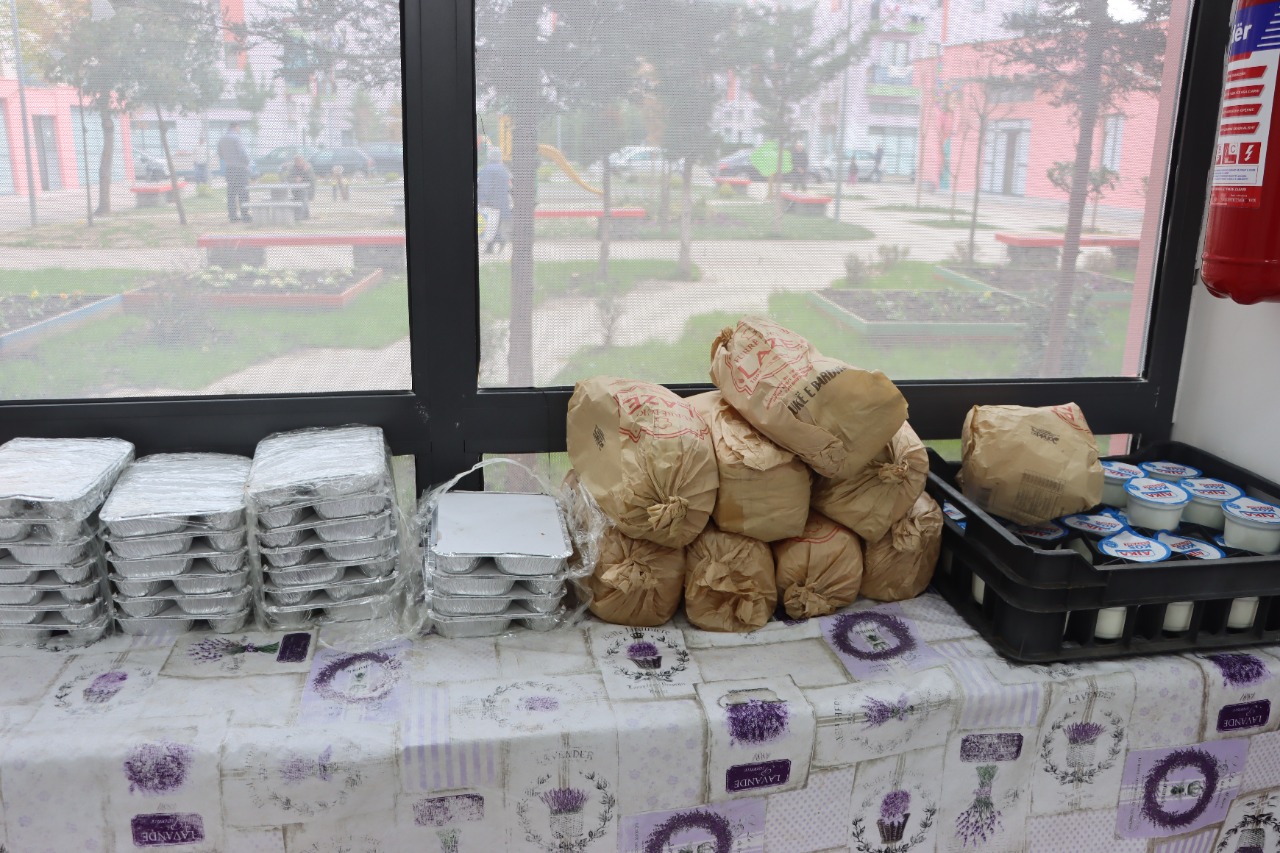
The food provided to the community comes mostly from the Firdeus Foundation , 230 rations that meet the needs of 334 other residents, so residents are given 3 rations for 5 people or 1 ration for 2 people. The lack of this service is also expressed by community residents, who indicate how important this service is for their families.
Engjëllushe Demiri says that she receives the canteen service only from Monday to Friday, only 3 portions, even though there are 5 people in the family.
"They don't count my husband. They tell me that it is not registered and, every time I ask for it to be registered, they tell me: "Yes, we will register it today". The meal is insufficient, but at least it is a meal, because we have nothing to do. We started working at the new clothes market, but no one was buying. It's a poor area here. We also had to pay the municipal tax and we couldn't keep the stall, so the man comes out, collects some bins or something else".
Besmira Brahimi has the same problem with registration at the community center.
"I have only been married here for a year and they only bring food for my husband, because they don't register me. I go there to the center, but again they don't do anything. We only get one meal each day and they don't even give us packages or anything."

Regarding the lack of food for the community and the insufficient rations from the company that won the tender, we sent a request for information to the Municipality of Tirana, but until the publication of this article we have not received a response from this institution.
Another disappointment for them is the lack of food packages, a service promised by the Municipality of Tirana, but which, according to residents, packages are offered by the municipality and by different organizations on occasions of holidays or different needs for the community, but the center does not distribute them to have them for emergencies.
According to the municipality, 5 food packages are sent to the Community Center, Shkoza every month or 60 packages a year, but residents say otherwise. The residents say that they did not even receive a package for the holidays, only the residents near the social housing received packages.
Leonora Ismaili, one of the community residents, says: " We didn't receive any packages, but even when we do, we are afraid, the pasta is expired. I don't want much food, I just want diapers for the children or some medicine. I go to the director's office and she says: "We don't have any," but the boxes in the back are full ."
To confirm this, we knocked on the director’s office, but she was not present and, after speaking with the staff, they told us that they themselves, as a center, do not provide aid packages, but distribute packages donated by various organizations, such as SHKEJ , Plan & Go and ARSIS . Asked about the packages, which the municipality states are delivered to the center every month, the center staff had no answer.
One of the most important Services that this center should offer is the registration of children in schools and educational institutions, as well as educational support after school. Evidence has proven that the education of Roma children is key to breaking the cycle of social exclusion and ensuring they are able to develop and progress in life effectively.
According to a community survey, only 4 out of 46 children attend school regularly, most of them are not in school, but on the street. Children do not go to school due to discrimination and economic difficulties, they are forced to go to the streets to provide one more meal for themselves and their parents.
Esmeralda Aliu says that, even though her daughter had finished preschool and she prepared all the documents for her school registration, the center did not register her daughter.
" They didn't explain much to me. At first they told me: 'Bring the documents' and I took them to them and, when they came and brought the books for the first grades, they didn't bring them for Erato, my daughter. I asked them where the books for the girl were, they told me: 'She's not registered for school, next year now'. I'm a widow and I have to go out and beg. My husband died because he got electrocuted while working on the wires, I can't leave my children alone, but when I take them to beg, I'm afraid they'll take them away and take them to an orphanage, these are the only ones I have."
Child self-employment in the black has led social Services to remove some children from their families to an orphanage due to parental neglect.
R.XH., mother of 5 children, tells how her son, Arbr, was taken by the social Services, because he was forced to rummage through the bins to sell cans.
"The children go out to work, sell cans, cans or beg, wherever they can find them, as long as they have the opportunity. They took Arbri from me, one of the older boys, the social workers. He's been there for about 3 months, but they want to take Marcel, the little boy, too, because he was photographed a couple of times on the street by the police. I have nothing to do, my husband doesn't work for me. What do I get when I beg... What can I take them to school with? I have nothing. At least the children on the street work, get some money, eat something."

Most of these families ensure their survival through informal self-employment - an activity impossible during this period due to the measures taken by the Municipality of Tirana for these activities, which, according to activists from the House of Hope organization (a Christian organization focused solely on helping this community), this initiative has left the residents of this community without any income.
Alison Kemp , director of the House of Hope organization , has indicated that it has become very difficult for the Roma community in Shkozë to secure income.
"They usually do dirty work, such as collecting metals, cans or begging, but in recent months they have not allowed them to beg or collect cans, taking away the tools they work with or even following them from after, with the threat that they will be arrested. I agree on one point, that they shouldn't do these jobs in the dark, but when they don't find jobs or don't support them with economic aid, it's difficult for them too. Our organization tries to help them with the preschool project, with different projects for men or women, but we are a small, local organization and we cannot do much for them".
The Roma and Egyptian communities are among the poorest, most marginalized and socially excluded groups in Albania. According to UNDP, studies show that the poverty level in Roma communities is twice as high as the majority of the population in the country. Low levels of educational attainment, high levels of unemployment, low monthly incomes, extreme living conditions and direct and indirect barriers to accessing public Services are indicators that prevail among the majority of Roma and Egyptians. For these reasons, these Services are very important for this community, to make the integration of this minority in society as easy as possible.