


Author: Klevis Paloka
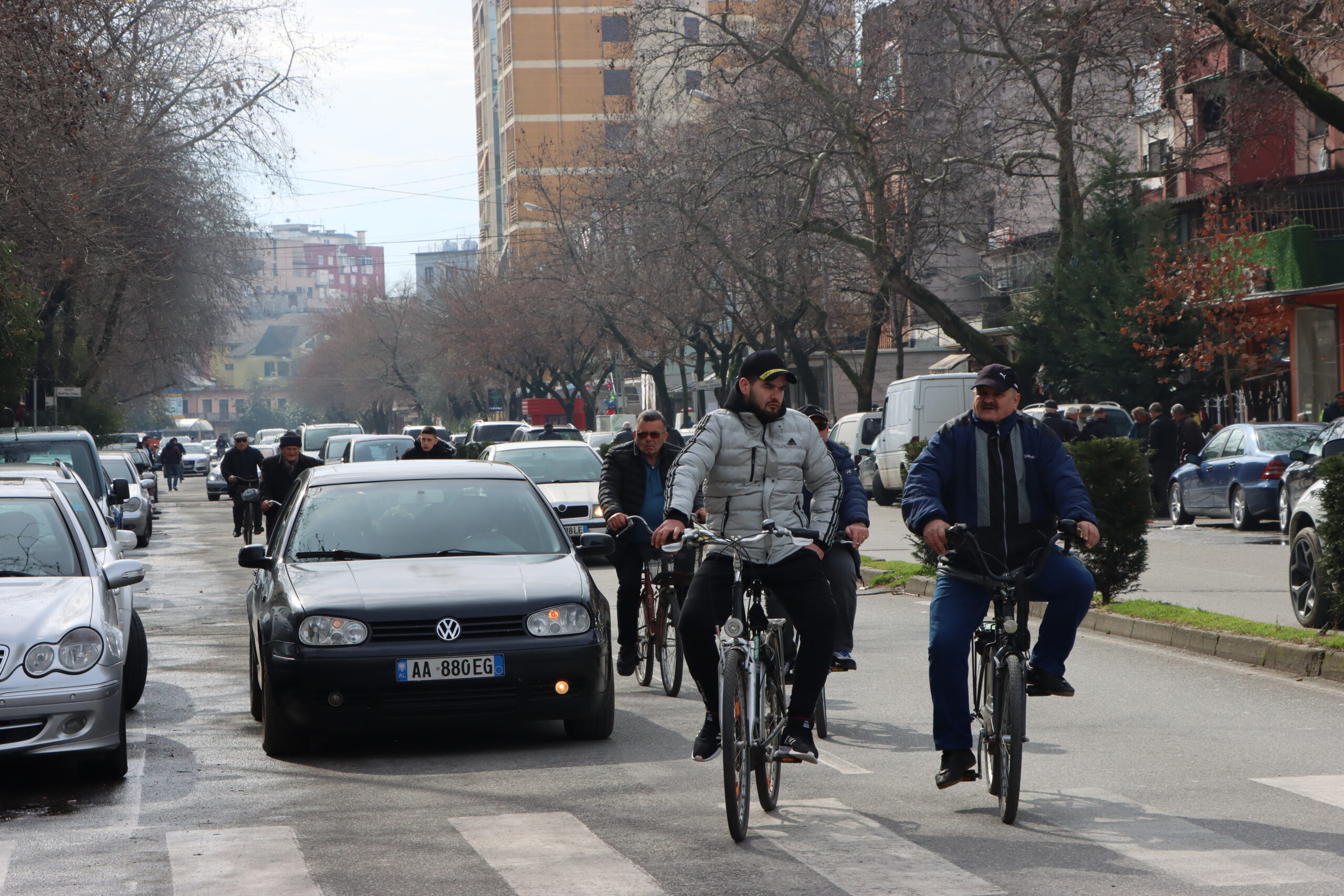
As soon as you enter the city of Shkodra, the first element that catches your eye is the massive use of bicycles. Through the vehicular traffic, on every axis, citizens of various ages, women hurrying to work and citizens carrying out the shopping rush to their daily routine by pedaling. Others cycle to the main points of the city. Since 1907 when the honorary consul of Sweden in Shkodër brought a bicycle from abroad, this strange vehicle since this year has become the symbol of the city and the most used vehicle of every season. So much so that it seems that this trend has turned into a local expression "You're not Shkodran if you don't have a bicycle at home", says a Shkodran pedaler with a smile.
Pedalers at risk
But even though every resident of Shkodër has a bicycle, a glance with the naked eye is enough to understand that there are no dedicated bicycle lanes in Shkodër. Despite decades, no one has kept their promise to make the bicycle city safer for users. Despite this situation, nothing has stopped the citizens of Shkodra from continuing to pedal in the city and having this vehicle as their first choice.
Zefi, an 80-year-old man who has been using a bicycle as a means of transportation for 7 decades now that he is retired, emphasizes that he is forced to move on the road of cars.
" We are forced to walk in car lanes, because we don't have bike lanes. I know it's wrong, and at my age I become an obstacle for drivers, who have to wait for me until I cross from one side to the other. We are also forced to walk in areas designated for pedestrians, but we have to cross somewhere because bicycles are a sacred thing for us Shkodra residents ," the elderly man emphasizes for "Sinjalizo".
Unlike the 80-year-old, for Muhameti, the bicycle is the vehicle he uses to go to work, while he adds that none of the mayors, even though they promised to do them, have forgotten them as soon as they came to power.
" For me, the bicycle is a work tool, as I go to work every day. We have been accustomed to the lack of bicycle lanes since I started pedaling. We know that it is wrong to move on the road of cars, but we are forced to have nowhere to go, since we also have to move somewhere, because we cannot move on the sidewalks because of pedestrians, and we are forced to move on the main road. The municipality has never decided, they do not even think about this, even though everyone has promised that we will make bicycle lanes. As soon as they get the chair, they forget that we need them," the 45-year-old says to "Sinjalizo".
Sakaq Shpresa, a young mother, is one of many citizens who use a bicycle to send their child to kindergarten and school.
" I use my bicycle to take my little child to and from kindergarten. Every day is a big risk for me, because in addition to my life, I also risk the life of my child, but we are not doing anything wrong. The biggest fault lies with the local authorities, who should at least install bicycle lanes near kindergartens and schools ," the 29-year-old tells "Sinjalizo".
When asked about this issue, Shkodra Municipality states that there are dedicated bicycle lanes in the city of Shkodra. It is also noted that the general local plan foresees bicycle lanes for each main axis.
" The General Local Plan (GLP) provides for bicycle lanes for each main axis. So, for each reconstruction or construction of each axis, the respective lane is also built. Also, based on this document, the Traffic and Mobility Study Plan has been prepared, which provides for the management of existing roads, remodeling their use with more spaces for bicycles. However, since urban mobility is complex and also includes the problems of car movement, in particular the management of parking lots, the Municipality of Shkodra is drafting the Parking Lot Management Plan.
The center of Shkodra is developed in an area with a radius of 500 meters, while the entire city of Shkodra is developed in a radius of 1.5 km. Based on the calculations made by experts in the field, the walking speed is about 5 km/h and the bicycle speed is 12-15 km/h, the walking time is from 6-18 minutes and the cycling time is from 2,5 -7,5 minutes per case.
Above, we inform you that there are functional routes for bicycles. The existing bicycle lane network is about 23 km. This network consists of the internal and the external network. The internal network consists of the following axes:
- Buna Bridge-Xhabije Square-Zogu i Parë Boulevard
- Mehmet Pashë Old Street
- Daut Borici Street
- Eastern Ring – Western Ring
- Shkodër-Shirokë road
In the last 5 years, bicycle lanes have been added to the axis of the By-Pass along Shkodra Lake in a length of about 5 km for each direction of movement.
The Municipality of Shkodra has not provided direct financing only for bicycle lanes. As part of the maintenance and reconstruction works of the road system, part of their projects has also been the creation of bicycle lanes through their opening and marking with signage. Soon, a bicycle lane along the lake (Shirokë - Zogaj axis) will be added, this integrated into the project for the complete reconstruction of the road , "said the official response of the Municipality of Shkodra.

And precisely in this answer, an important point is highlighted: " The center of Shkodra is developed in an area with a radius of 500 m ", but even though the Municipality of Shkodra emphasizes that it has added lanes, precisely in the city center where the main state institutions are located, where the mobility of citizens is greatest precisely in this area, the Municipality of Shkodra has not taken any action to install dedicated bicycle lanes.
But even on some of the roads where these lanes are placed, the monitoring shows that some of them are blocked by cars, who see them as parking spaces.

So the greater flow of pedalers in the city center where there are no dedicated lanes is also emphasized by a sustainable urban movement plan Shkodër Municipality (2017-2025) drawn up by the GO2 Organization.
" Regarding the measurements of the flow and structure of traffic in the city of Shkodra, it follows that the number of cyclists is quite large and reaches over 22%. In less attractive areas, the inclusion of bicycles in the overall traffic structure varies from 14%-20%, while in the city center area it reaches 25-35% ," the plan states.

This plan also clarifies another point, where it ranks Shkodra in the fifth city in Europe, where before it there are European cities such as: Bolzano, Munster, Copenhagen and Groningen.
" For decades, Shkodra has been known as the city of bicycles. According to the study developed by the Mobalb project, bicycle travel is 29% of the total mobility in the city, ranking it alongside several other European cities that have a high percentage of bicycle use for daily needs and qualifying it as the first Bicycle Champion city in Southeast Europe ," the plan states.

The leader of the "Eko Mendje" organization, Mirsad Basha, describes the lack of bicycle lanes as a long-standing neglect that has also come as a result of Shkodra citizens not raising their voices.
" There are various policies that the Municipality should have created, but in fact they have not been created. They have not been created because there has been a long-standing neglect of this problem, given that Shkodra is the city of bicycles, at the same time in Shkodra homes there are over two bicycles. So a family can have 3-4 bicycles, then we have accessible bicycles, we have a bicycle culture and since we have a bicycle culture, we have never had a problem with bicycle mobility. So we have bicycles in our daily lives, having them, then the various municipal policies of the local government have not seen it as a problem. This is very wrong, having advantages on all sides, municipal negligence has been seen in not creating bicycle lanes ", Basha says for "Sinjalizo".
But Basha shows that as a reason for this there have been accidents, this is also a consequence of the lack of culture by Shkodra pedalers.
" Accidents have increased because the population has grown, as the population grows, cars also grow. Shkodra is a border point, there are four border points, which are Hani i Hotit, Muriqani, the Vermoshi part and Komani, and being such a large border point and being a tourist point, the mobility in cars is very high. Being so large, traffic also increases and being so, as a result, there has been an increase in bicycle accidents where there have also been deaths in bicycle accidents that have occurred in the city. Without wanting to blame anyone, but these are the consequences of not having dedicated bicycle lanes. Cyclists in Shkodra have no culture of cycling at all and this comes as a result of the lack of bicycle lanes ," says the director of "Eko Mendje".
But even from the monitoring done on the main streets in the city, we witnessed several dangerous cases created by pedalers by interrupting the road, or entering intersections and roundabouts without looking at all for cars.
Dangerous roads for cyclists
From the statistics of the Shkodra Police, it appears that in the last 5 years, 14 accidents have occurred in the city of Shkodra, with 6 victims and 5 people seriously injured.
" During the past 5 years, 14 accidents have occurred, involving bicycle drivers. Of these accidents, 6 resulted in death, 5 resulted in serious injuries and 3 resulted in minor injuries. Of the 14 accidents that occurred, 5 of them involved violations involving bicycle drivers ," the response from the Shkodra Local Police Directorate states.

According to Road Safety experts, dedicated bicycle lanes are a legal obligation.
" The Albanian Road Code, in law 8378, dated 22.07.1998, clearly defines where bicycles should circulate, they should circulate in those places where it is reported and every entity, road owner, who owns the road must create bicycle lanes. So that cyclists do not circulate in the car's path, there must be special lanes for them to move. When bicycle lanes are missing, they must make it possible for them to circulate as close to the right side as possible, because they are considered as a road vehicle, as a vehicle, so as a road vehicle, as a motorcycle, as a bicycle, as a car, they have the same rules on the road, all the rules apply ", says expert Fisnik Zicishti.
Experts: lanes are a legal obligation
Although the Road Code clearly states it, for the expert Fatmir Hasho dedicated bicycle lanes for a city like Shkodra are an obligation.
" Dedicated bicycle lanes for a city like Shkodra, which is also known as the city of bicycles, are not only a legal obligation, but also a moral one, as this city needs these bicycle lanes ," says expert Hasho for "Sinjalizo".
But the leader of "Eko Mendje" emphasizes that for many years he has been making various protests and advocacy for this problem, but that they have fallen on deaf ears.
" The solution is what we have always sought, we have made many advocating, various protests. We have often raised our voices to make bicycle lanes or those bicycle lanes that are in the city respected and especially blocked by cars that park in the bicycle lanes. It is known that in Shkodra it is not that there is no bicycle lane, it may be a very small lane that does not match the population and mobility in the city. Even the few lanes that we have are blocked by car parking. So we have raised our voices to free these up, but we have also asked the Municipality of Shkodra to add bicycle lanes. In every electoral campaign, such as those for the municipality or for MPs, we have asked both parties to make policies for bicycle lanes ," insists the representative of "Eko Mendje". He adds that if this continues, we risk losing this culture or even becoming a bicycle city.