


Author: Denis Tahiri
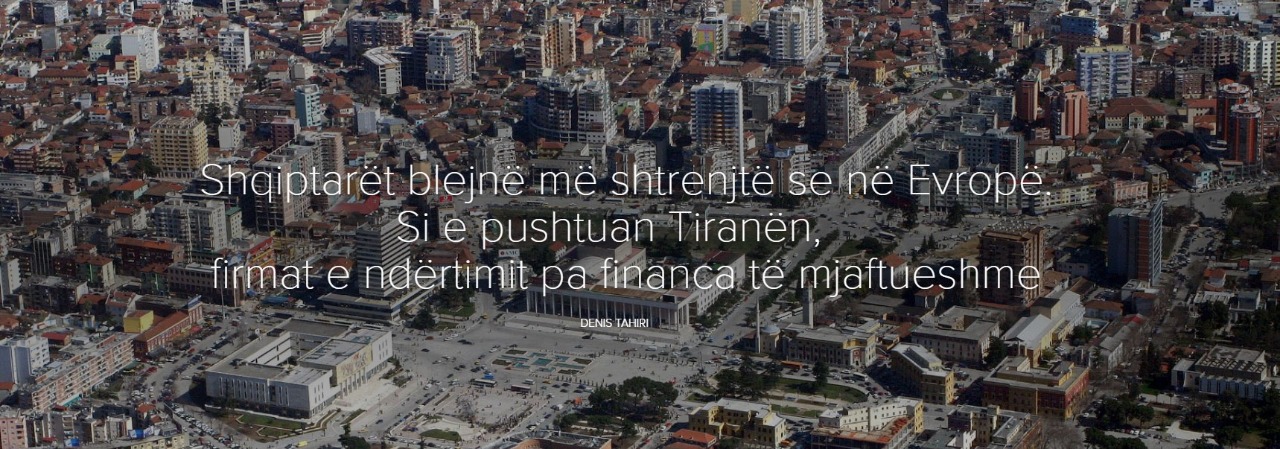
Endless real estate agencies tempt you with prices that are by no means a bargain. A house on "Mine Peza" street is offered online for 1400 euros per square meter. Near "QSUT", apartment for sale 900 euros per square meter. A simple search on Google is enough to confirm that dozens of apartments with unrealistic prices remain in stock due to the salty prices that continue to rise not only in Tirana, but in every city.
"This comes from the many requests" - explains Leda - a sales agent who earns her percentage for each successfully completed contract. Especially at a time when buying a home continues to be one of the main goals of Albanians, stemming not only from tradition, but also from considerations of greater security.
" I have been working for over 8 years and have paid rent to live in Tirana during these years. I thought that at least I would pay the lek I pay for rent as loan installments and in the end the house would be mine," says Igli, a 30-year-old with a degree in IT, who does not hesitate to show his disappointment after he started looking for an apartment in the capital.
"In the suburban areas, the price per square meter ranged from 750 euros when it was under construction to 1000 euros when it was finished, and that was in the best case. So a 1+1 apartment, as we usually call it, went for somewhere around 40-50 thousand euros. And when you add the bank interest and all the costs for the loan procedures, it is something that you realize is almost impossible, when you get a salary that ranges from 700 to 1 million old lek ," says the young man, adding with humor that if you want to buy an apartment closer to the center, you will have to work your whole life to repay the loan that, according to him, is holding your life hostage.
But Igli is one of dozens of young people who want to capture Tirana through a house, but who is financially unable. For this reason, unlike the phenomenon of immigrants who, despite living far away, buy a house in Albania, others depend on credit. Out of 100 Albanians, 88 of them stated that they find it impossible to buy a house in a questionnaire conducted by the Bank of Albania in the index that it compiles for business and consumer confidence indicators.
On the other hand, in times of crisis, the spending of money by citizens decreases, but even though during the crisis caused by COVID-19 many sectors of the economy recorded a decline, the real estate sector recorded another record. According to INSTAT, for the 9th month of 2020, property transactions reached the value of 612 million euros.
We are not yet in the EU, but prices are more expensive than in Milan
Juliana Nela, master broker at one of the largest real estate companies in Albania, says that Tirana offers a wide range of prices. "They start from 700 to 3500 euros per square meter, with new projects from international studios in super-preferential areas, where construction has been prohibited until now," she says.
And from the research of the Albanian Center for Quality Journalism, it turns out that the price per square meter in the capital is different. But it almost never goes below 700 euros, even when the purchase is made at a time when the building has not yet begun to lay the foundations.
The areas with the cheapest prices in the capital are that of Kashar, Yzberishti and a part of Astir, New Boulevard and Fresk. In these areas, the price ranges from 700 euros to 1100 euros per square meter. But the value of 1100 euros seems like something low compared to the prices in the areas around the center of the capital. On "Elbasan" road, the price when the project has just started to be implemented and the foundations have not yet been laid is 1200 euros, as well as in the area of "Muslim Shyr" road or even near the 9-storey area. But this price also reaches 2000 euros, when the project is finished, then climbing towards the figure of 3000 euros. On the other hand, in some other areas of the capital, the price per square meter goes up to 3500-4000 euros.
While such prices are unaffordable by Albanian citizens, at least in terms of the formal income they have, in this sector, the lack of information is high and calculations cannot be made with the data of the formal economy.
" Let's not forget that we have an informal economy. So we cannot do the calculations with INSTAT data, when we have an underground informal economy that is flourishing more and more every day," says Juliana Nela, who adds with certainty that the price of real estate in the capital will continue to increase in central areas.
Such prices, for economic experts, are not influenced by the supply-demand rule, and are not compatible with any element of the formal economy.
"The dynamics of real estate prices in Albania, and especially in Tirana, simultaneously reflect supply-demand developments, developments in the economy that include the pumping of formal and informal and criminal money, as well as urban chaos ," says Zef Preci.
Also for expert Ornela Liperi, such prices of apartments in the capital are not related to real purchasing power.
"If you look at it, Albania is the third most expensive in Europe, while Tirana is more expensive than Milan, Vienna and other cities in other countries. So it is not related to real purchasing power, but to the informal money that is introduced and channeled into construction," says the expert.
When economic indicators cannot provide answers
Construction in Albania is one of the main sectors of the economy, accounting for about 5% of the Gross Domestic Product in the last 9 years. So after 2016 in Tirana, the number of construction permits that have been granted, have seen a large increase, where their total figure reaches 907. Meanwhile, the economic expert Zef Preci considers the "boom" of construction in the capital a fiscal amnesty in silence.
" Through the construction sector, a silent fiscal amnesty is taking place for informal and criminal sources in the economy, mainly from activities such as corruption of officials, such as trafficking in narcotics based on their cultivation in the country, as well as trafficking in hard drugs from Latin America, etc.," he says, adding that this situation has led to minimal sales and mainly in preferential areas to an increase in prices, since the price is usually conditioned by supply and demand, and can also be limited by taxes, but this is not the case in Albania.
Money laundering was also highlighted by a US State Department report published in March 2021, which highlighted that Albania remains vulnerable to money laundering due to corruption, organized crime networks, and weak legal and government institutions. “The country has a large cash economy and large informal sectors, with significant flows of money from abroad in the form of contributions from emigrants and various investments, mainly in the field of real estate or business projects,” the report states.
But even in the report of the Money Laundering Prevention Directorate for 2020, it is noted that from the reports of suspicious activities, typologies related to the purchase of real estate prevail.
"I keep it in stock and I don't sell it"!
The earthquake that hit Albania, where thousands of citizens were left homeless, brought out another clue. Thousands of apartments which have been unsold in the capital for years, but their price does not fall.
"The reason is because most businesses, we are not saying all, have nowhere to put their money and it is a term called "cash parking", says Ornela Liperi, who adds: "There was a GFI report, which said that almost 60% of firms do not justify the source of money. When you look at all the indicators of the formal economy, none of these justify this construction boom. These expensive apartments, many market actors admit that they are bought in cash. Even though the sale and purchase of apartments is more regulated than construction, there are still ways to make the purchase."
Liperi points out that in Albania there are companies with low income, but that build apartment complexes.
"If you go out to Tirana, look at the names of the companies and check their balance sheets, you realize that they do not have the resources to do such constructions. In recent years, I have seen many balance sheets of companies that are building buildings and if you check them, they are either dormant companies, inactive, that have no connection to other large groups. There are companies that had an income of 30 thousand dollars and suddenly start building complexes of buildings, where do they find this money?" asks Liperi.
Millions of suspicious euros in brick and mortar
After a four-year period where the number of building permits was significantly limited, Albania saw rapid growth in the construction sector in 2016. According to a report by the Global Organized Crime Initiative, this growth was due to increased investment of dirty money from the proceeds of crime. "In Tirana, 65 percent of all construction permits for residential premises were issued, with a total amount of 400 million euros. Of the 141 companies that obtained construction permits for buildings higher than six floors, during the period 2017–2019, 59 percent of them did not have the financial resources to complete the buildings. According to the balance sheets of these companies, their income was minimal, and they did not have properties or loans that could allow them to make such investments. According to our estimates, approximately 60 percent of this value came from dirty money, approximately 240 million euros ," the report warns, which also estimates the amount of dirty money laundered in Albania in the real estate sector during the years 2017-2019.
“A money laundering expert in Albania estimated that approximately 500 million euros were laundered through the real estate sector in 2019. Using the same formula for 2017 and 2018, the respective figures are 320 million euros and 570 million euros. According to these calculations, a total of 1.6 billion euros in dirty money was laundered through the real estate sector in Albania ,” the report says. Through the figures, the report shows that the use of illicit funds in the construction sector has affected real estate prices, where in 2019 the average price for apartments reached just over 1000 euros per square meter, representing an inflation rate of 16% since 2016.
Even the expert Preci connects the high number of construction permits in Tirana with the injection of dirty money in this sector.
" For more than two years now, permits have been issued wherever there is a square meter of public or private land, and concreting has been carried out at the highest rate in the last 30 years. But this type of concreting expresses both the pumping of informal and criminal money and the lack of vision," he says, adding that this has also begun to affect other sectors of the economy.
"It must be admitted that this phenomenon, although it is no longer an Albanian phenomenon, I think that in Albanian conditions it is taking on a great weight and the implications that come from this are not only in the construction sector, but there are signs that it is shifting to other sectors. The circulation of money outside banks over the last 3 years is the highest on average compared to the last 30 years, which means that fiscal performance is becoming more difficult," he says, adding that the certification of applicants for construction permits does not pass the appropriate filters.
"Banks are in financial difficulties and under pressure to engage in money laundering, the government is unable to expand public investments, as public debt has grown rapidly and almost uncontrollably. So they can no longer borrow. Private investments tend to shrink when there is uncertainty about public policies. Foreign direct investments are at minimal levels ," he concludes, reiterating that under these conditions, the very process of granting construction permits is a silent fiscal amnesty.
For experts in the field, this high level of informality in this sector of the economy is only due to the lack of political will, as it could be regulated to a large extent if a mechanism for controlling financial resources for firms that get permission to understand in advance whether or not these firms have the appropriate financial means for the implementation of the project.