


Author: Denis Tahiri
Electoral crimes in Albania have occurred, their punishment has been absent. In the discussions about the next reform, in addition to strengthening criminal measures, raising awareness and democratization, and taking responsibility for political parties, there is also talk of introducing voting technology.
In the local elections held in Korça in 2013, after the appointment of the mayor of this municipality, Niko Peleshit as deputy prime minister, the Top Channel screen showed the purchase of votes from students to vote for the candidate of the Socialist Party. The value of the vote was only 2 thousand ALL. After the appearance of those images, even in the Parliament of Albania, something unusual would happen. One of the deputies would point to the elephant in the hall, which no one had "seen".
" What happened in Korça, I take this opportunity to thank the media for broadcasting it, is truly very serious. But, it's not just that! The problem is much bigger than the 20,000 lek that was given to the students in Korça!", These are just a few words from the speech given on November 7, 2013 in the Parliament, by the late MP Sokol Olladshi.
"Nano started it, LSI perfected it, but, for the sake of truth, not only LSI. Other parties, small ones, in coalition with you or in coalition with us. Even we from the DP pretended we didn't see it. And we come today, to Korça. But before Korça we were on June 23. There was nothing more shameful, nothing more dirty than the June 23 campaign. We used to go around the electoral districts and tell the voters: "We have done these works, we have this project". And the answer that came to us was: "This one gave 20, this one promised 30, this other one 50. How much do you give?".
The speech of the late MP Olldashi was not applauded, but neither was it opposed. The 140 deputies were silent.
After the amnesty voted by the Parliament, this case was closed.
"The amnesty from the SP of this electoral crime confirmed that the buying and selling of votes was done with deliberate political support". - declared PD, the main opposition party.
Electoral crimes would no longer be talked about so openly from the floor of the Albanian Parliament, and no case was registered where a representative of a political party committed a "Mea Coulpa".
In the 2013 parliamentary elections, one of the most important recommendations of the OSCE-OHDIR mission was not to pressure individuals to vote in a certain way.
“ Authorities and political parties may consider taking more determined steps to ensure that no pressure is exerted on public sector employees, political activists, or other persons to participate in campaign activity or vote in a particular manner. Any such pressure should be investigated and the perpetrators brought to justice according to the law. ”
After the 2013 parliamentary elections, this recommendation was listed fourth on the long list of OSCE-ODIHR recommendations.
Four years later, this recommendation is listed second. "serious efforts are needed to address the ongoing issue of vote buying, both through a civic awareness campaign and through criminal prosecution, in order to strengthen confidence in the electoral process."
The priority recommendation requires commitment and "responsibility" from the candidates themselves and the political parties
“Political parties can make a concrete and genuine commitment to combat vote-buying practices. Also, a public refusal by politicians to accept financial support from individuals with criminal records would help build public confidence in the integrity of elections .”
In other recommendations, emphasis is also placed on the government, which should analyze the effectiveness of efforts to combat the waste of state resources and workplace-related pressures on voters.
Electoral reform with two oppositions
In June 2019, the German newspaper "BILD" published 16 audio recordings from what would later become known as the Dibra file, or "File 184". Prime Minister Edi Rama, former minister Damian Gjiknuri, as well as other names of high-ranking figures of the Socialist Party, state administration and members of the Parliament appeared in one of the interceptions. The published interceptions were good fuel for political debate, but stopped a media and public discussion also due to the fact that the Prosecutor's Office was not taking any steps. Even today (09.03.2020) file 184 continues to be thrown like a ping-pong ball from the Prosecutor's Office of Dibra to SPAK and vice versa.
File 184 served as a source of inspiration for memes on social networks, where many memes would be created after the words "earthquakes, earthquakes" of the former minister Gjiknuri that emerged from the wiretapping. Mr. Gjiknuri is the representative of the majority at the electoral reform table.
The sale and purchase of votes has already become the battle horse of the Albanian opposition, which accuses the government of having obtained the governing mandate thanks to electoral crimes. A wave of opposition protests would follow in the country, while the Albanian opposition parties did the unprecedented act of mass burning of madats, leaving the Parliament.
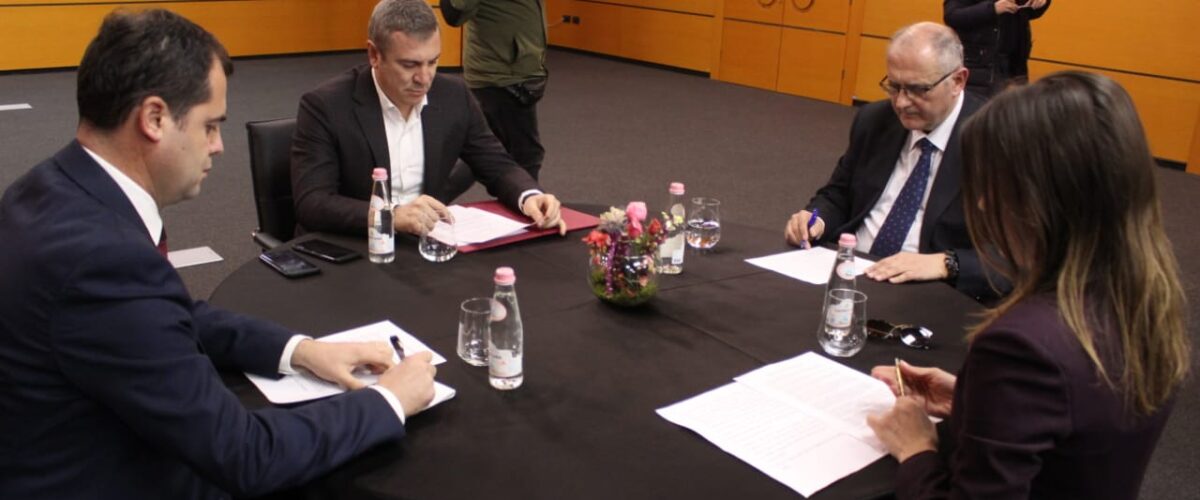
Today, the parties have agreed and are sitting at the table to carry out the electoral reform, which is one of the criteria set by the German Bundestag. The deadline for project submission is March 15.
One of the main points on the negotiation table for the electoral reform is the inclusion of the Prosecutor's Office in the elections. This point is supported by both the largest opposition parties in the country, the Democratic Party and the Socialist Movement for Integration.
In an interview for ACQJ and BIRN, PD representative Ivi Kaso also explains the changes required by this political force.
"All relevant prosecutors will be obliged, which at the end of the election period, will include all the detailed material on the denunciations that have come in, regarding the actions and inactions and the way they have handled specific issues, as part of a report that will be judged or seen by the Albanian Parliament. This is our approach, which we believe will work even if it is accepted by the other side," says Kaso.
Although with the changes required in the electoral reform, there will also be changes in the Criminal Code and the electoral code, for Silvi Caka, representative of LSI, the Electoral Code has all the provisions and the Criminal Code a part of the provisions, and the whole problem for the elimination of electoral crimes lies in the will for their implementation.
" All the will lies with the justice bodies and not with the political structure, not with the political parties. The subjects have different desires, they have different wills, the whole thing will then lie with the Prosecutor's Office, and we have thought of including the Prosecutor's Office more in the game," says Caka.
- Damian Gjiknuri, representative of the Socialist Party at the table for the electoral reform in which he is also its chairman, said that he could not pronounce as his statements could affect the work of the commission. In the short statement given to ACQJ and BIRN, Gjiknuri stated that in principle they are open to accepting reasonable proposals of the opposition for strengthening measures for the prevention and punishment of electoral crime, adding that one of the effects of the electoral reform will there should also be increased transparency and accountability of the electoral administration in order to prevent and detect violations.
However, political scientist Afrim Krasniqi is skeptical that changes in the Criminal or Electoral Code are the solution.
" The last university elections. We all know that criminal groups entered the race and there were accusations of vote trafficking, pressure, etc., etc. and when this happens in the largest academic, scientific center of Albania, imagine what happens in the deepest village of Albania where a vote won makes you a school principal, customs officer, gets you a job in the state, gives you privileges, you become a police officer, and creates a social status ," says Krasniqi, who adds that as long as this culture continues and positive models do not emerge that take action, surely none of the changes made to the Criminal Code or the Electoral Code would be able to offer a solution.
Krasniqi adds that the problem we have is not the legislation, since we have three laws, but we have not determined who is the priority.
" We have the law on political parties, the Electoral Code and the Penal Code, but in fact the law on political parties is approved with 71 votes, the Criminal and Electoral Code with 84 votes and the Penal Code as a rule does not change for a long period. By establishing three acts with different numbers of votes, we have also created the problem of which act will be a priority and to whom we will refer. One of the tasks that the Political Council of the electoral table should have is to determine who prevails in investigations in such cases. The Prosecution through the Criminal Code, the CEC and the Prosecution with the Electoral Code or the legislation regarding political parties. As long as this is not resolved, practically most individuals who will go to face justice formally will have an alibi through their lawyers to get through the situation, as has happened so far", says Krasniqi.
But the cases when files for electoral crimes and the part of buying and selling votes have gone to the Prosecutor's Office have not been missing. Not only the case of vote-buying in Korça, in which the Prosecutor's Office started the investigation by publishing the vote-buying on national television, but there have also been cases where criminal charges have been filed by the Central Election Commission itself.
In 2017, the CEC reported to the Prosecutor's Office members of the CEAZs in the Capital. Sources at the Prosecutor's Office of Tirana, where this report was also filed, said that the proceeding was initially registered for articles 326/1-25 and then it was separated by being divided into 14 other proceedings which the Prosecutor's Office sent to the court for dismissed, but the court accepted the Prosecutor's request for some of them, while four others are still under investigation.
But for the 2017 elections, voluminous wiretapping files were not missing either, which were published in the German media BILD so that the Albanian Prosecutor's Office could start investigations and give a positive signal that electoral crime is being eradicated. In the file known as "File 339", in addition to the alienation of properties, drug trafficking, the former mayor of Durrës, Vangjush Dako, appeared in the intercepted conversations, whom the Democratic Party accused after the publication of the conversations of buying and selling votes. The investigations by the Prosecutor's Office were closed and 12 people were charged.
The cases where the Prosecution has sent to court persons and subjects who have distorted the will of the people are few.
In the 2017 elections, the Prime Minister publicly called on teachers and policemen to dedicate themselves to their work to get as many votes as possible for the SP. A call clearly contrary to the law for the State Police and the civil servant.
"I call on the teachers of all of Kuçova and all of Albania not to let a minute, day or night go by without taking advantage of the fact that their dignity is being violated again. I call on all State Police employees, the moment they leave their uniform, after work, to dedicate themselves to getting as many votes as possible for the SP, so that we do not allow the shadow of shame to return to their uniform and together in the next 4 years we will make the police the EU average. I call on all state employees to do the same" , this would be the call made to the employees of the administration and state police from Kuçova on June 16, 2017 by Prime Minister Rama.
The Socialist Movement for Interrogation made a report to the Prosecutor's Office of Berat at that time, but the case was dismissed. The Prime Minister apologized a day later.
" At that time, we filed a complaint with the Berat Prosecutor's Office because due to jurisdiction, it would be done in that Prosecutor's Office. The case was dismissed. We took the case to the General Prosecutor's Office, the case was dismissed at the General Prosecutor's Office as well. Only the next day he came out and said, "I apologize. All people can commit various crimes and the next day they can apologize and what should the police do? Should they forgive them? What should the Prosecutor's Office do, close the case?! This is all a matter of implementation by law enforcement agencies ," says Silvi Caka.
Politician Afrim Krasniqi points out that even in cases where certain individuals after the elections have declared that they gave money and bought votes, in no case was an investigation launched and they were not even reflected in the reports of the CEC, and nor in the problems of political parties. For Krasniqi, the inclusion of the concept of penalizing parties in cases where they are caught stealing votes, trafficking votes and criminal financing is necessary and this, according to him, would bring about an automatic change of political parties in the country as well as a distancing from electoral crimes.
"If we introduce the concept of penalization, that the party loses its mandate, that it loses its electoral funding, that the party is fined as happens everywhere in the world, then automatically the parties would be forced to change regardless of who the leader is, both those who are there today and those who were there before 2008, when the legislation was changed. As long as political parties are not penalized, are not held accountable, and there is no measuring mechanism, it is all rhetoric and has no value, but is for political consumption," he says.
Technology to help stop vote-buying?
For years, the introduction of technology in voter identification, voting and vote counting has been seen as a very good opportunity to reduce electoral crimes in Albanian election processes. The opposition has brought to the electoral reform table the concrete proposal for the use of technology in electoral processes.
"The system guarantees the verification of voter data based on biometric data from the electronic ID card system, as well as the voter list generated from the national civil status registry ," states the proposal made by the DP.
Ivi Kaso says that the Democratic Party believes that electronic voting and counting will be able to guarantee not only political forces but also Albanian voters that their vote will go where they started, and will become part of the results as it should. , as well as will restore voting confidence to citizens.
With the aim of returning this trust, in the proposals of the Democratic Party, the method of voting through EVMs (Electronic Voting Machine) has become clear.
"In order to avoid vote buying and voter intimidation, the printed vote cannot be physically taken from the voter. Voters and the commission should not have access to the equipment or the ballot storage box, and every action for printing, cutting and discarding the ballots will be performed automatically by the EVM," the DP proposal further emphasizes.
This proposal of the Democratic Party has also found the support of the Socialist Movement for Integration. Ms. Caka says that the political camps have had contact with companies that offer this service, and demonstrations have been made on how it operates.
"Personally, they seemed relatively inviolable to me, the whole question remains about time. Will we have time to implement such an electronic system, because they also have their own time, their own cost, they have a pretty high cost, but if we want to break away once and for all from this tradition of buying and selling votes, I think it would be a very good thing to be able to implement a process of biometric identification, voting and electronic counting ," says Caka.
For Kristaq Kumen, the former head of the Central Election Commission, the inclusion of technology in the electoral process is one of the possibilities that can be used, but he emphasizes the trust that the parties must have for the use of this technology.
"First, the trust that the parties must have in the use of this technology because it is not the technology that creates trust, but the trust in it, and then the possibilities to reduce interference in electoral processes as a result of the political preferences of the administrators are significantly reduced, and as this is reduced, electoral crimes are also reduced," says the former head of the CEC, adding that although electoral crimes can be reduced, they are not definitively solved.
Actors outside the political system, but also those within the system, see the only solution to strengthening democracy in Albania in the growth of the democratic culture within the political parties themselves, and then they can show this culture during the election processes. Increasing transparency, but also imposing penalties on political parties caught in electoral crimes is one of the fundamental steps to remove electoral crimes from the complex electoral processes and give the citizen the opportunity to express his sovereignty.
Electoral crimes in Albania have occurred, their punishment has been absent. In the discussions about the next reform, in addition to strengthening criminal measures, increasing awareness and democratization and taking responsibility of political parties, there is also talk of introducing voting technology.
The next elections, in the most distant case, are in June 2021. Will these elections, as has usually happened in these decades, be followed by the next OSCE-ODHIR recommendations? The answer to this question depends a lot on the product and the consensus that the Political Council of the electoral table will produce. March 15, the deadline to see what the political will cooks up, is at the door.