


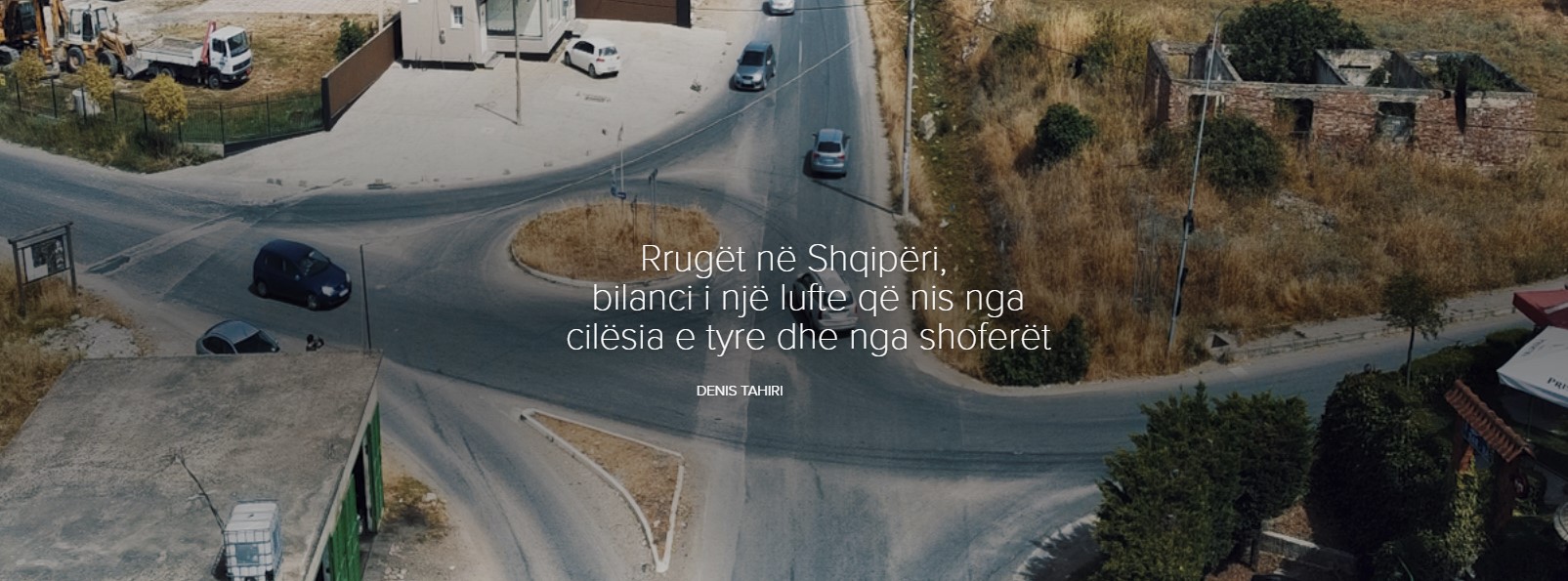
Author: Denis Tahiri
Especially the summer months are the season of police checkpoints where, in addition to fixed patrols, drones have also been introduced. On average, 30 to 60 citizens are fined every day across the country (during weekends), and yet accidents continue to cause tragedies and bloodshed on national and rural roads. The latest police campaign "save a life, save a wallet" did not result in any prevention, while at its peak, on the national road towards Vlora, during a car accident, an entire family was killed, due to the speeding at which a young man was traveling, currently in handcuffs. But if you go back in time, along with dozens of campaigns and initiatives, the deaths on the road from road crashes are a warning for several years that the roads and drivers are problematic.

1200 Albanians lost their lives during the last five years and the cause is only one: car accidents. The numbers are dramatic for the injured and maimed, where during the same time, almost 11 thousand Albanian citizens were officially reported as seriously and lightly injured.

The most problematic axes, both for ARRSH and for the Police, continue to remain Tirana-Durrës, Thumanë-Milot, Elbasan-Librazhd, Elbasan-Peqin-Rrogozhinë and Fier-Tepelën.
As far as municipalities are concerned, Tirana holds the first place for the number of accidents in 5 and a half years, where 4284 such accidents were registered. This figure is considered high and many times greater than in the second municipality, that of Durrës, in which 882 accidents were registered during the same time interval.
But even during 2021, considered a pandemic year that brought a reduction in traffic, the accident figures are frightening. In the first 5 months, 564 accidents were registered, with 88 killed on the road and 654 slightly and seriously injured.
Meanwhile, according to the police, the causes of accidents have a different dynamic than what happens on the ground. Car drivers are listed as the culprits, where it is stated that 2164 accidents were caused by the use of mobile phones and the distraction of control, from which 121 people lost their lives and 217 others were seriously injured. The second cause in statistical ranking is "Sudden change of direction", where 1123 accidents were caused, 116 citizens lost their lives and 152 others were seriously injured. The use of alcohol, atmospheric conditions, but also the technical conditions of the vehicle are no exception.

The "Tirana-Durrës" interurban axis is one of the roads with the busiest traffic in Albania, not only because it connects the capital with Durrës, but because it is the main junction towards the south of the country. At the same time, it is considered by the Traffic Police among the most problematic roads, not because of the quality, but because of the speed with which it circulates. As a black spot is considered in this perimeter, the exit no further than 1 kilometer from the overpass that leads to Tirana and the detour mark the victims and the injured.
Along the length of the interurban axis, the immediate exit is accompanied by the lack of a deceleration lane, while the intersection of this exit with the secondary road of the highway and a branch leading to Mzezez, has truncated signage.

"It is an intersection that is technically non-functional because vehicles coming from Kashari in the direction of Tirana do not have a deceleration lane, which would allow vehicles to avoid the interurban road lanes and slow down before entering the secondary road. This intersection has poor signage, horizontal signage is missing," says Islam Qibini, a road safety expert, who adds that it is the duty of the Albanian Road Authority to intervene to make this intersection as functional as possible for drivers and to prevent accidents.
And at this intersection, although it is not allowed, the exit of vehicles from the secondary road to the interurban road, this is something that happens regularly, turning into a source of accidents. Taking into account the speed with which vehicles move along the "Durres-Tirana" axis, the consequences are fatal.
"Not more than a month ago, I almost lost my life just because of this intersection," says Elio, a 29-year-old who works as a van driver delivering food products to stores. " I was returning from Qafa e Kasharit when a guy in a Mazda car, without looking, entered the highway directly from the intersection. I only escaped because I was going about 60 km and the van managed to stop," concludes the young man.
The strangest roundabout in Albania
The Shënavlash roundabout in Durrës is probably the roundabout with the greatest public attention. This is due to the fact that it is one of the roundabouts that, as the experts claim, has failed in its conception and efficiency on the road, causing it not to play its function. This point has become the source of life-threatening accidents.

" The roundabout located at this intersection where there are four roads has been moved to the left. It should have been in the center of the intersection, so it should have been moved to the right, so that all drivers could enter the roundabout and then take the lane ," says expert Qibini, according to whom not only is the layout wrong, but the signage is also almost non-existent.
But there are many problems in the residential centers as far as road signs are concerned. In Tirana, there are dozens of points where road signs are missing, wrong, or contradict each other.

Rruga e Qelqi in the capital, or as it is otherwise known as "Kinostudios" street, since its reconstruction until now, several people have been killed in accidents. Serious accidents with costs in human lives show that this axis has been wrongly re-conceptualized and reconstructed. In many internal axes of the capital, even when the signage exists, it turns out that it is placed incorrectly. Such a sign is found at the Selita bridge traffic light in the capital, where even though the middle lane is limited by a continuous line, at the end of it there is a horizontal sign that allows the driver to move straight, but also to turn right.
" This problem is not the same as the Kinostudio road," says road safety expert Fatmir Hasho, who adds that: " In places from "Bardhyl" road to Kinostudio, the line in front of the traffic lights is interrupted and has also been a consequence of serious accidents."
New roads, but no innovation...
Migjeni Boulevard, or as it is otherwise known in the capital, "Yzberishti" Boulevard, has given development to this area, but has also increased the risk of accidents with serious consequences.
Incorrect horizontal signaling has often been the source of accidents, where citizens have lost their lives. Residents say that crossing this boulevard is a challenge, since in addition to missing signage, drivers also drive their vehicles carelessly. Not infrequently, they also use the spaces of the white lines to pass from one side of the boulevard to the other.
" This is a problematic segment, both drivers and state authorities need to be sensitized. The Traffic Police, the city municipality, which must exercise permanent controls on this road segment, to also ascertain and verify violations, as here drivers drive at speeds above the permitted rates," emphasizes Mamir Hodo, head of the Bureau of Professional Engineers and Road Safety Experts.
Hodo also provides a solution to reduce the risk of accidents on this road axis, this option which requires the cooperation of the Traffic Police and Tirana Municipality.
"I think that in addition to monitoring by the traffic police, this road segment should also have measures taken by the municipality, which should reinforce the vertical signage at every pedestrian crossing. The signs that are placed on the right side are not visible in some cases. Vehicles park in front, there are trees and it is not visible in some cases. In addition to the vertical signage system, horizontal curbs should also be installed. I call on the municipality of Tirana not to be ashamed of placing horizontal curbs on the road, as this horizontal curb will help us avoid road accidents," adds expert Hodo.
Audit of the road network, a body of experts is set up, but they have no budget
"In every road accident or road anomaly, the patrol service is obliged to notify the road owner, to take the necessary measures to repair or restore missing or damaged elements," this is how the General Directorate of the State Police officially states, after being asked what are the problems identified by the Road Police on the problematic axes.
Also in its response, the General Directorate of Police adds that: " There are entrances and exits on the road without criteria and without respecting distances, and this is a legacy of road construction, or lack of legal standards at the time of construction, lack of signage which has come about over the years, as a result of the lack of road inspection/audit element."
But for two years now, the body of certified road safety experts has been established and they are functional as a certified body, but as the State Police officially claims, there are still no funds available in the budgets of the Municipalities and the ARRSH to carry out a audit of the safety of the national road network and urban roads.
" This was created in 2017 and has nothing to do with funds. The European norms themselves, where we inspire to go, require that the road safety auditor and inspector must be present in every country, but to be honest, what needs to be done here has not been done," says Hodo, who adds: " An auditor is independent, I have no need to depend on him, I simply take the task from the contractor, I receive work orders from the road authority and continue to do the inspection and at the end I give the conclusions. I tell the authority that for this project, this is the plan, and this plan must be put on the table, it must be studied well and this plan must be executed. This has not been achieved so far," concludes Mr. Hodo.
The bills speak for themselves
But the bills show something else. The cost that the Albanian Road Authority has spent for five years and specifically from 2016 to 2021 for road signage is 2,697,227,076 Lek.
In 2016, ARRSH spent on signage 681,186,114 ALL, in 2017 an amount of 490,612,397. While in 2018, this budget has suffered a significant decrease from the year before, where ARRSH has spent a lot of 278,935,146 ALL. But the expenses increase during the last two years, where it turns out that for the years 2019 and 2020, 441,166,898 ALL and 587,626,521 ALL were spent, respectively. While the budget available for financing road signage for 2021 is in the amount of ALL 217,700,000.
Although hundreds of millions of lek are spent every year on road signage, it still remains a problem in the Albanian road network. When officially asked if the incorrect placement of road signage by road construction and maintenance firms continues to be a problem for the Traffic Police, the State Police stated that: “ First of all, the incorrect placement of road signage by road construction and maintenance firms is a major problem for drivers and road users, as the lack of clear rules “written on the road” in the form of road signage causes confusion, traffic jams and in other cases, more serious consequences and road accidents.”