


Author: Cal Lundmark, Merxhan Daci
In the old city, where East once collided with West, today concrete collides with ceramics.
Imagine a city where hundreds of ships bringing goods from Alexandria docked every day, where trade flourished and emperors were entertained by troupes of actors in the amphitheater with 20 spectators.
Durrës was a glorious city.
35 km from the capital, Durrës is more than a destination for sun, sea and sand.
Archaeological evidence tells us that this city is a treasure.
The ruins of the city take us back to 627 BC. But, in a few years, this history is being covered by concrete rather than by the dust of millennia.
If you walk for a few hours in the amphitheater of Durrës, you may not meet any tourists. Also, in the ruins of the ancient market, except that there are no tourists around, the area is locked.
The archeological fort is best known for the amphitheater and museum, while other ruins have simply been discovered, but are not shown to the public or known.
The well-known archaeologist, former director of the Institute of Cultural Monuments, Apollon Baçe, tells PSE that what makes Durrës special is the continuity of civilizations that the city has had.
"It was the fourth largest city in the world. This city is very important for the history of Albania, but not only. In Durrës, the West has collided with the East, there is a continuity as a city and this makes it special. This is where the military, economic and cultural flow to the East passed", he emphasizes.
Durrës and Albania do not lack sea and sand, but the "ruins" are the magnet that should attract tourists to Durrës throughout the year, just like in other countries of the region.
But for years the city has been facing mass constructions without criteria, but also with strong accusations towards the local government, that it has taken care of the construction industry more than the identity.
Baçe says that the monuments have not been maintained and that after communism they were damaged and many times destroyed under the pretext of development.
"This is the most miserable time possible for archeology in Durrës. Those data that are important for humanity are being damaged, and as a result, tourists have no reason to come, when concrete is served to them", he says.
In the official tourist guide of Durrës it is written: Durrës, the city where the sea wets antiquity. Durres is in the ruins of old Epidamos. There's a saying for kids in the city: If you dig deep, you can find temples.
But are these "temples" open to visitors?
The tourism expert, lecturer at the University of Durrës, Brunilda Liçaj, says that the monuments should be marketed much better and that there is a lack of a strategy for tourism, as well as for the creation of the city's identity.
"Durres' slogan is the smell of the sea, but it should not only be the smell of the sea, because there are many more opportunities for tourism. Monuments can be better exposed. Services must be increased, we must have more people dealing with tourism", says Liçaj.
She remembers the bitter comments that important tourism operators have made about this city with a glorious past during tourism seminars and conferences.
"Two years ago, I was at a European meeting for tourist trips by boat and one of the managers of one of the biggest companies said: "In Durrës we sit and look at the sea, when we are at sea we look at the city, it is an urban massacre", - she points out.
According to Liçaj, even the residents of Durrës themselves have very little knowledge about the history of the city. In her experience with students she shows that they have many gaps in information.
Most of the tourists who come to Durrës are "patriotic tourists" from Kosovo, Macedonia and Montenegro. "Sea" tourists are only for the summer period. Seasonal tourism remains a challenge that a city with such potential as Durrës should have overcome.
For Hysniu, a resident of Durrës who sells books on the Volga promenade, the constructions have changed the city drastically.
"Tourists come only in summer. There are so many constructions and empty apartments here! In my palace of 60 entrances only my family and 4 others live. We need a new tourism system more than buildings", he says.
How much does urbanization cost and what is it being paid for?
Archaeologist Apollon Baçe considers what has been done with urbanization in the city a crime.
According to him, construction permits were given abusively with corrupt tactics. He shows staggering amounts of money that were offered to him in exchange for an approval from the Institute of Monuments, at the time when he headed this institution.
"I was the director of the Institute of Cultural Monuments. They offered me 60 to 150 euros to approve building permits on the ruins. I have not accepted, there are others who have received these sums", claims Baçe.
A Byzantine ruin beneath a 14-story building, according to Baca, was mercilessly bulldozed to take up less space for builders.
In 2001, the construction of this palace began in the area near the port of the city, where even though it is noted by the institutions that an archaeological ruin has been damaged, the continuation of the works is allowed, reasoning that the works for the building would highlight the Byzantine wall. And this is one of the examples where antiquity is subsumed by modernity.
Today, this ruin camouflaged with modernization cannot be visited unless you have lunch at the restaurant that has been erected there. And this is where private meets public, treasure meets concrete.
The city has many assets, but also a great need for "other" tourists.
Zenepja, the young Albanian from Montenegro, has chosen Durrës for a few days vacation, even though before the summer season.
"I often come here, I like it, because it is more or less like my country, Ulcinj. Yes, we have been to the archeological sites last year. The ruins are wonderful, it is our history, we are Albanians", she emphasizes.
Ledion Lako, the director of the Regional Directorate of Culture in Durrës, says in an interview for PSE that, from the past, the city has suffered numerous damages.
"Tourists, when they come, enjoy the city and appreciate it, even though mistakes were made in the past. It has been a silent war and archaeologists have worked to preserve the rich heritage. The Law "On Cultural Heritage", in area A (the central part of the old city), categorically prohibits construction and no permit has been given", he said.
According to Article 30 of the Law "On Cultural Heritage", any type of construction intervention is prohibited in area A.
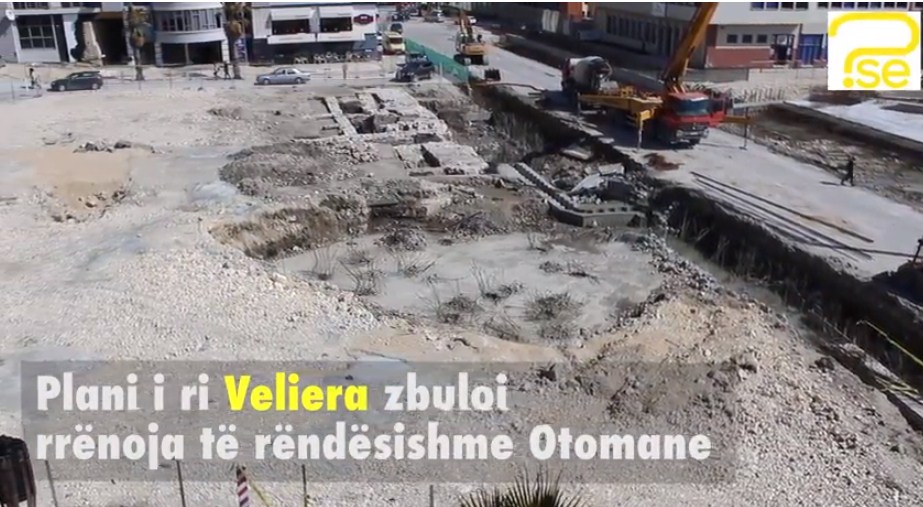
As a result, Veliera, the much-discussed project to rehabilitate a square near the city's port, contradicts this law, as well as the urban plan of Durrës, approved in 2011. Veliera brought to light ancient Byzantine ruins which are affected by the iron and concrete of the 5.5 million Euro project.
The well-known archaeologist and historian, Neritan Ceka, in a televised debate (March 2017), says that only 5% of the archaeological wealth of Durrës has been discovered and that this should make us care more about the city and the archaeological discoveries.
The local government in Durrës has an answer to the criticism coming from the media and civil society.
The mayor of Durrës, Vangjush Dako, in the same televised debate said that "the alleged violations were committed in the service of the community".
But should the past be sacrificed for the present?
In Durrës, for years, the smell of the sea is not the only one. The aroma of concrete is not only felt, but it is sealing the victory in the unequal battle with ceramics.