


Denada Jushi
"I had a vitamin deficiency and my hair started falling out. When I went to ask ChatGPT, I was shocked. I thought the worst about my health, so much so that for several days I couldn't go to the doctor..."
This is the story of a 22-year-old girl, who represents an increasingly high number of citizens who make mistakes when it comes to health.
Health misinformation in Albania is no longer a small phenomenon or limited to social networks. It is becoming a serious risk to public health, directly affecting the lives of citizens, trust in doctors and institutions, as well as the health security of society.
Incorrect information is not even saving health.
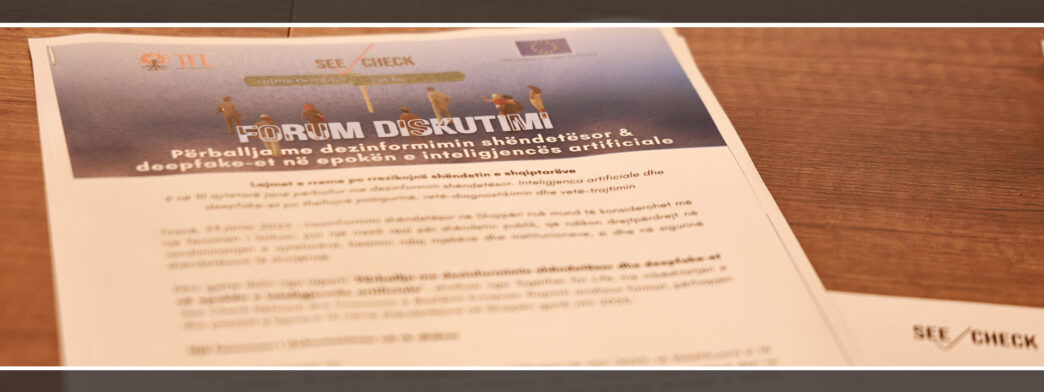
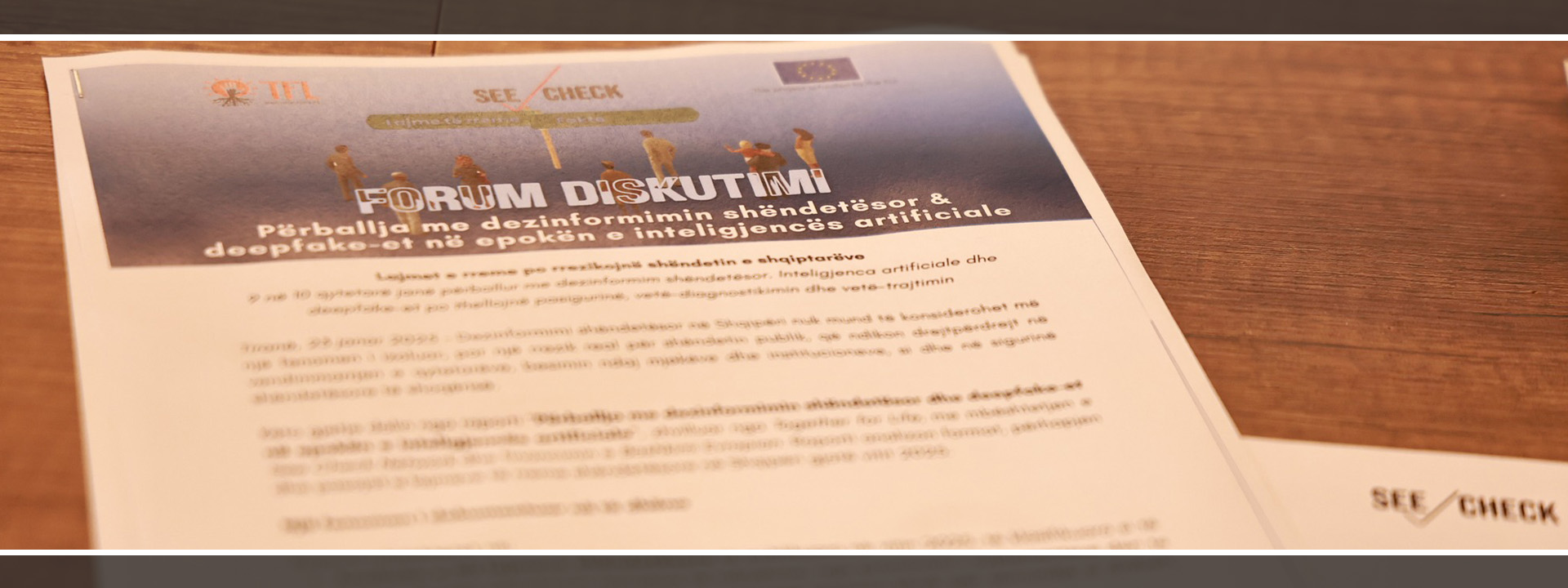
These conclusions emerge from the report “Confronting health disinformation and deepfakes in the age of artificial intelligence” , drafted by the Together for Life association , with the support of the SEE Check Network and funding from the European Union. The report analyzes the forms, spread and consequences of health disinformation in Albania, placing this phenomenon in relation to rapid technological developments and the increasing use of Artificial Intelligence.
The report highlights that health misinformation in Albania has gone from a sporadic phenomenon to a serious public health problem. Almost all citizens surveyed declare that they have been directly confronted with fake health news, while the majority consider its spread to be critical. The most affected topics are related to chronic diseases and widespread concerns, such as obesity, weight loss, cancer, diabetes and cardiovascular problems, areas where fear and uncertainty make the public more vulnerable to manipulation.
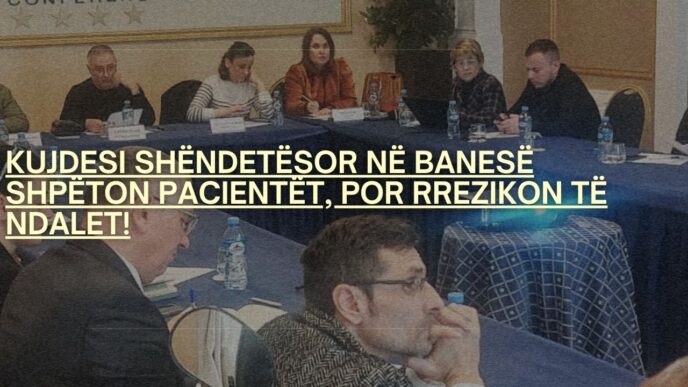
The findings were presented at a forum attended by representatives of public institutions, the media, health professionals, civil society organizations, citizens and young people. The discussions highlighted concrete concerns and personal experiences on the impact that disinformation has on daily life and on the citizen-health system relationship.
The dominant form of disinformation is commercial: articles disguised as news or interviews, fake doctors, stolen identities, and manipulated images or videos are used to promote products and “miracle cures” without any scientific basis. In parallel, the circulation of disinformation about vaccines and conspiracy theories continues, which undermines trust in the healthcare system.
One of the issues discussed is related to audiovisual media and the advertising of health products. Alida Cenaj, Director of the Cabinet at the Audiovisual Media Authority (AMA), announced that over the last two years, six cases of violations related to surreptitious advertising and illegal promotion of health products have been identified.
"Our monitoring shows that the most problematic violations in audiovisual media are related to hidden advertising and illegal promotion of health products, where the moderator or guests become direct advertisers. That is why we have undertaken the 'Infodemia' initiative, which aims to give journalists concrete tools to avoid crossing the line between informing and harming public health," said Cenaj.
The report also highlights another risk related to the misuse of the identities of well-known doctors through deepfakes, manipulated videos and images used to promote products or treatments without scientific basis. These practices not only deceive citizens, but also harm the doctors themselves.
Skënder Brataj, Director of the National Emergency, stated that he has personally faced such cases.
"The abuse of doctors' identities through deepfakes and false advertising is not only financial fraud, but a real risk to people's lives. I have reported several cases where my name and image have been used without my knowledge to sell medical products, but the lack of protection and effective response exposes doctors to threats and self-justification," Brataj said.
The report also focuses on the role of Artificial Intelligence in the spread of disinformation. Eglantina Bardhi, Executive Director of Together for Life , tells ACQJ that the most dangerous forms of disinformation are those that imitate credible sources.
"The most dangerous forms we have identified are the promotion of 'miraculous' products or treatments, presented as scientific discoveries, using figures of well-known doctors. Visual manipulations generated with Artificial Intelligence and imitation of credible media formats are also very widespread. By falling prey to these news, patients can interrupt their doctor's treatment and follow 'cures' that are even life-threatening," says Bardhi.
According to her, the risk of AI becomes even greater when it is used for self-diagnosis.
"The use of AI tools for health information is already widespread. AI becomes dangerous when citizens use it for self-diagnosis and self-treatment, or when they postpone consulting a doctor. This leads to inaccurate diagnosis and unauthorized use of medications," warns Bardhi.
On the other hand, representatives of the Commissioner for the Right to Information and Personal Data Protection emphasized that health institutions have an increased responsibility to provide accurate and reliable information.
"The fight against disinformation is not won only with laws, but by seriously investing in the education of young generations and in media accountability," said Redi Skënderaj.
Health misinformation, recommended by experts, should be officially treated as a public health issue, requiring interventions to strengthen the regulatory framework, increase institutional capacities and investments in media and health education. The appeal comes to every citizen not to believe every advertisement and not to ask ChatGPT about health, but only to the relevant doctor./ acqj.al