



Author: Arlis ALIKAJ
The photos with a public investment in the Municipality of Librazhdi can be found on the Facebook address of the majority deputy, Taluant Balla, a very widespread and dominant phenomenon during the election campaign of the Parliamentary elections of April 25, 2021, for many candidates in different regions of Albania.
This situation has come as a result of numerous legal gaps in the regulatory framework of the election campaign, as in terms of the use of public assets for campaigning, something strictly prohibited by the Electoral Code, but indirectly allowed by the Regulatory Commission of the CEC , and the complete lack of regulation of the political campaign in online media, both those of a public nature and those of a social (personal) nature.
In the city of Librazhd, despite the various legal prohibitions and restrictions in force and due to gaps in the regulatory framework, the Mayor of Librazhd Kastriot Gurra and MP Taulant Balla have shared almost every week on their official websites photos of the infrastructure works carried out by the Municipality of Librazhd and the meetings held in the community. The AlbaStar company, which carries out the works with the German KfW grant, has employed almost the entire youth workforce in Librazhd.
The incomplete regulatory framework has allowed an uncontrolled campaign
In December 2020, the CEC Regulatory Commission, with decision No. 9, dated 24.12.2020, prohibited the promotion of public activities for which funds have only recently been made available (4 months before election day) or for which unforeseen movements in the budget have been made, excluding from the obligation long-term activities and investments, which in fact constitute the majority of public investments at the national level. It is now rare to see the beginning of “electoral investments” and the cutting of electoral ribbons in investments in infrastructure, energy, social or economic investments. This decision of the Regulatory Commission, further, taking into account the situation in which Albania and the wider region find themselves, has excluded from inclusion in prohibited activities the information and promotion of investments that have come as a result of reconstruction efforts after the November 2019 earthquake and the global pandemic caused by COVID-19, or at least this is how this permission was read by the political entities in the campaign, which have found the best way to benefit from the pandemic for electoral campaigns, often demonizing political opponents through public figures in high positions in the health administration.
The Regulatory Commission's decision provides that "... Exceptionally, in cases of imposing extraordinary measures due to a state of natural disaster or epidemic/pandemic, the provisions of point 1.1 of this article (prohibited activities) shall not apply to acts or activities aimed at taking measures to cope with the consequences of these natural disasters or epidemic/pandemic,..." , a provision which in no case allows information or promotion on the achievements of campaigns undertaken within the framework of post-earthquake reconstruction or the promotion of the vaccination campaign against COVID-19, but only the notification or announcement of the public about the measures that will be taken within the framework of the latter.
These legal gaps, or misinterpretations of the regulatory framework, have multiplied further and with the total lack of regulation of the political campaign in online or social media, something that has given political subjects a free hand in promoting their arts, or promoting online electoral campaign, without any prohibition or legal restriction.
Beyond this, taking as its origin a complaint from a political entity against the Mayor of Tirana's social media posts of activities perceived as political, the CEC's Complaints and Sanctions Commission has issued a decision in which it evaluates the use of social media in promoting electoral activities during the electoral campaign. In this decision , KAS reasoned that “Posting photos, videos or comments on social media about activities does not automatically make the activities public in terms of the definition of point 1 of Article 92 of the Electoral Code. In most cases, the posts pursue purposes other than the purpose of information required by point 1 of Article 92 of the Code…”, further continuing that “In most cases, the posts aim to promote the account holder, or issues that are important to him, to express positions or opinions, to raise problems or raise awareness, to incite discussions or debate…”, thus excluding posts on social media from general legal prohibitions due to the personal nature of these media, but leaving it up to KAS to assess whether these posts aim to inform the public for electoral reasons, or are simply personal opinions.
This decision-making by KAS, but also the lack of a legal framework for monitoring or limiting propaganda and political activities in the online format, have allowed the various actors in these elections to conduct their election campaign through uncontrolled social media and without the concern of the regulator. , even before the official start of the election campaign.
The election campaign with the construction of water pipes and the systemization of sewers in Librazhd and Prrenjas
With an observation of the respective pages of the socialist MP Taulant Balla or the Librazhd Municipality on Facebook, but also in the meetings they have held in this city, almost every day, the socialist MP, often accompanied by the Mayor, has also been seen at the construction sites of the AlbStar company.


"The city of Librazhd has not had any intervention in its water supply since 1960," said Mr. Balla in a meeting attended by Prime Minister Edi Rama, adding that " there is no other water supply in Albania of this size. Our good works need your vote to continue. In the next mandate we will do even more."
Traffic chaos has been going on for months, the rains block the movement of residents and cars at the main intersection of the entrance to the main city center, due to inert materials. Problems after the rains appear at the intersection near the pension office, on the police road. This road also serves as a ring road for the movement of vehicles.
Mrs. Feride, a resident of neighborhood number 1 in Librazhd, says that she cannot sleep because of the noise. “The works start at 7 in the morning, workers shouting, the dust that gets inside us and during rainy times it is red mud”. Shahini, also a resident of this neighborhood, adds “The campaign has accelerated the works, I doubt their quality, most of the stones and tiles that were laid earlier are broken and have lost their compactness”. While many other residents express indignation at the lack of water and the inappropriate time and pace of the works. The chaos created due to the campaign and hasty investments is also seen in the publications of the election candidates against the reality on the ground and the damage observed in the current infrastructure is high.


The support and promotion of public projects has been evaluated by the jurists of the Albanian Committee of Helsinki in the category of activities prohibited to be promoted and contradicts article 3, point 1, letters a) and ç) of decision no. 9/2020 of the Regulatory Commission. After getting to know some citizen's denunciations forwarded through local coordinators, KShH sent an official letter to the State Election Commissioner for verification and taking measures on these denunciations.
" Further verification of the facts or indications referred to in these complaints is, in our assessment, the competence of the CEC, which, if applicable, if there is a violation of electoral legislation, applies administrative sanctions in accordance with Article 172 of the Electoral Code ," says the Albanian Helsinki Committee, which with the assistance of local coordinators is proactively monitoring the pre-election process.
Use of subordinates and public resources in the campaign
To avoid the use of public resources in the campaign, the Electoral Code was amended by broad consensus in the agreement of June 5, 2020.
Lefterie Luzi, election expert and former president of the Central Election Commission, appreciates the strengthening of penalties and the possibility that the public can now make complaints themselves.
" The addition of Article 123/3 of the EC on public participation in denouncing facts, this added to the fact of specifying the procedures that the public must follow or maintaining anonymity certainly helps the process and increases integrity, since the inclusion in this process and especially the voter who is part of this process would help the process in a positive direction. The obligation of the CEC to maintain and preserve regular statistics on all criminal investigations on electoral matters is a novelty of the changes in this code (Article 167/1). These elements that the legislator has foreseen to significantly increase the integrity of the elections and to give credibility to the electoral process," concluded Luzi.
However, the Institute of Political Studies (ISP) is monitoring the CEC and the electoral campaign regarding the implementation of new legal norms in this area. From the monitoring data and the critical reports of the media and political parties in the elections, it results that a large number of employees with civil status and public administration are involved in the electoral campaign during the official working hours. They are involved in political activities, electoral propaganda and political debates of the day, mainly in social media.
"ISP comes out with the recommendation that DAP should have approved a guide for the behavior of the public administration and civil servants during the electoral campaign and the CEC should have requested from the state and public institutions a system of monitoring, verification and response in application of the criteria that requires an election process with standards. Law 152/2013 defines the limitations for the exercise of political rights for civil servants."
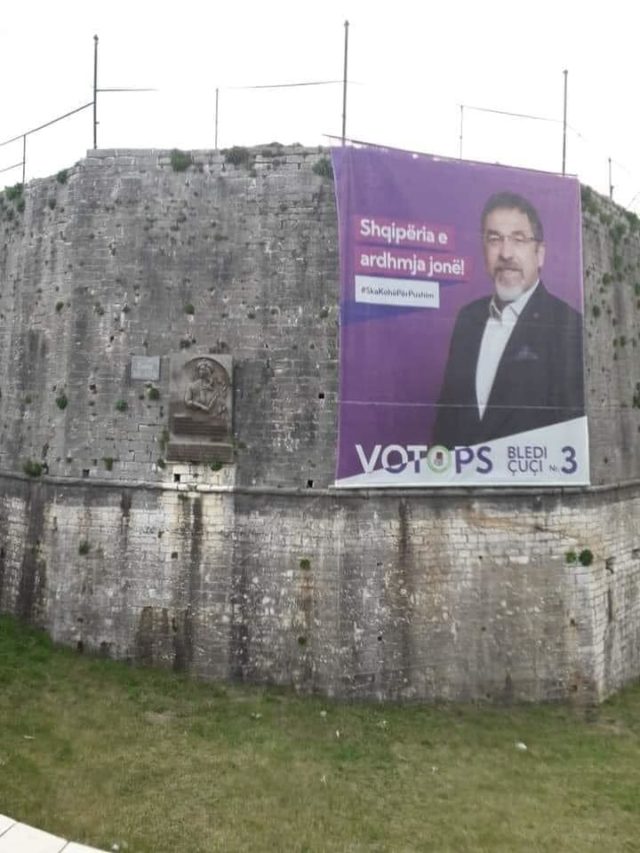
One of the key aspects in which the local government has violated the provisions of the Electoral Code on the use of public resources and the Instructions of the State Election Commissioner on the use of propaganda materials during the election campaign is the failure to accurately determine the public places in which political entities can place their propaganda and educational materials for voters, including the Municipality of Tirana, which for these Assembly elections, in complete violation of the law and the instructions of the State Election Commissioner, did not provide any political entity with a dedicated space for their propaganda materials, as well as a number of other municipalities that have allowed the use of public spaces that are part of the cultural heritage and public administration buildings, as in the case of the Municipality of Librazhd, for the publication of these propaganda materials.
On April 14, the State Election Commissioner found that the Municipality of Librazhd and its mayor, Kastriot Gurra, have violated Articles 78 and 91 of the Electoral Code and Article 3 of Instruction No. 6/2021 “On the use of propaganda and educational materials and the rules for their display during the election campaign”. The municipality in question has placed a Socialist Party poster on the wall of the building, while according to the Electoral Code, the display of propaganda materials during elections must be done at a distance of up to 5 meters from the electoral office of political entities. The denunciation was made by the Librazhd Democratic branch. Despite the fact that the CEC ordered the mayor of Librazhd to immediately remove the Socialist Party electoral poster from the facade of the municipality, officials of this municipality have still not taken the necessary actions in accordance with the law. The ACQJ journalist confirmed that on 21/04/2021 the poster was still on the facade of the Librazhd Municipality building and the CEC decision had not been respected.

The municipality did not respond to our request for comment regarding the State Commissioner's decision on the case in question and its non-compliance. The number of public denunciations in various media and social media for non-compliance with the norms for electoral propaganda are numerous, but unfortunately, the decisions given to fix the situation by the CEC is only 1, the one against the Librazhd Municipality, a decision which he was eventually ignored.