


Author: Nertila Dosti
The identity of every Albanian citizen and their health diagnoses should have been digitized since December 2016 in a unified electronic register, for which 14 million euros were spent.
Albanians should already have their health data stored in an electronic register, where with the ease of one click, the diagnoses could be displayed on any computer screen in all 88 health institutions of the country. This was expected to be realized through the "Nationwide Electronic Health Registry" project.
One of the main goals of the project was to replace the old handwritten registers in hospitals and health centers with a new, unified, electronic register. Citizens' health data were expected to be easily updated and shared between health care institutions in real time.
The project started at the end of 2014 and an amount of about 14 million euros was made available to it, from an agreement concluded between the Ministry of Finance and Unicredit Bank Austria AG for the benefit of a soft loan in June of that year. The Ministry of Health was appointed responsible for its implementation and the deadline, when the initiative should be completed, was December 2016.
Now, when three months have passed since the end of the project, the ministry considers it a success and the sum of 14 million euros has been all disbursed.
Meanwhile, PSE, from a detailed observation in seven health institutions in Tirana, Elbasan and Librazhd, interviews with citizens, the leaders of these centers and the reports of the High State Control, reveals that the project is still not fully functional. Five of these health centers and hospitals were part of the pilot phase of the project and work should have been completed by 2015.
The data speak of the complete malfunction of the electronic register in other health institutions of the country.
The lack of investment in technology and the non-equipment of these health centers with additional staff that should implement the electronic registry project, seem to be the main reasons that have brought about the failure of the project aimed at digitizing the health system in the country.
The project did not start well
The creation of the electronic, nationwide health record was a project planned to be developed in two phases. Its first pilot phase with a value of approximately 7.5 million euros began implementation in the second half of 2014 and was expected to be completed within six months. In the first phase, the project was expected to be implemented in all the health centers of Tirana, as well as its surroundings.
However, the documents show that this phase did not fulfill the purpose for which it was launched. This is also evidenced in a report of the Supreme State Audit, KLSH, published in June 2016.
"We note that at this stage only eight sites have been completed. The loan was disbursed to the extent of 93%, while the installation of the system was done gradually. Although the equipment and programs have been disbursed to the company, the implementation of the project in all sites has not been completed," the report reads.
But, even though these shortcomings for the project have been identified by KLSH, this institution has not requested administrative measures or criminal prosecution for the violations found in the implementation of the project contract.
"Responsibilities of the former project manager and the former project director have been established, for which we do not recommend disciplinary measures, for the reason that these persons are not in a working relationship with the Ministry of Health", - the report emphasizes.
Despite the non-implementation of the project in the vast majority of the health institutions, defined in the first phase, the Ministry of Health continued unconcerned with the disbursement of the fund for the realization of its second phase. In the second phase of the project, the electronic health record was required to be a reality in all health institutions of Albania. The project was officially closed in December 2016, and representatives of the ministry did not hesitate to consider it a success.
PSE contacted the project manager, Tomi Thomo, and he said: "The project has been implemented without any problems in 88 institutions across the country. All patient data, including the diagnosis, have been entered into the system."
Meanwhile, during the months of January and February, PSE also conducted an observation in seven health institutions in Tirana, Elbasan and Librazhd and found that the electronic registration of patient data is a process that has only just started, far from being completed.
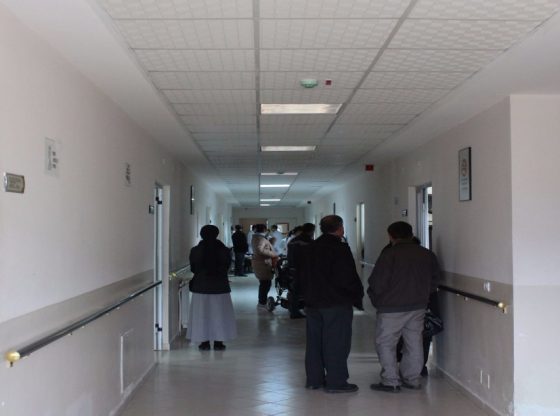
Thus, in Polyclinic number 3, in Tirana, a special office was created from where patients would be registered, but, as can be seen from the provided photographs, there are only a few computers and no one working on them. Meanwhile, employees still use the handwritten register as they record patient diagnoses. The director of this polyclinic, Valdete Malaj, told PSE that, due to the large influx of patients, the institution she runs is unable to register every patient in real time.
"The patient is registered through a form that the counter prints. With that form he goes to the relevant doctor, who gives him the diagnosis. Then, when the shift ends, from lunch, we dump the data into the computer. Hundreds of visits are made here per day and at the moment we cannot record them all electronically; we don't have much since we started with this process", said Malaj.
However, this institution has not yet been equipped with the appropriate infrastructure, although the project of the ministry provided for this. Malaj emphasizes that, with the secondary income of the polyclinic itself, several computers will be purchased that will be placed at the disposal of doctors to perform the registration.
"We have bought a part of the laptops, which have been distributed to the doctors, the programs must be installed and the doctor can start working directly and stop filling out those sheets that they write by hand," she emphasized.
Meanwhile, the project followed the same rhythms in the Polyclinic of Specialties number 2 and in Polyclinic number 10 of the capital. The director of Polyclinic 10, Rudina Gjini, expressed her readiness to make available to us the data on the progress of the project, but emphasized that only the basic data of the patients were registered in the system, at a time when the project also envisaged the digitization of their diagnoses.
"We have all the names of the patients in the electronic register. We put their first and last names, IDs and addresses, not diagnoses. We haven't done the visits and diagnoses, we have manuals for everything", said PSE Gjini.
While the director of the Polyclinic of Specialties number 2, Mirela Hasanaj, told PSE that the system already works and information can be exchanged with other institutions, but not all patients are registered.
"We only put the data of patients who are chronically ill in the system. I give importance to chronic diseases, not acute ones", she said. However, Mirela Hasanaj refused to make the data on the progress of the project public without first obtaining authorization from the Ministry of Health.
The director of the maternity hospital, "Queen Geraldine", Blenard Nonaj, did not respond to PSE's interest in the project.
"I have three surgeries, I don't have time", said Nonaj, as he directed us to the Ministry of Health, to the project manager, Tomi Thomo.
Meanwhile, PSE has observed the progress of the project in the city of Elbasan and in the city of Librazhdi. The project in these two cities was implemented in the first phase at the end of 2014, but since almost two and a half years since then, the electronic register is still not fully functional.
In the Elbasan Regional Hospital, only the patient's basic data and not the diagnosis are entered into the system, and this is confirmed by employees of this institution without wanting to be identified.
"We do not enter the diagnoses of the patients, we only enter the name, surname, date of birth and place of residence in the system. Once the diagnosis is determined, it is entered in the card by the doctor, but not in the computer", says a nurse of this hospital.
Meanwhile, at the Polyclinic of Specialties in Elbasan, the staff cannot register patients electronically due to the large influx.
Shortages in personnel, as well as the large number of patients, force them to use only the manual register, while the data in the system says that they throw them at a second moment or second day.
"The data must be thrown at the moment, but when there is a lot of flow, we throw them later, since the priority for us is that the patient receives the service as soon as possible", - says one of the two nurses who throw the data into the system. without wanting to be identified.
The same deficiencies are found in the polyclinic of Librazhd.
"We have more problems in the emergency room, where there is a lot of flow. There we also use the manual register, because we cannot register all the patients electronically", says the head nurse of this polyclinic.
According to him, the system often shows problems, the Internet is weak, computers break down and this forces them not to register any patients for days.
"When there are problems, we take the computers to Elbasan, and we stay for two or three days without registering the patients at all. The Ministry has told us to remove the manual register altogether, but we still use it, because the electronic one does not work well", he said to PSE.
But, even in this case, private health care institutions are one step ahead. MB, 44 years old, a patient in one of the country's private hospitals, tells PSE that his health data is already in the institution's electronic system.
"They just need to write my name and surname and all the data appears in the system", he says, adding that he has not encountered this procedure in public hospitals.
Citizens, unclear about the initiative
E. Rrapo, due to health problems, is a regular visitor to the Polyclinic of Specialties number 2 in the capital and holds a large volume of documents in his hands.
When asked if he is aware that his data should have been electronically recorded, he replies that he does not believe this has happened.
"I have also lived abroad, in Canada, and there all the patients are registered on the computer, here neither I nor my wife were registered", he emphasizes.
Although the Ministry of Health, as part of the project, should have undertaken a wide awareness and information campaign for citizens, it seems that from the testimonies of the latter, this did not happen.
Shkëlqim Barjami, another patient of the Polyclinic of Specialties number 2 in the capital, says that every time he goes to a health institution, he must take all the necessary documentation with him.
"We are registered only with the family doctor, with the hand register. I have the documents and all the tests with me. Until now, they have not managed to register us", he says for PSE.
"We are only registered in the handwritten register, as in the case of the family doctor, also in the polyclinic. I don't know how to register on the computer. None of the doctors have informed me, neither have I been interested", says another patient with the initials ED, frequenter of Polyclinic number 10, in Tirana.
Unclear and uninformed are thousands of patients who enter the doors of the country's hospitals every day and admit that after visiting the relevant doctor, their diagnosis ends up in the handwritten register and never on the computer.