


Author: Fatjona Mejdini
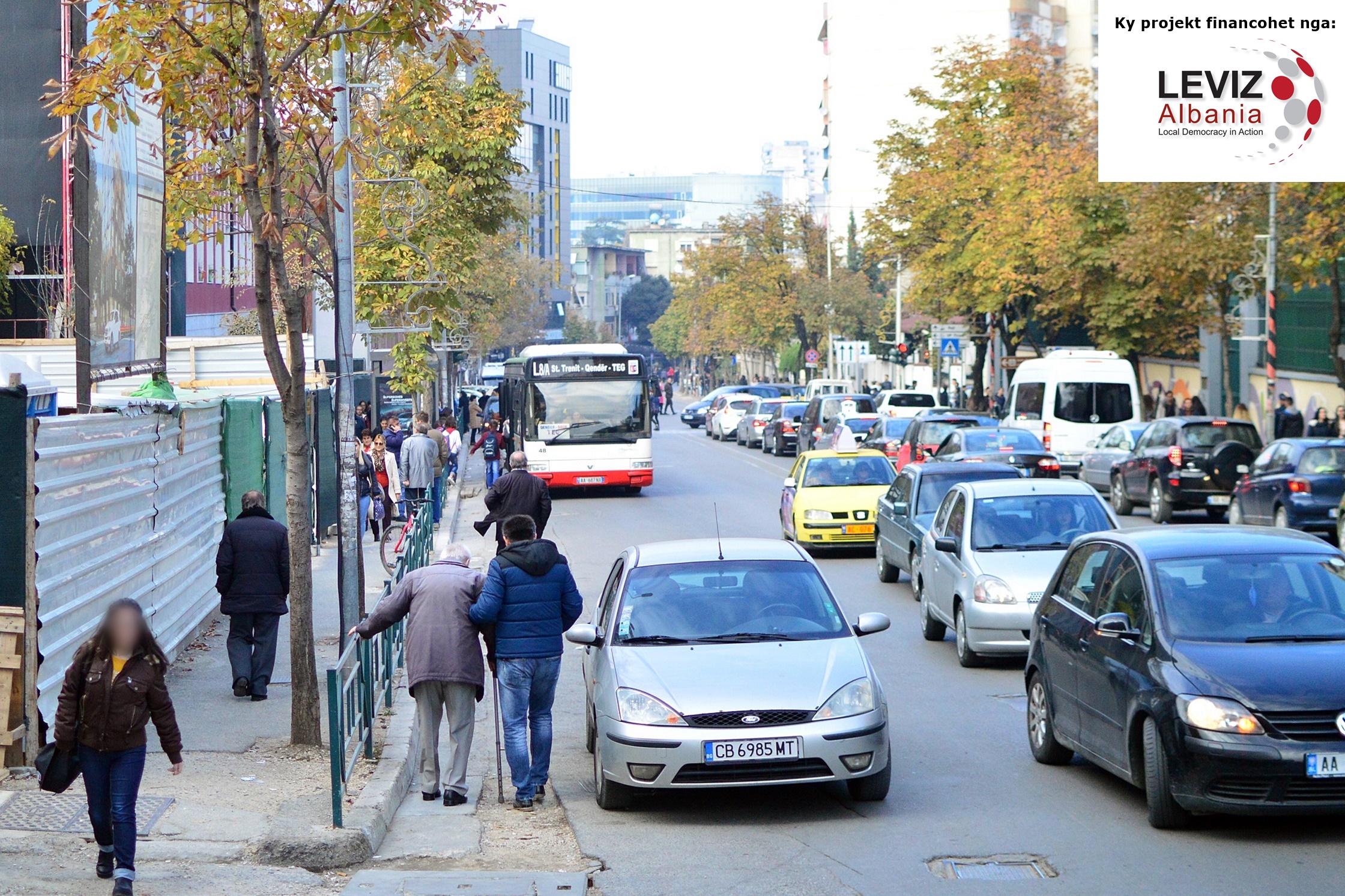
On the sidewalks of the central streets of Tirana you can find everything: Poles holding signs and advertisements; trees surrounded by wide borders; parked bicycles; goods advertised for sale and kiosks. Often inside the sidewalk there are shop stairs or bar stools, while what is almost always missing is the free space for pedestrians to walk.
An observation by the Center for Quality Journalism on the sidewalks of Tirana, including those of the main and secondary streets, concludes that their surfaces are narrowing day by day and that pedestrians have priority only in the written plans of the municipality.
On main roads, citizens often have to queue to cross the sidewalk. Despite this, no investment is observed to change the situation or intelligent solutions, which could empty the pavements of the excessive burden they carry.
On the other hand, in inner city streets sidewalks for passers-by are still a luxury and largely undeveloped. Even the new roads that are reconstructed by the municipality do not make a difference, when the sidewalks have no priority.

When in December 2016 the municipality approved the local general plan under the name TR030 and the vision for the transformation of Tirana into an intensive and polycentric city by 2030, a “pyramid of principles” was strongly emphasized in the document.
In them, pedestrians stand at the top of the pyramid with the plan that promised that, not only will it preserve the fact that 30 percent of all trips by the residents of Tirana will be made on foot, but it will increase this percentage by strengthening their status and widen the roads.
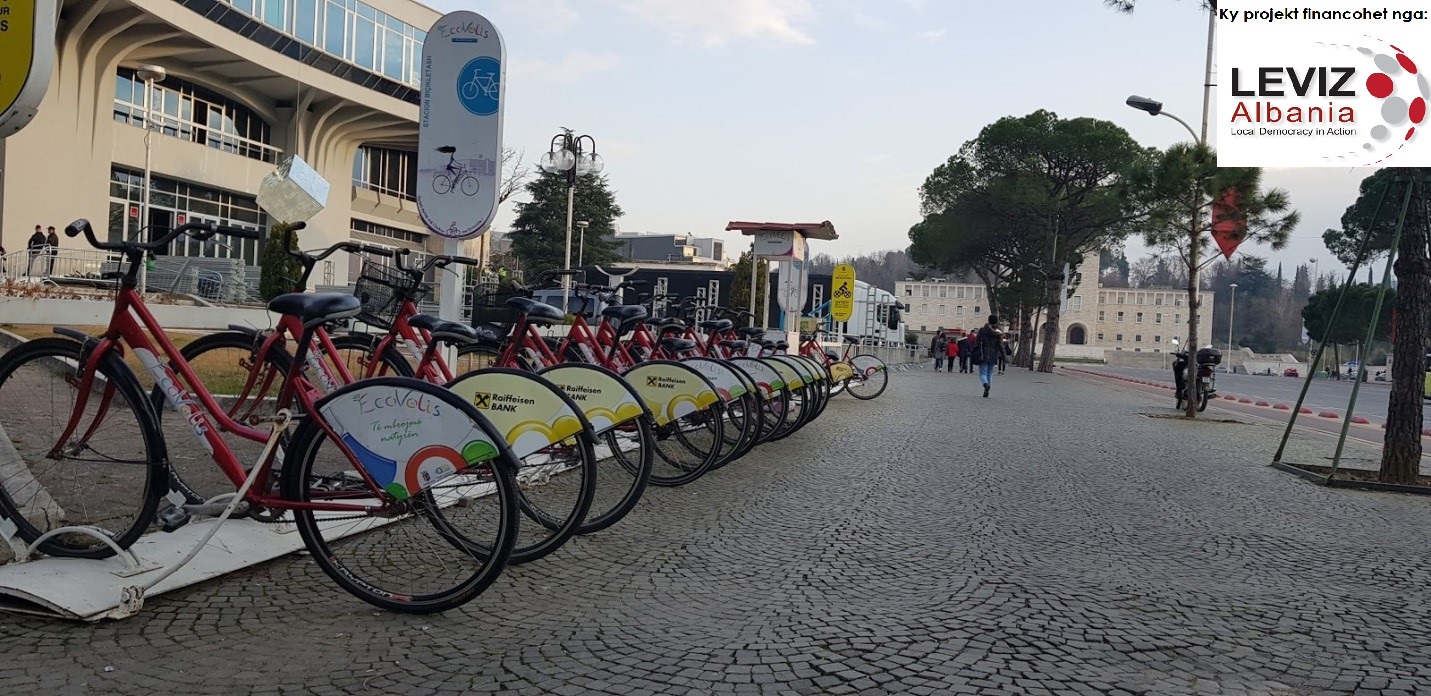
The municipality places bicycles as the second priority, and cars are at the bottom of the pyramid. Currently in Tirana there is a real improvement of the infrastructure for the use of bicycles. According to the Municipality of Tirana, so far they have worked on several main roads to create dedicated bicycle lanes with a total area of 18,194 linear meters or 18,1 km. The municipality details all the roads where these lanes are located and the length for each of them.
But, when asked how many new sidewalks have been built in Tirana along with the number and length of those reconstructed, the answer coming from the municipality is just one line, emphasizing that "108,000 m2 of sidewalks have been built, both in road infrastructure and in urban redevelopment."
Based on the need to know the position of the municipality regarding the situation and the plans for improving the surfaces for pedestrians, the Center contacted the director of Directorate No. 2 of the City Workers, Elton Kacidhjan, who initially expressed his openness to discuss.
When some questions were sent to the email address along with photos of some sidewalks in Tirana, the mayor became unavailable.
Political opponents of the municipal administration led by Erion Veliaj see the problem of sidewalks in Tirana closely linked to the lack of vision of the TR030 plan . Akil Kraja, a member of the Democratic Party in the Tirana Municipal Council, said that this plan leaves Tirana essentially a city and does not allow its transformation into a metropolis.
"People are asked to come to Tirana and the city is not connected to the surrounding areas, not giving the latter a chance to develop and integrate to form the metropolis.
Also, the plan has significantly increased building permits, narrowing spaces and creating constant conflict between those who want to walk, pedal or drive," he said.
Shifted priorities
Tirana with almost 800,000 inhabitants is often described by visitors as a pleasant, bustling city with Mediterranean features, where walking is the best and often the fastest way to meet the needs of the day.
But walking in the city has become problematic and it seems that, despite the written plans, expanding the spaces for passers-by is not a priority.
The sidewalks of "Sulejman Delvina" street that connects Willson Square with the intersection of "Vasil Shanto" school are a typical example of the situation with sidewalks on the central streets of Tirana.
Arta, 39 years old, mother of two small children, who lives in one of the blocks in the area, emphasizes that crossing the sidewalks has become a challenge for her.
"I still have the little boy in the stroller and it's hard to walk while I'm holding the other one's hand. This situation has become stressful for me, because if I go out with them in the morning, I create a long line of bored people from behind", she says.


During the summer on "Sulejman Delvina" street, the municipality worked to open a lane dedicated to bicycles, with two directions, but, on the other hand, there was no effort on the part of its employees to widen or free the sidewalks.
According to Etleva Dobjani, architect, lecturer at Polis University, "a sustainable city is considered by all to be one that is accessible to all, without architectural barriers, which creates ease and access for people with disabilities, for mothers, which move with their children's carriages, etc."
"In the case of the "Sulejman Delvina" street pavement, the element of greenery had to be designed better, both in its identification and in the creation of curved lines, so that the walking of pedestrians or strollers was fluid". – she suggests.
According to the member of the Municipal Council, Mr. Kraja , the lack of will to be consistent in the announced initiatives has further worsened the condition of the sidewalks in the city.
"There is no continuation of the initiatives started with great fanfare. This is the case when in 2015 the campaign to free the sidewalks was started, but this was not followed and was left half-way", he said.
Pavement, luxury for secondary roads
The problem of sidewalks in Tirana seems to have been going on for a long time as a result of the chaotic constructions in the capital, coupled with the lack of attention of the administrations to undo the damage and return the public surfaces to the citizens.
The use of public affairs mainly for electoral makeup seems to be an old disease from which the citizens suffer.
The secondary road "Hajdar Hidi" connecting "Myslym Shyri" road with Kavaja road was quickly inaugurated by the former mayor of Tirana, Lulzim Basha, during the 2013 electoral campaign.
What they forgot to do for this road, which until those moments was only cobbled, were precisely the sidewalks.
Mereme Ahmeti, who has lived on this road for 60 years, says that residents live with the fear of being hit by cars.
"It is a problem, that many cars pass here. Even the road is narrow and I am forced to accompany my grandchildren myself in every case", she says.


The investments in the roads of the Municipality of Tirana are currently not bringing hope for a change in the situation with the sidewalks.
Herman Gmeiner Street near the SOS village in Sauk is a negative example of new urban developments in the capital. The sidewalks next to private houses with wide yards and high walls are extremely narrow and almost completely occupied by poles holding up signboards. Passing there is made even more difficult by vegetation that has sprouted or fallen onto the sidewalk.


The need for sidewalks in the city and its surroundings is not only aesthetic or that helps citizens to move as smoothly as possible, but a necessity, in the conditions where, in their absence, the lives of citizens are put in danger every day.
*In the first photo at the beginning of the article, the sidewalk with obstacles for pedestrians to cross near the Kosova school on Elbasan Street. Some citizens choose to cross the road of vehicles. Photo: Antonio Çakshiri
**Note

This article was produced within the project "Tiranalytics: An assessment of public expenditures of local government in the Municipality of Tirana" which is supported by LevizAlbania. The opinions and positions expressed in this article do not necessarily represent the opinions and positions of the donor.