




Bajrie Istrefaj
During the winter we just left behind, the first morning lecture at the Faculty of History and Philology in Tirana did not begin with the opening of notebooks or the discussion of the day's topics. It began with a simple but significant gesture: the students hugged their sweatshirts, tucked their hands into their sleeves, and looked for a place where the cold would feel a little less. Inside the auditoriums, the temperature differed little from that outside. With the arrival of summer, it is worth looking back and taking stock of the cold months we left behind, to see how little the conditions in the auditoriums of public universities have changed.
Majnure Zeqo, a master's student, remembers that during the winter the auditoriums were almost as cold as the environment outside the building.
“As cold as it was outside, it was also cold inside. Because of this, classes often didn't run to their full capacity,” she says.
In these conditions, concentration becomes difficult and the learning process takes a back seat. Heating, one of the most basic elements of the functioning of an educational institution, is repeatedly lacking.
This reality is not limited to one building or faculty. Interviews with students at the Faculty of History and Philology, the Faculty of Social Sciences and the “Liria” building at the University of Tirana, as well as at the Faculty of Humanities in Vlora, the Faculty of Computer Sciences in Durrës and the Faculty of Natural Sciences in Shkodra, along with field observations, show a widespread problem: cold auditoriums, non-functional equipment, lack of internet and hygienic-sanitary conditions that often remain below minimum standards.
ACQJ's analysis of the budget data of four public universities in Tirana, Durrës, Shkodër and Vlora for the period 2020–2024 identified a common trend: funds exist, but a portion of them remains unspent, while infrastructure problems continue to be part of students' daily lives.
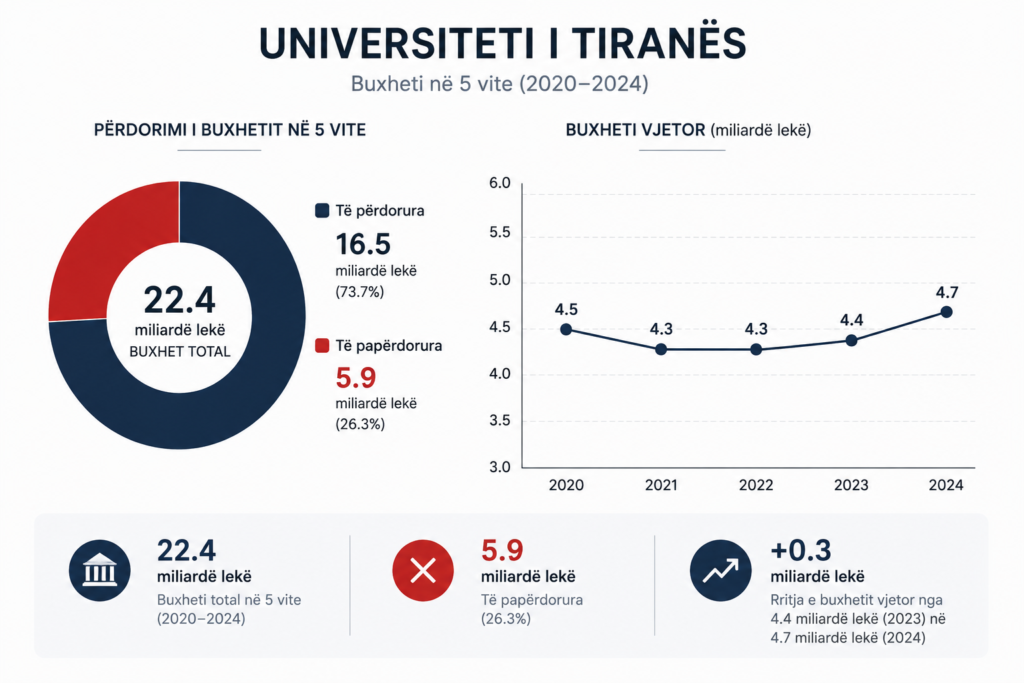
The University of Tirana alone has administered a total budget of around 22.4 billion lek over the last five years. Of this amount, around 5.9 billion lek are unused. Meanwhile, the university's annual budget has increased from 4.4 billion lek in 2023 to 4.7 billion lek in 2024.
A similar trend appears in other public universities analyzed by ACQJ.
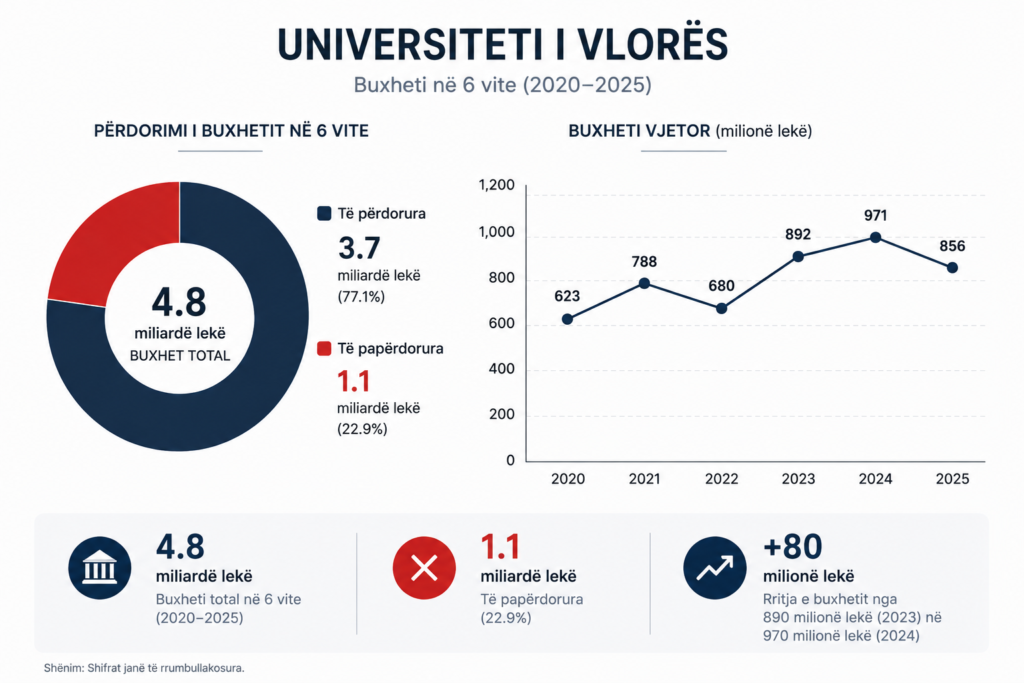
At the University of Vlora, during the period 2020–2025, the total budget reached about 4.8 billion lek. Of this amount, approximately 1.1 billion lek are unused. From 2023 to 2024 alone, the university's budget increased from 890 to 970 million lek.
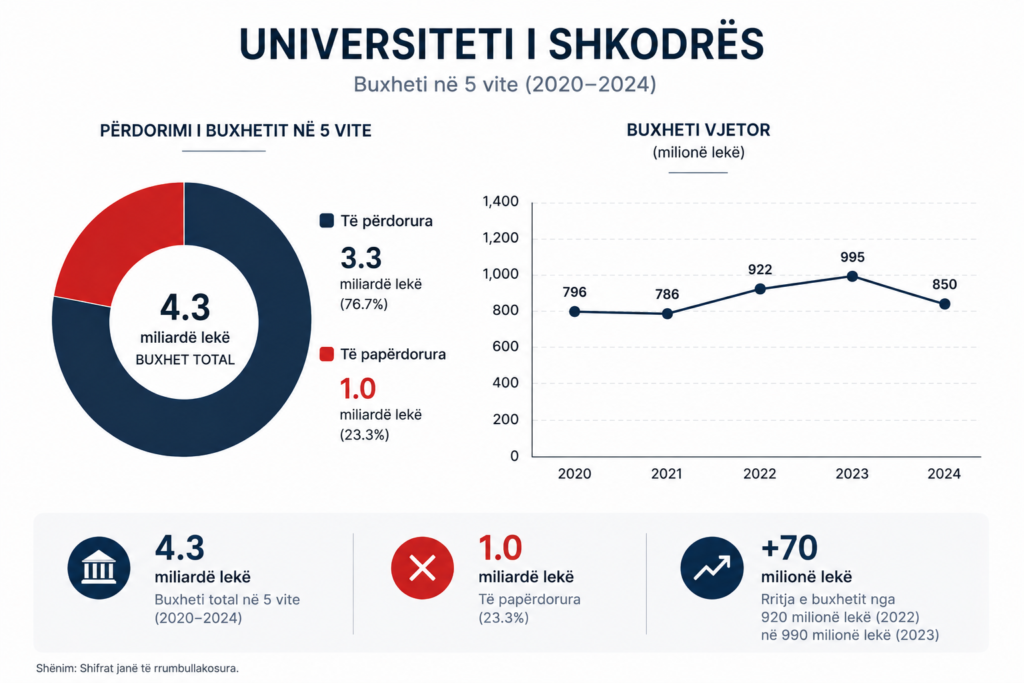
At the University of Shkodra, the total budget for the years 2020–2024 was around 4.3 billion lek, while nearly 1 billion lek remained unspent. In the same period, annual funding increased from 920 million lek in 2022 to 990 million lek in 2023.
Meanwhile, the University of Durrës administered about 3.2 billion lek during the years 2024–2025. The annual budget increased slightly, from 1.59 billion lek in 2024 to 1.61 billion lek in 2025.
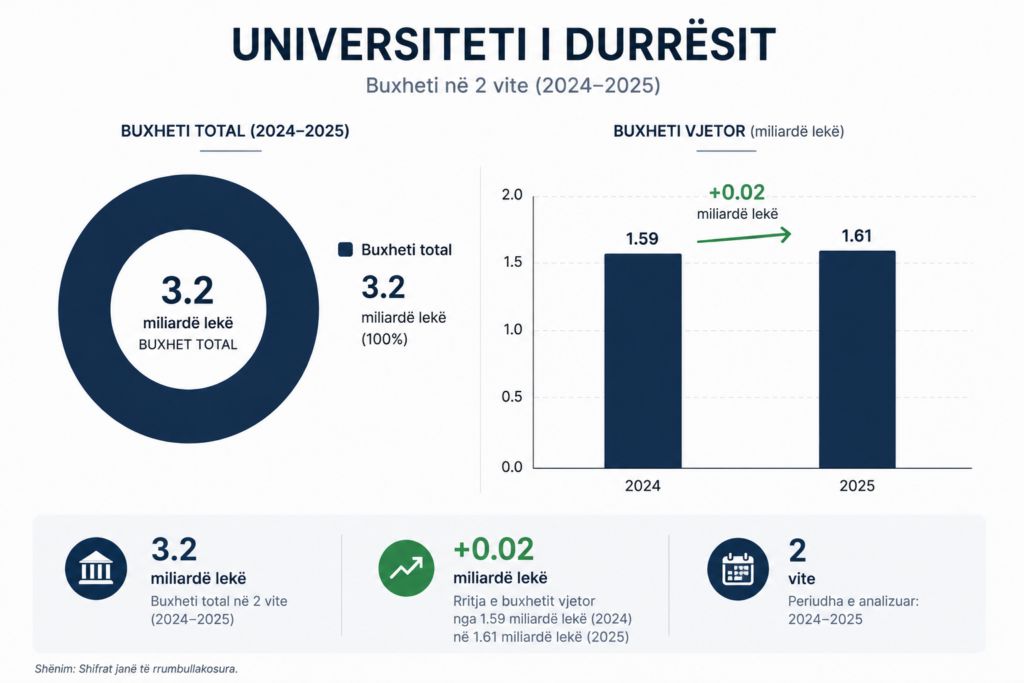
However, the increase in budgets does not seem to have been reflected in the improvement of basic conditions for students. In all four universities, a significant part of the funds remained unused, while investments in heating, technological infrastructure and hygiene and sanitation conditions continue to remain minimal or ineffective.
"The clock is ticking, but not properly"
For Areljo Dulla, a student at the Faculty of History and Philology, these absences are not just everyday inconveniences. According to him, they directly affect the quality of teaching and the way lectures are conducted.
"In one specific case, the projector was out of order and the internet wouldn't connect at all," he says.
“The teacher had prepared all the material for the presentation, but was unable to use it. As a result, the lesson was conducted in an improvised and ineffective manner.”
According to Dulla, such situations are repeated frequently and affect the real content that students manage to acquire from lectures.
“We lose a lot of planned material. And it happens more often than it should.”
He says that students have repeatedly raised concerns with faculty leaders, but the responses have remained general and without concrete deadlines for intervention.
“Promises of improvement are often made, but in practice changes are very slow or do not happen at all. This creates the feeling that our concerns are not taken seriously.”
Rigesa Hoxha, also a student at the same faculty, describes a problem that extends beyond the classroom.
"There is heating only in some halls, not in all. Meanwhile, the toilets are in poor condition. There is often a lack of water, soap or other basic materials."
She also mentions a detail that, according to students, raises questions about the management of facilities within the faculty.
"It's striking that some toilets, which are in better condition, are kept closed and not accessible to students."
When asked by ACQJ about this practice, the dean of the Faculty of History and Philology, Mark Marku, initially denied that the toilets were kept closed. He later argued that some of them were reserved for academic staff.
In the Faculty of Social Sciences, the problems reported by students are similar. For Majnure Zeqon, a student in this faculty, the lack of heating is not only related to physical comfort, but directly affects the learning process.
“When students are focused on the cold, attention to the lecture drops significantly.”
It also raises concerns about safety and privacy in sanitary facilities.
"The toilet doors are broken and don't have locks. You don't feel safe. You have to go with an escort," says Zeqo.
In the “Liria” building, the situation has also produced a collective reaction. In January of this year, students of the language and literature department boycotted classes due to the lack of heating. According to the students, the boycott lasted from three to seven days and involved about 70 students.
“After a few days of boycott, the problem was fixed for the time being,” says Desada Xhetani, a member of the Academic Senate at the University of Tirana. “But then the situation returned to the way it was before.”
Circles in a fragmented reality
At the University of Durres, students' experiences show a divided reality between depreciated buildings and newer investments.
For Orest Berberi, conditions remain problematic.
"The conditions are not comfortable and suitable for teaching. There was no heating and the hygiene and sanitary conditions left much to be desired."
He says that student complaints rarely receive concrete responses.
"No response, except avoidance."
Meanwhile, Endri Tanku, a student at the Faculty of Computer Science, gives a more positive assessment of the new buildings at the Hospital.
"The buildings at the hospital are in very good condition."
The financial data of the University of Durrës for the years 2024–2025 show that, out of about 3.2 billion old lek total budget, only 243 million old lek were spent on current expenses, categories that include heating, technology, and hygiene and sanitary conditions.
At the University of Shkodra, students describe a mixed situation. Gjergj Shegaj says conditions are “generally good,” but admits that the heating problem remains persistent.
However, the financial data shows a more problematic picture. During the period 2020–2024, the University of Shkodra has spent:
- only 51 million lek for heating,
- about 150 million lek for technology,
- while no specific expenditure item for hygiene and sanitary conditions results.
The Supreme State Audit report on the financial and compliance audit at the “Luigj Gurakuqi” University also highlighted a number of problems in the administration of public funds. According to the audit findings, the university’s financial statements contained material discrepancies, including unrecorded differences in treasury accounts, uncollected income from students, and immovable assets that were not reflected in the balance sheet.
The report also highlighted irregular payments made to several categories of personnel, unjustified bonuses for overtime, and violations in public procurement procedures.
At the University of Vlora, students report similar difficulties. Redi Çapoj rated the situation with a grade of 4!
"The equipment is old, the heating does not cover all the premises, and investments are lacking."
For Fatime Hodaj, the lack of conditions directly affects the learning process.
"When you're focused on the cold, you can't focus on class."
While Klea Hoxhaj described the lack of basic sanitary conditions.
"We are often forced to use the toilets in the bars, because the ones at the university are closed or without water."
According to data sent by the University of Vlora for the period 2020–2025:
- about 45 million lek were spent on heating,
- 64 million lek for technology,
- and only 8.5 million lek for hygiene and sanitary conditions.
Figures on paper and reality
While student testimonies speak of cold auditoriums, out-of-function equipment, and a lack of basic conditions, the data made available by universities attempts to mask the reality.
Analysis of the University of Tirana's budget for the period 2020–2024 showed that, out of about 22 billion lek total budget, only 6.6 million lek was spent on heating, technology, and hygiene and sanitary conditions.
These findings were also confirmed by the Civic Resistance's monitoring report on the financial transparency of eight public universities for the period September 2024 - August 2025, according to which only 0.08% of the budget was spent on internet and telephone, only 0.2% on heating and cleaning, while about 27% of the total budget resulted unused.
Migen Qiraxhi from the Civic Resistance links the situation to the lack of transparency, consultation and accountability in the administration of public funds.
"Students and faculty have no access to information on the use of funds. Consultation is almost non-existent," he says.
According to Qiraxhiu, in many cases contracts and financial decisions are justified as "trade secrets", limiting public access to how university funds are used.
Beyond the data from the Civic Resistance report, ACQJ also addressed the University of Tirana with a request for information on the implementation of the budget for the years 2020–2025.
The university refused to make the requested data available, arguing that monitoring reports are confidential, a stance that raises questions about transparency in the administration of public funds.
SS, a former student at the University of Salzburg, says that basic conditions such as heating, technological infrastructure, and hygiene are considered minimum operating standards in European universities, and are not even questioned, unlike what happens in Albania.
Meanwhile, education expert Ndriçim Mehmeti argues that the problem is not only related to the level of funding.
"Projects are approved, but not implemented. The conditions are far from the standards of countries in the region," he says.
According to Mehmeti, there is also a lack of administrative capacity for investment management and the efficient use of technology.
Across the four universities analyzed by ACQJ, the pattern that emerges is similar: funds exist, but their impact on improving conditions for students remains limited.
From cold auditors to the lack of basic infrastructure and financial transparency, the problem is not only related to the amount of funding, but to how it is administered and distributed.
"In the long term, the lack of conditions and standards risks reducing the quality of programs and diminishing the value of diplomas," Mehmeti concludes./ acqj.al