


The only country in Europe without a hospital-prison for the mentally ill
Author: Brejdon Xhavara
Albanian courts regularly deal with various crimes, such as murder, injury, physical violence, etc., whose perpetrators are people with mental health problems. Often the crimes are among the most barbaric. Those accused of minor crimes are in many cases released, while those who have committed more serious or violent crimes are simply imprisoned. According to the Albanian Committee of Helsinki, since January 2019 they are 279 persons who have mental health problems with medical measures closed in prisons.
Albania is the only country in Europe that locks this category of people in the same prisons as other people who have committed crimes, even though they need medication or other Services, such as a neurologist, psychiatrist, psychologist, etc.
Law no. 44/2012, requires the state to guarantee care for mental health, but Albania lacks a special hospital for housing and treatment of people with mental health problems. Although the courts constantly give decisions to close this category of people incriminated in the hospital for medical treatment, this does not happen, because there is no such hospital.
ACQJ spoke with the head of the Albanian Committee of Helsinki, Mrs. Erida Skëndaj, who emphasized that "in terms of prevention, very little has been done by the institutions and it is mainly the media that sensitizes the population from time to time with broadcasts/chronicles, where psychologists, neurologists or psychiatrists are interviewed, who provide information about the forms of mental disorder, how it appears it and what are the influencing factors".
In Albania, there are currently two health institutions that care for patients with mental disorders, Neuropsychiatric Hospital no. 5 in Tirana and the Psychiatric Hospital in Elbasan, where patients with more serious mental disorders are treated.
Kudretja is one of the women who has been suffering from mental health for more than 17 years. Throughout these years, she has been treated on an outpatient basis near health centers and Psychiatric Hospital no. 5 in Tirana. Her health situation worsened during a family incident, as a result of which she was admitted to Hospital no. 5, where he received outpatient treatment. His parents denounced him for the violence perpetrated in the police station, where he was then prosecuted by the prosecutor's office.
Right decisions, wrong decisions
On the day of the trial, the family rejected the accusation, showing remorse, and the case was closed with the decision that Kudretja be treated in one of the residential institutions to receive outpatient treatment.
According to the procedure, the police had to implement the decision to accompany him to the residential institution to receive outpatient treatment, but according to the law "For the treatment of persons suffering from mental health" should have gone to the residential center for the treatment of these persons, a center that did not THERE.
In the absence of this center, the police together with the prosecution decided to send him to the Prison Hospital, contrary to the court's decision.
According to the Helsinki Committee, this is a violation of human rights.
"This category, which is accommodated in the prison system, is in violation of Article 46 of the Criminal Code, because Albania has failed to build a special medical institution (not a prison) for them. They are distributed in two institutions, namely the Prison Hospital (in a smaller number), as well as in the Special Penitentiary Institution of Zaharia (in a considerable number).
Institutional burnout and fatigue of elderly parents
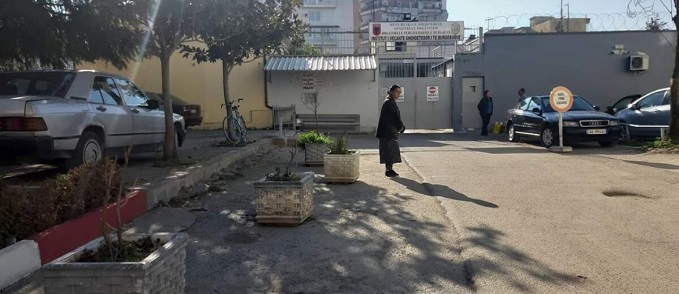
Under the white scarf, sick with tension and diabetes, she leaves her apartment on foot to the University Hospital Center near the Prison Hospital to meet her daughter, Kudrete, who suffers from mental health, schizophrenia, a disease with disorders of thinking, as well as depression.
In order to meet her daughter, Fatmira has to go through the checks carried out by the State Police employees, first the bags filled with food and clothes are checked and then the physical check is performed.
The meeting is held in a room with extremely bad conditions, which are physically and psychologically burdensome, where bars are placed to prevent physical contact.
She told ACQJ: "U I've been coming here every Monday for months. We retracted the charge and repented, but no one listened to us. Now I come here tired of life, suffering and no one says a good word to us about when we will get her out of here and the girl will continue the treatment as before".
Kudretja was previously treated at the Neuropsychiatric Hospital on an outpatient basis, under the care of doctors. Her family had the opportunity to meet her every day, even to sit in the cafe, so she had her freedom, where her rights as a human being, but also as a patient, were respected.
ACQJ interviewed the Ombudsman, Erinda Ballanca: "The Ombudsman, in the role of the National Mechanism for the Prevention of Torture, Cruel, Inhuman or Degrading Treatment or Punishment, has drawn attention to the situation in mental health care hospitals in Albania".
In the period 2014-2019, a total of 22 inspections in psychiatric hospitals. But what is it found during these inspections? "Contrary to Article 28 of Law no. 44/2012 "On Mental Health", it was found that, based on court decisions, people with mental health disorders who committed criminal offenses continued to be treated in these institutions, for which the courts have decided on "forced treatment in a medical institution".
Residential institutions in our country are also provided for in the law, but none of them have been built yet, making the mental situation of patients suffering from disorders even more difficult. In the state budget for the period 2015-2020, no special fund has been provided for the establishment of the Special Medical Institution, as provided by law no. 44/2012, dated 08.05.2012 "On Mental Health"
Pandemic Covid-19
Even prison institutions did not escape the coronavirus pandemic. Some people in Prison 313 in Tirana, who were infected by Covid-19, were transferred to the Prison Hospital, QSUT to be treated. Meanwhile, there were 22 people suffering from mental health in this hospital. In the absence of a specialized hospital, prisoners with mental health problems were sent to Prison 325 in the neighborhood Ali Demi, where women suffer deprivation of liberty, this to make room for those who were infected in other prisons.
During the 3 months in quarantine, the General Directorate of Prisons together with the Ministry of Health and Social Protection did not allow these patients to meet their relatives, thus preventing physical, visual and emotional contact. Sources from the ministry said that computers would be placed in the meeting rooms to chat through the application. Skype or Whatsapp with the prisoners.
As part of the investigation, ACQJ went to Prison 325 to inquire how the method of virtual meeting with patients is working. When we asked when they will be moved from there to go to the Prison Hospital at QSUT and when the visits can continue, one of the guards replied: "We have orders that none of the patients will be allowed to Skype with their relatives and that we have no answer as to when they will be moved out of here."
Fatmira, Kudrete's mother, told ACQJ: "I have not seen him for more than 3 months, I have no information and no one tells me when I will be able to meet him and reassure him why I have not come these 3 months. I have nothing to complain about."
We remind you that the Albanian Committee of Helsinki pursued one of the cases of patients with mental disorder in the European Court of Human Rights, where it managed to win the case. The ECtHR unanimously declared that it found "a violation of Article 3 (Prohibition of inhuman or degrading treatment) of the European Convention on Human Rights due to the inappropriate living conditions in the Prison Hospital, where Mr. Strazimir has been detained under inadequate psychiatric care and in violation of Article 5 (Right to liberty and security/Right to lawful detention promptly ordered by a court), in particular due to the continued deprivation of his liberty in a prison and not a medical facility, as an appeal against the ban has been pending in the Supreme Court since 2016.
In the press release of the ECtHR, it is noted that there is a failure of the Albanian authorities to build a medical institution for the treatment of persons with mental illnesses who require forced treatment, whose freedom has been restricted by court order.
Albania is ordered to establish appropriate institutions for this problem and to ensure that the complainant receives psychotherapy and not just medication.
In conclusion, Albania was sentenced to compensate the complainant with 15 euros, as well as to cover 2,500 euros in court costs.
The Albanian Committee of Helsinki and the People's Advocate have long sought and made recommendations for the establishment of a special institution, where people with mental health disorders, who have been assessed as such by a court decision, will be treated, but there is still nothing. new in this direction and patients have been forced to be locked up near prisons, deteriorating from mental health and being denied any social and legal rights.
*Note: The Ministry of Health and Social Protection has never responded to requests for information.