



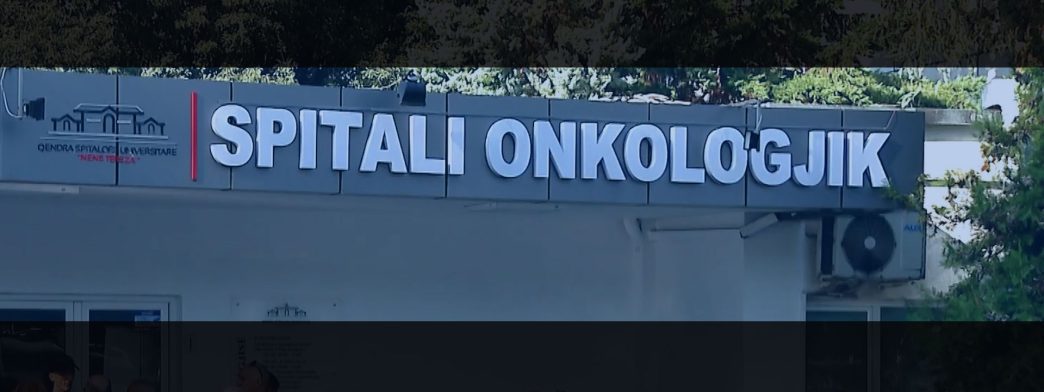

Ida Ismail
Public healthcare is declared to be free, but it is becoming increasingly unaffordable.
Being sick with cancer seems to be more of a social curse than a medical diagnosis.
From the moment of diagnosis, a patient in Albania must face a bureaucratic maze and lack of Services that turn the treatment of a serious illness into an endless journey towards despair.
When 21 days become 3 months
The protocols stated by the QSUT sound good on paper: examination within 21 days, answers after a week, and the entire procedure within four weeks.
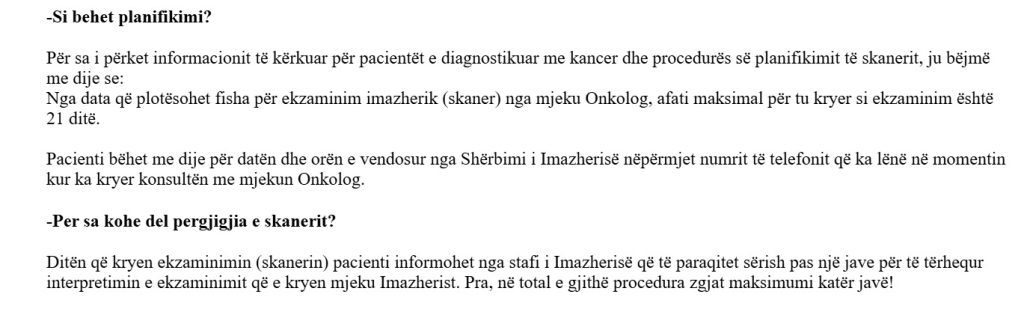
But, as it turns out, this “perfection” remains a utopia for patients who are forced to wait months for a scan. One patient, who expects to live with a serious diagnosis, recounts waiting three months for an examination that she claimed was “planned.” During this time, the disease may have progressed, while hope has faded.
Public hospitals: When CD becomes a business
In a century of technology, QSUT fails to provide disks for the scanner or resonance. The shortage has created a private business within the walls of the public system, where patients are forced to buy a CD for 500 lekë, many times more expensive than it actually costs. This is a grotesque example of a system that has allowed corruption and management deficiencies to enter at every level.
Analysis: An unaffordable luxury
Cancer patients face a poignant irony: tests that should be done every six months are not offered in public hospitals due to a lack of solutions. The state, which is supposed to be the protector of its citizens, turns these people away to private hospitals, where prices are beyond the reach of most.
A patient who has beaten breast cancer says she has not had a test for a year because the state does not provide it. This lack not only endangers her health, but is painful evidence of a system that has given up on its patients.
"The state does not offer me the tests that I need to do every 6 months, because they tell me that there is no solution," says a patient who has defeated breast cancer with concern. The 55-year-old says that she has not had the tests for a year, because they are expensive in private hospitals, and every time she goes to the Oncology Hospital, she receives the answer that the solution has not yet been made available.
Doctors: Between the desire to help and the lack of means
Doctors in Albania often work in conditions that leave much to be desired. The Head of Oncology, Silvana Çeliku, speaks of improvements in oncology Services, but the daily reality shows the opposite.
Çeliku says: "People should have faith in the health structures, as there is an extraordinary staff that fights, despite the shortages, the not ideal conditions in which a doctor can work". Çeliku adds that today there is an improvement in the service from the reception given to patients, from the first contact with the doctor to the treatment that will be given to them".
But the reality is that doctors complain about a lack of medicines, while patients remain unsure whether they will receive the right treatment.
How can you fight such a severe disease when even the most basic weapons are lacking?
For the specialist of the Institute of Public Health Alban Ylli, the state must be prepared to spend a lot of money on cancer treatment, to have little benefit.
"Every year new medications are introduced, companies are working, but no revolution is expected for this disease in the next 5 years."
Ylli underlines that the health system is not perfect, but there are improvements and efforts, better treatment and earlier detection.
Doctors also raise concerns about the lack of medicines, as a result of problems with tendering.
Oncologist Anila Pema says: "There are also cheap medications, but they are in short supply and cannot be replaced. We have front lines, still uncovered. We are in a dilemma before the patient to tell them which is the best or what we can do."
Until the moment when they do not receive dignified service, when there is a shortage of medicines, when tests are not offered, citizens will continue to lack confidence in the health system in the country. Some of them will be forced to turn to private hospitals with a high cost of treatment or abroad. Therefore, more must be done by the state for the health system, public hospitals, so that doctors have all the conditions to offer their service, do not leave Albania and patients receive the treatment they deserve.
At the end of the day, patients who cannot afford private hospitals remain victims of a system that has forgotten them. For those who can afford it, treatment abroad becomes the last resort, turning borders into a dividing line between life and death. Doctors, on the other hand, leave for countries where their work is valued and where the dignity of the profession is preserved.