


Author: Denis Tahiri
"I'm renting with my friends. I wake up in the morning, go to the University, attend lectures and seminars, then work on any assignments I may have," Anjeza Boja, a student from Shtërmeni, told "Sinjalizo" and had to rent an apartment to pursue her higher studies in Elbasan.
The figure calculated in 2021 for the living of a student in Albania is 324 euros. For this "Civic Attitude" study, 775 students were surveyed. The figure of 324 euros is the average cost over their basic needs such as accommodation or food, without taking into account study fees.
And while living prices have increased significantly, currently no institution in our country has an official figure regarding the amount spent by a student during a month.
Who spent more and on what?
Albanian universities, since the signing of the "University Pact", have an obligation through the U-transparency platform to provide total transparency of funds, what they spend, what they spend it on, as well as their income. But not all Higher Education institutions in the country do this, even though they should be the first in transparency. Meanwhile, a breakdown of their expenses has been made by QQ , in several reports from several years.
"Aleksandër Xhuvani" University, for the academic year 2021-2022, has spent 431 euros only for building security, 944 euros for meals and travel, 115 euros for car fuel and 985 euros for telephone and internet for staff. On the other hand, this institution has spent only 29 euros on studies and research and 000 euros on books and publications. These expenses are from the total of more than 23 million euros that this institution has spent in the past year, where 479 euros were spent only on the "Personnel expenses" category.




Meanwhile, the situation is similar at "Luigj Gurakuqi" University. For the academic year 2021-2022, this university has spent almost 4 million euros, where the biggest items are personnel expenses with 2 euros. For the security of the building, this institution paid 614 thousand euros, while it spent 949 thousand euros on car fuel. On the other hand, 252 euros were spent on research and studies, while 64 euros were spent on publications and books.
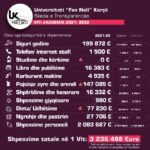
At the University of Korça "Fan Noli" for studies and research for the academic year that we left behind, not a single lek was spent, out of the total expenses of more than 3.2 million euros. Meanwhile, more than 77 euros were spent on food and travel and 147 euros on office equipment.
3.7 thousand euros is the expenditure made by the University of Durrës "Aleksandër Moisiu" for studies and research from the total of almost 6 million euros it has spent. This university has spent 195 thousand euros for building security and more than 4.5 million euros for personnel expenses.
Meanwhile, the University of Tirana, which is the largest in the country and has a total expenditure of 9-10 million euros, has not spent a single lek on research and studies, but on the security of the building a full 637 euros. On the other hand, this institution has spent more than 454 million euros on office equipment and furniture.
Shades of corruption in Universities
In September 2022, the Prosecutor's Office of Tirana requested the arrest of four persons, staff of the Agricultural University of Tirana, for a tender of 10.5 million ALL. The case started after the report of A.Ç, employed for 10 years at the Agricultural University of Tirana. The whole case, after the completion of the prosecution's investigations, turned out to be a game with the documentation, where a part of the goods that should have entered the warehouse, never entered.
"According to the entry form in the warehouse, the value of the goods was 10.5 million. The informant in good faith signed the entry slip and stated that the goods for the amount of ALL 3.7 million were never entered into the warehouse and from this amount, the informant, in good faith, signed an exit slip for the amount of ALL 1.958.500. The exit for this value of goods, according to the complainant, was made under the constant pressure of the AR citizen. it is stated in the notification of the Prosecutor's Office of Tirana. But the cases when the prosecution conducts investigations on the expenses of the Universities in the country are rare.
Rigels Xhemollari from Qëndresa Qyvetare says that there is a practice where things are bought as if they were purchased and in reality they do not physically exist. " For example, at the University of Durrës, 100 computers were purchased through a contract and the students and lecturers say that the computers are fake, they do not exist," he says, adding that the same thing happened with the Agricultural University, which bought chemical fertilizer for trees for 100 thousand euros, but the prosecution's investigation revealed that it had only come in and out on paper.
For Xhemollari, the first practice that stands out the most in Albanian Universities is the budget for guards, where the budget is tendered and by tendering, much more money is spent than would be spent if it were a guard who would be paid by the rectorate or the faculty where it is located.
" I think that the budget for the guards is multiplied here and I think that there is an abusive, corrupt contract hidden here, considering the salaries that the guards receive," he says, adding that the professors who pay from their salaries to do research are powerless to be part of decision-making and democracy. " They don't know how much money comes in and how much goes out, which means that the level of democracy, transparency, participation is 0 inside, imagine then outside," he concludes.
And while in many countries around the world, universities are a model of transparency and democracy in their functioning, thus cultivating in their students a culture that improves society, according to Xhemollari, in Albania they are playing the opposite role. " They are teaching students how to be corrupt, how to get a diploma by cheating, they are playing the role and giving a very negative model for how a public authority should be transparent," he says.
Meanwhile, another point that Xhemollari emphasizes is the ethics councils in universities. " At the University of Tirana, elections were held for new members. There is no decision by the ethics council, imagine in the last 10 years there is no violation, no plagiarism, no complaints from students, imagine how many conflicts of interest there are inside, how powerless this army is to judge itself and then to provide the model that society requires", he concludes.