Author: Dallandyshe Xhaferri
No dormitories, no libraries, no public canteens
7%-10% of students studying in public universities are accommodated in dormitories. Some buildings are still in the process of reconstruction, while some are depreciated. The lack of large libraries and environments to spend free time is evident, while there is a lack of public canteens where students can spend less on food.
48 hours to register in the dormitory
On September 19, around 5:30 in the morning, Olta B. left the city of Prrenjas for Tirana to register in one of the state dormitories for medical students. Although he arrived in the capital before seven in the morning, he could not secure a number for the registration queue. The third-year medical student tells "Sinjalizo" that in order to secure a dormitory room for the academic year 2023-2024, she needed more than 48 hours of waiting in the capital.
"After I checked into the hotel on the 19th, the next day around 6:20-6:30 I went near the Student Residences and saw many people, parents and students pushing each other to get a queue number, and on the other side there were some guards throwing numbers into the crowd or passing the bunch of numbers to each other as if it were a game," says Olta, who was in line with number 160 and managed to register around seven in the afternoon on September 20.
"I made the payment at the bank on the 21st and signed the contract that same day because I was afraid I would be left without a room and I couldn't afford a rented house," she says, indicating that she is currently accommodated in building number 1 of Student Residence number 2.
There are 2 buildings in RSU 8, of which 6 are new buildings, while buildings number 1 and number 2, according to Zhanina Dapit, Director of Dormitories in RSU 2, will undergo reconstruction next year. In the academic year 2023-2024, 1523 students have been registered in this residence, of which 772 are medical students.
According to director Dapi, there are 1933 beds available to students, while there is a closet in each room.
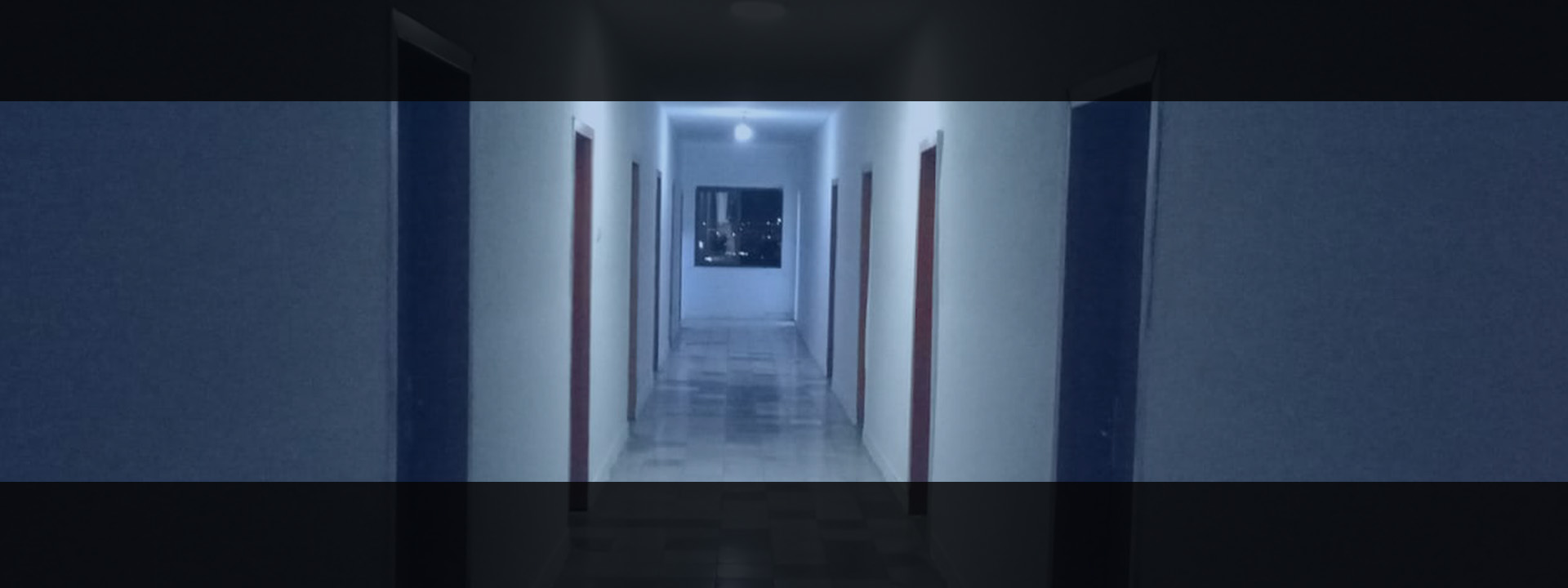
"We don't have a big space, I can't take all the clothes, I take some and take another," says student Olta B, claiming that in building number 1, one floor has been closed to students due to dampness in the walls, while each floor has 27 rooms.
Another problem for students living in state-run dormitories is the lack of large libraries and collaborative spaces. “There are no large libraries, no large study and interaction spaces between students, and no sports facilities. If we look at it from the front, we are dealing with a student dormitory rather than a university campus as promised,” says Rigels Xhemollari, executive director of the Civic Center.
Delayed reconstructions
In Student City, the reconstruction of buildings began in 2019 with building number 6, a work carried out in cooperation with the Turkish agency TIKA. Some buildings are still in the reconstruction phase, while others are depreciated and inhabited by students. In the response that the Directorate of Student Residence number 1 gives to "Sinjalizo" it is stated that of the 29 buildings included in RSU1, 22 are in function of students. "One is in the final phase of construction, as well as 5 dormitories in reconstruction within the framework of the German Government Program through KFW ", - the response states.
Two of the buildings that are being reconstructed are building number 16 and the one with number 17. According to the data published on the information board near the buildings, the investment for each of them is over 9 million euros, while the deadline for completion is December 13 of this year. the year.
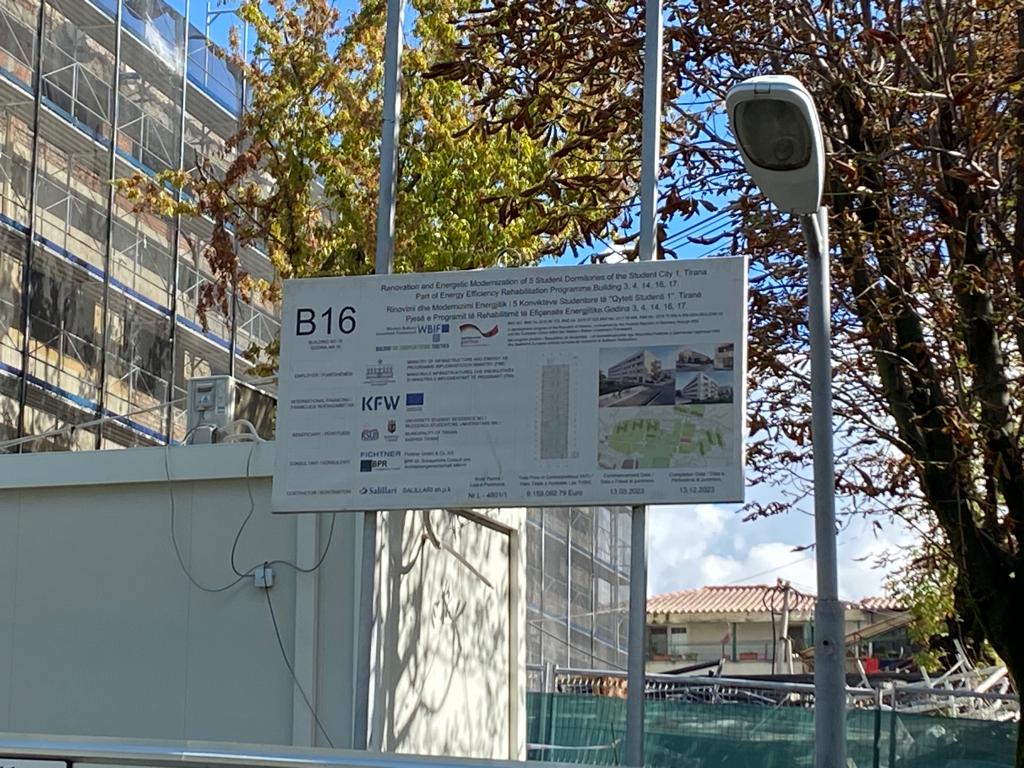
But these buildings should be entirely for the benefit of students. In the Pact for the University , a plan of promises for the 8 demands of students made public during the December 2018 protest, announced by Prime Minister Rama in the same month at the University of Vlora, it is stated that the reconstruction interventions with funding from the State budget would be carried out within the 3-year period, 2019-2021. Also, by decision of the Council of Ministers in 2020, the decision was made for the reconstruction of building number 16 by allocating funds worth 311,425,288 lek. A year ago, "Sinjalizo" published an article where the administrator of the dormitory, despite the approved decision, was not informed about the works that could be carried out, although building 16 began to undergo reconstruction only in March 2023 with funding from the German Government project.
The buildings planned to be reconstructed in the Student City are buildings 24-25, as well as buildings 27-28.
Anisa, a student of Social Work, says that in these buildings, “Only a few rooms have been painted .” Coming from Kukës, she says that she chose to stay in state dormitories only because of the more favorable payment. “I pay 4300 lek per month and for the conditions that are there, it can be justified.” But the second-year bachelor’s student of Sociology, Esmeralda Sherfi, thinks differently, who has decided to live in a rented house. “I share the rent with two other girls and in terms of the monthly payment for the dormitories, it almost cost me the same as with the house,” says the student who came from Konispol, emphasizing that in this way she manages to live in better conditions.
Xhemollari: 7%-10% of students in public universities are accommodated in dormitories
The Directorate of Student Residence number 1 says that the buildings have accommodation capacity for 4600 students, while currently 3974 students are accommodated. In the University of Tirana for the academic year 2022-2023, the number of students of the First Cycle, Second Cycle and Executive Master's study programs at UT is 22, of which 076, or otherwise about 13% of them come from the municipalities the other. Meanwhile, according to data from INSTAT for the same academic year in Tirana, the total number of students is 450.
"Regarding the accommodation capacities of student buildings, these residences currently accommodate 7%-10% of the total number of students studying at public universities," says Rigels Xhemollari, according to whom the way university campuses are organized in Albania lags behind Kosovo.
“ None of the student residences in Tirana have a public canteen that offers reduced-cost meals to the students who are there, costing them half of the monthly budget,” says Xhemollari, adding that all the buildings are not fenced or built within a “security zone.” “They are accessible by cars, by bars, hairdressers, and many businesses that disrupt normal student life or tranquility,” he concludes.
Students accommodated in old dormitory buildings pay about 4300 ALL per month, while household appliances such as cooking stoves and refrigerators are provided privately by them, not being considered by the dormitories as elements that are included in "accommodation capacities".
This article was created based on input provided by individuals who have chosen to speak up. Share your story, empower others and be an agent for change. Visit the website: www.acqj.al/sinjalizo-dhe-ti/