


Ida Ismail
Exactly 37 years ago, in 1988, a group of engineers first drew the Arbri Road on the country's strategic map, a fast and functional connection between Tirana and Dibra, and then with North Macedonia.
Today, after three decades of plans, promises, and delays, this road has been inaugurated several times, while the main problem is no longer whether it will be completed, but whether this road was built responsibly, with quality, and for the public good.
How did Abri Street get its name and when was it first mentioned publicly?
The road was first publicly discussed in 1995, and in 1996, 45 intellectuals from Peshkopia sent a petition to the Mexican government for its construction. The road was named after Arbri to honor the historical heritage of this region.
Arbri Road, part of the promises in electoral campaigns
In every election cycle since the 2000s, the Arbri Road has returned to public discourse as a repeated promise of every government.
In 2003, when the prime minister at the time was Fatos Nano, it was decided to conduct a feasibility study first, with the state budget. Engineer Faruk Kaba says that after the feasibility study, an implementation project was also done, in order to finance the construction, but it was completed in 2010-2011, that is, 7-8 years later. According to the engineer, the delays came from interests against the construction of this road.
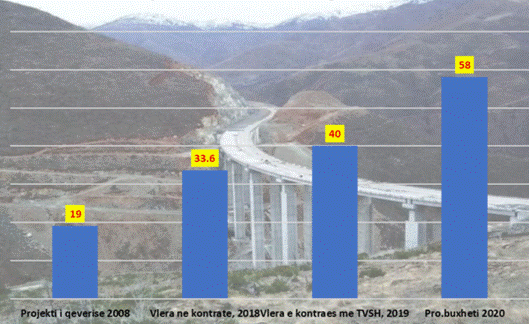
Cost of the road: From 184 million to 460 million euros
In 2015, a Chinese company offered to build the road through a concession worth 184 million euros and a completion deadline of 36 months. But the deal fell through. Instead, in 2017, the project was awarded to the Albanian company “Gjoka Konstruksion” through a PPP concession with an initial value of 33.6 billion lek (about 270 million euros).

In the following years, this amount increased by 45%, reaching 460 million euros, due to “geological difficulties” and the collapse in the Murriz tunnel area. “We will build the Arbri Road, free of charge for citizens. This is the road of trust between us and the people of Dibra,” declared Prime Minister Edi Rama during one of the road’s inaugurations.
Arbri Road was inaugurated three times by the Rama government.
The road was first inaugurated by Prime Minister Rama in November 2021, then again in March 2022, on the eve of the partial elections in Dibër.

On March 14, 2025, on Summer Day, the Hawthorn Tunnel, a key segment of this road, was inaugurated for the third time.
"Today we open the Murriz tunnel, one of the greatest engineering challenges, which proves the power of the infrastructural transformation we have initiated," said Prime Minister Rama on this occasion.
Experts on the quality of the Arbri road, the violations found
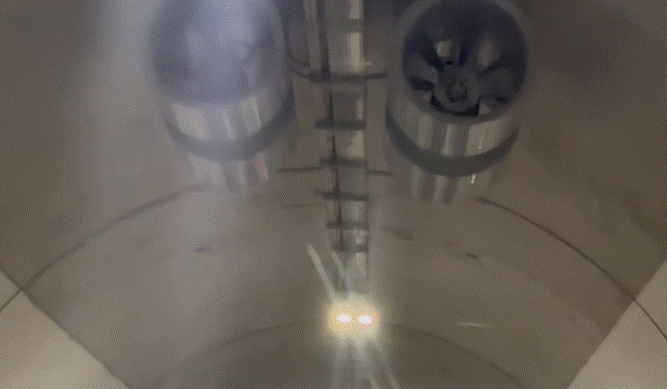
But according to experts, the road cannot be considered completed: The ventilation in the 3.8 km tunnel is not functional, there are illegal entrances and exits in Gjorica, and the Maqellarë-Peshkopi segment, as well as the connection to Dibra e Madhe, have not been completed.
Expert Faruk Kaba, a road designer in the 90s, says that the Murriz tunnel could have been shorter and more economical:
"I am convinced that this path could have been done better, faster and cheaper. But technical decision-making was replaced by the logic of political interest."
Violations with the construction of the Murriz Tunnel, Balluku: It will be completed within 2022
The government has blamed the delay in the construction of the Arbri road on the geology of the Murriz Tunnel.
Minister of Infrastructure Balluku said that "The contract has a delivery deadline of the end of April 2022 and we will do our utmost to deliver everything on time."
But, this deadline was exceeded by more than two years.
Engineer Faruk Kaba: "The tunnel went 3.8 km, it could be reduced to half of it. I was ready to cooperate, but unfortunately these processes are not judged by experts. A suggested 1.7 km tunnel, they say, is half of the construction and the time would be much shorter."
Concern, supervision of works on Arbri Street
Meanwhile, another concern is the supervision of the works: According to Kaba, the contractor appointed its own supervisor, compromising the technical and financial integrity of the project.
Bujar Karoshi, one of the initiators of the request for the Dibra road, which was later replaced by the Arbri road, is categorical:
“The Arbri Road is not finished. There is no real connection to North Macedonia and the segment towards Peshkopia is not part of the project. The promise of regional integration has remained on paper.”
The Arbri Road is the most illustrative example of how an infrastructure project can be used as an electoral tool. Three inaugurations, promises of delayed completion, and cost increases without transparent justification, turn this road into a “golden axis,” as the opposition has called it, more because of its price than its economic impact.
Arbri Road remains a complex story of engineering vision, political interests, systematic delays, and a lack of transparency. It is a symbol of a country that often prioritizes propaganda over infrastructure and facade over function. In this sense, it is not simply a road connecting Dibër to Tirana, but a road that shows how development is constructed and often mismanaged in this country.