


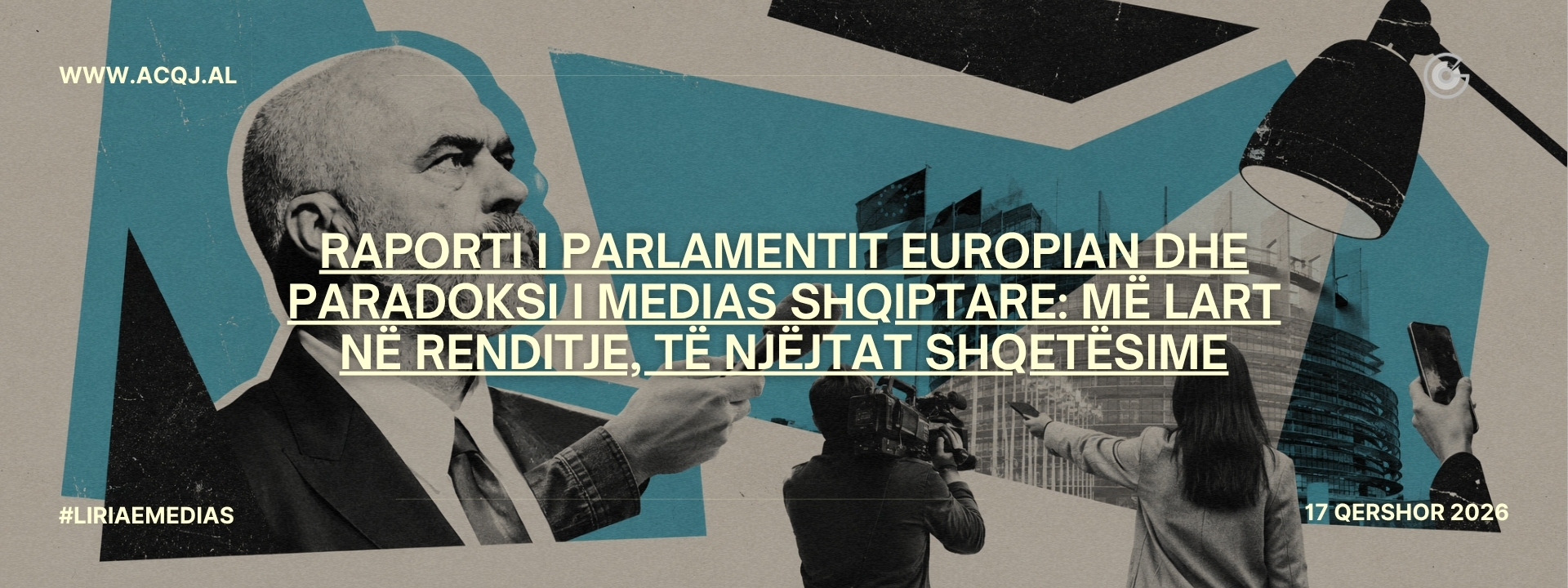
ACQJ editorial office
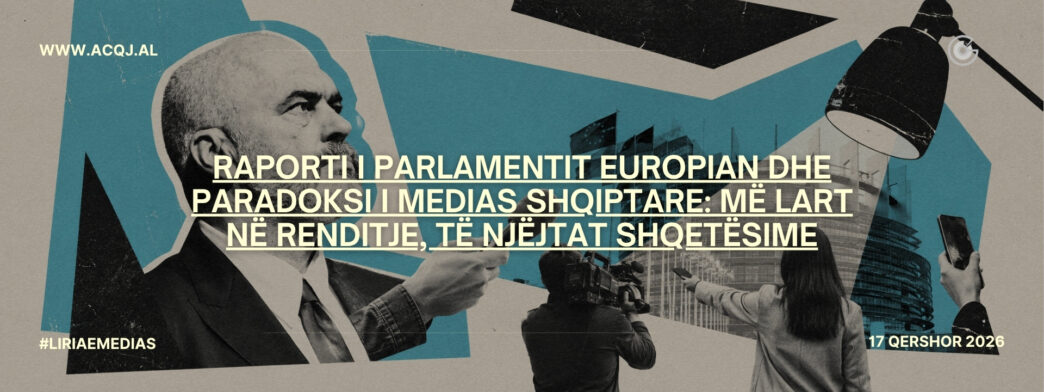
The European Parliament today voted on the resolution on the European Commission's Report on Albania for 2025, with 483 votes in favor, 103 against and 70 abstentions. The main message that emerged in the media headlines was somewhat overwhelmingly positive: Albania is moving quickly towards the European Union.
But a more careful reading of the document reveals a different story.
Amidst the praise for the record opening of negotiation chapters and the acceleration of the integration process, MEPs hint that one of the oldest problems of Albanian democracy continues to remain unresolved: the freedom and real independence of the media.
In fact, while many of the report’s chapters focus on justice reform, the fight against corruption, or public administration, the language used on the media is among the most direct and politically significant of the entire document. It suggests that Brussels is no longer viewing the media as a separate sector of reform, but as a direct test of the quality of Albanian democracy.
The Albanian Paradox: Rankings Improve, Concerns Remain
On the surface, Albania has reason for optimism. The European Parliament welcomes the fact that the country has climbed from 99th to 80th place in the Reporters Without Borders World Press Freedom Index. For a country that has been the subject of criticism for years for its political and economic capture of the media, this is undoubtedly a positive development.
However, what is striking is that MEPs do not treat this improvement as sufficient proof that the problems have been solved.
On the contrary.
Immediately after the reference to international rankings, the report returns to almost all the concerns that have dominated the debate on Albanian media over the last decade: the lack of transparency of ownership, potential conflicts of interest of owners, political pressures, economic pressures on journalists and the non-transparent distribution of state advertising.
This contrast is significant.
He suggests that, for Brussels, improving its position in an international ranking is of no value unless it is accompanied by structural changes in the way the media market functions.
In other words, Europe is saying that the problem of the Albanian media is no longer a matter of laws. It is a matter of power.
State advertising and invisible influence
One of the most interesting signals of the report is found in the reference to state advertising. At first glance it may seem like a technical detail. In reality, it is one of the most important debates taking place today in European institutions about media freedom.
In various countries of the European Union and Eastern Europe, European institutions have concluded that governments no longer need to close down television stations or censor journalists to influence public information. They only need to control the economic resources from which the media survive.
Public advertisements, institutional contracts, and communication campaigns can be used as mechanisms to favor certain media outlets and penalize others.
The European Parliament does not claim that Albania is in this situation. But the fact that it is demanding greater transparency in the distribution of state advertising shows that there is a real concern that political influence can be exerted not through censorship, but through the economy.
For a small media market like the Albanian one, where many media outlets operate with limited financial margins, this is an issue that directly affects editorial independence.
Attacks on journalists are no longer considered "political debate"
Perhaps the strongest part of the report is that related to the treatment of journalists.
The European Parliament strongly condemns the hostility towards independent journalists and media professionals, citing verbal attacks by senior officials, discrediting campaigns, online harassment and pressure on reporters covering corruption, the rule of law and justice issues.
For years, the debate centered on formal censorship. Today, the focus has shifted to the informal pressures that produce self-censorship.
A journalist doesn't need to be arrested to be afraid.
It is enough to constantly face public attacks, political labeling, lawsuits, or discrediting campaigns that make his profession more insecure and more costly.
At this point, the European Parliament report leaves little room for interpretation: the climate in which journalists work continues to be a serious concern for European institutions.
Media owners remain the unanswered question
Another element that appears in the report is the transparency of media ownership.
This may seem like a technical requirement, but in reality it is one of the most sensitive topics in the Albanian media sector.
For years, international organizations have raised questions about the links between economic interests, business, politics, and media ownership. In a market where many media owners have significant activities outside the information sector, Brussels' concern is not only who owns the media, but also which interests can influence the editorial line.
When the European Parliament calls for greater transparency, it is asking for citizens to be able to understand not only the news they consume, but also the interests that may lie behind it.
From media freedom to the quality of democracy
Perhaps the biggest change the report reflects is the way the media relates to democracy.
In the past, media freedom was treated as a separate chapter in the integration process. Today, it is part of the discussion on elections, corruption, accountability and public trust.
When the European Parliament talks about equal access to the media during elections, about political polarization and the need to strengthen democratic control over power, it is treating journalism as a democratic institution and not simply as an industry.
This matters because it changes the way Brussels will assess Albania's progress in the coming years.
The question will no longer be whether the media can broadcast criticism of the government. The question will be whether Albanian citizens have access to an information environment that is sufficiently pluralistic, transparent, and independent to keep power under control.
The European Parliament's report is, in essence, an optimistic document for Albania. It recognizes the progress made, welcomes the pace of negotiations, and appreciates the country's clear European orientation.
But when it comes to the media, optimism is accompanied by a large dose of skepticism.
Brussels admits there are improvements.
However, he is not yet convinced that the problems that have plagued the Albanian media for decades have been resolved./ acqj.al