


Author: Klevis Paloka
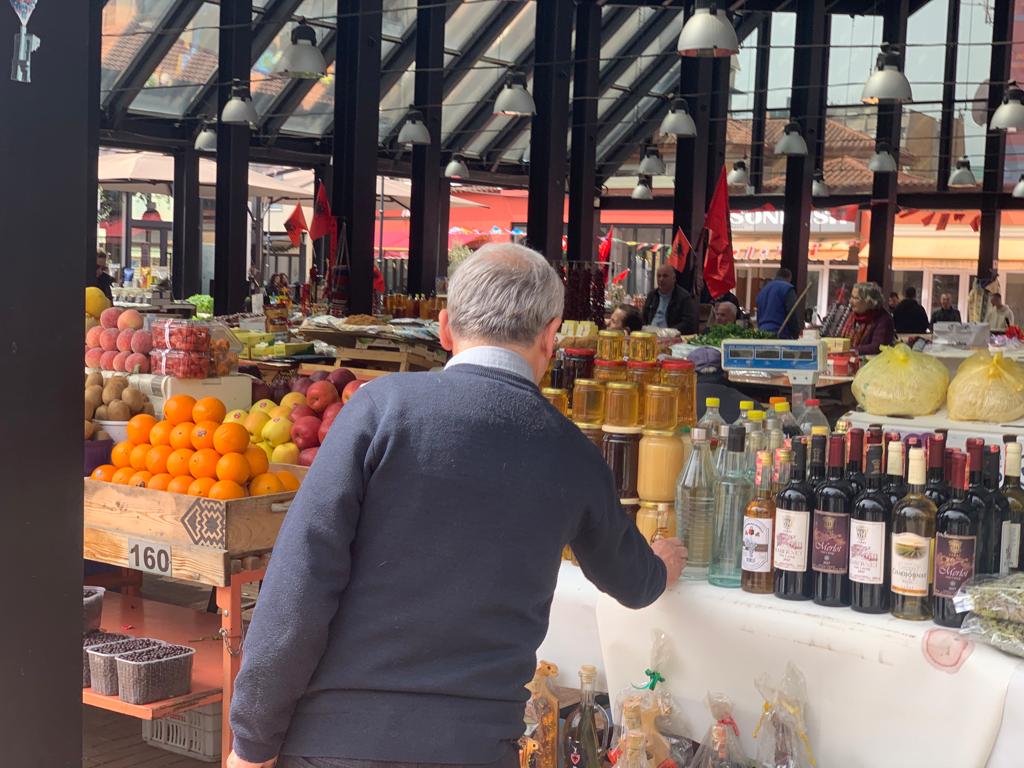
With unstoppable rates, the prices of basket foods are increasing, directly affecting the citizens. The elderly man, Sarafin Lleshi, walks among the stalls in one of the agro-food markets where, next to the products, the prices are not the same as yesterday.
" They have grown so much that we don't have money to take them. We can't meet the conditions for anything, we just go out in vain. The government must find a solution so that it doesn't let us die for bread. In the lek for bread scenario, with a pension of 5000 lek that I have, I can't even go out for bread, increase the pensions. It's good that I have my children abroad, because it's impossible for me to make ends meet, " this is how the 80-year-old begins his story for "Sinjalizo".

The pensioner is able to count one by one, each of the products starting from the main ones such as bread, flour, oil, rice, sugar, etc.
" Bread has gone up by 20 lekë today alone, all vegetables have gone up, tomatoes have gone up by 20 lekë, potatoes by 20 lekë, cucumbers by 10 lekë, spinach by 20 lekë, apples by 30 lekë. Groceries have gone up. Oil, flour, rice, sugar, " recalls the pensioner who is walking around hoping to find them a little cheaper somewhere. But because food prices have gone up, Sarafin Lleshi is forced to return home empty-handed, convinced that maybe the price will go down.

Hasan Stafa, who heads the Consumer Protection office, repeats that the "madness" of prices started on February 22, jumping up to 25%.
" The increase began two days before the invasion of Ukraine began. Flour for mass bread at wholesale points on March 1 was sold for 7600-8000-10000 lek per quintal, while on March 8, 1 quintal was sold for 8000-8400-10000 lek per quintal. The price of bread from March 1 to March 8 has increased by 10-20 lek per 1 loaf of 720-800 grams. Edible oil has increased by 20% from 210 lek on March 1 to 250-280-310 per 1 liter. Rice has increased by 25% within 1 week. Milk and eggs have increased by 10%. Fruits and vegetables have increased by 5-10%. The highest price increases are in the districts of Tirana, Durrës, Vlorë and Dibër ", says Stafa for "Sinjalizo".
Trying to understand what happened to the basket of food, the director of the "Albanian Consumer" center, Ersida Teliti, has another alibi for a crisis that, according to her, started earlier.
" The increase in basket prices started earlier, before the Ukraine-Russia conflict actually began, but it had its main impact at the moment this war began. Prices have been increasing since before, we recall here the increase in the price of bread in the summer period, August-September, where we addressed the competition authority through a letter. The increase in hydrocarbon prices will directly affect the increase in all prices, including basket prices, since it will be through means of transport and the citizens will bear the largest costs ," Teliti tells "Sinjalizo".
Prices in the sky, no one interferes
The latest report published by the Institute of Statistics in the report of the monthly index for consumer prices shows the increase in the prices of basket products, but also of other categories.

"Within the food group, prices of the subgroup "vegetables including potatoes" increased by 16,4%, followed by the subgroups "oils and fats" by 10,1%, "fruit" by 7,0%, "bread and cereals" by 6,8%, "sugar, jam, honey, chocolate and confectionery" by 6,7%, "meat" by 3,9%, "milk, cheese and eggs" by 3,3%, etc.," the report states.

Everyone was affected, but especially the needy strata
According to the director of the "Albanian Consumer" center, not only citizens in need are assessed as the most affected by price increases.
" So the so-called needy classes, including clients who are not only those who receive economic assistance, not only people who have no income, not only marginalized communities, but also family women or people who have minimalist pensions below the average wage, who will be directly affected by the increase in prices in every aspect of life. These will also affect almost the majority of the middle class, because practically in their family budget at the end of the month there will be more expenses than income ," says Teliti.
Also, the expert calls the reasons why this trend happened as abusive.
" The justification that the price increase is being influenced by the war is somewhat inaccurate or abusive in the conditions when we should have a price increase that will be affected a little later, as discussed by many traders and businesses in their warehouses or in their warehouses there are still products that were purchased before the war started. That is, they were purchased at a lower cost and the increase is often unjustified. Generally, in the framework of economic theory, in order to have a price increase, we must have a provision of Services, we must have greater quality or even variety in Services, as price increases in such emergency conditions occur in those cases when they are truly directly affected by these situations, force majeure such as war ," says Director Teliti.
Even according to the economy expert, Klodian Muço, the reason why the needy and middle classes will feel more is related to the expenses that occupy the highest percentage of income.
" Albanians are suffering from the price increases of the basket, because almost 40% of the budget of an average typical Albanian family goes to food goods, that is, for food products and non-alcoholic beverages, so it has a large weight. While an average family in the European Union this is only 18%, so for Albanian citizens it is a very heavy burden and the more these prices are increasing, the more the poverty level in Albania is increasing ," Muço emphasizes for "Sinjalizo".
So the former finance minister, Arben Malaj, adds that in addition to the increase in prices, the reason for the increase in poverty is also the high inflation.
" High inflation affects the increase in poverty. We must keep in mind that inflation is a tax that hits those with lower incomes the hardest. This tax acts automatically, without a legal act, but directly through the increase in prices of goods and Services. According to World Bank studies, in our case, based on the structure of the family budget, the poor and those close to the critical poverty line are at high levels. The risk is high that high prices in their chain effect will hit more individuals and families in need of social support ," argues former Minister Malaj.
On the other hand, the Bank of Albania notes that inflation for the month of February 2022 reached 3.9%, while a year ago it was only 1.1%.

Why is price speculation not supervised?
According to Mrs. Teliti, the main authority that should monitor the competition is the Competition Authority. The expert says that the organization she leads has reacted by complaining about the increase in the price of the basket.
" Regarding prices, we have discussed with the main institutions, here we can regularly mention the complaints addressed to the Competition Authority, the last of which was sent on March 5, but also other complaints that we have addressed to other institutions. The approach is who is the responsible institution and who is billed for this, so we must have a combination through this institution, through the Ministry of Finance, and in the meantime between the tax investigation and taxes, in the case when it is found that these abuse prices and do not declare these prices. In all other cases, the institutions have a very difficult time, referring to their powers, to intervene. Currently, the best reaction should be from the Competition Authority, which should conduct an investigation because, in fact, the focus and key function is the protection of free, fair and fair competition. In the end, precisely a free and fair competition in conditions when we do not have a monopoly or oligopoly situation or the dominant position in the market is not abused, in the end, it is the consumer that must be protected, where the price is "It is really established according to the rules on the basis of supply and demand, so we hope that these institutions or other institutions involved in direct or indirect processes can act ," says Teliti.
But when asked by "Sinjalizo", the Chairman of the Commission of the Competition Authority distanced himself from the powers.
" We are guardians of competition between businesses. We are neither price regulators, nor food quality controllers, nor the government. There is no legal possibility for the Competition Authority to open an investigation into the prices of basket products. The government deals with these, not us as an independent institution, with a unique focus on competition ," said Denar Biba in a reaction to "Sinjalizo".
Even though the chairman Biba insisted strongly on the fact that it is not the competence of the Competition Authority, on Friday, March 11, this institution announced that it has started monitoring the subjects operating in the market of basket products.
" Meanwhile, the Competition Authority, pursuant to Article 28 of Law No. 9121/2003 "On the Protection of Competition", also prompted by information and concerns received from the media about the immediate increase in prices for basket products, through Order No. 190, dated 11.03.2022, and Order No. 192, dated 11.03.2022, has immediately placed under monitoring the entities operating in the vegetable oil, flour, egg, rice and sugar products market ," the Competition Authority's announcement states.
Ironic is the fact that this authority is recalled after almost 3 weeks to place under monitoring the entities that increased the prices of basket products.
"Sinjalizo" was also interested in the Consumer Protection Commission, an institution under the Ministry of Finance and Economy that deals with consumer protection.
" There are no complaints from consumers about the prices of takeaway food at the Consumer Protection Commission. If a complaint from consumers had been submitted to the Consumer Protection Commission, we would have delegated it to the relevant ministry ," Klotilda Neziri, a senior official of this Commission, told "Sinjalizo".
So "Sinjalizo" also requested a response from the Ministry of Finance and Economy regarding the increase in the price of basket products, but until the publication of this article, it did not receive any response.
But what can be done to prevent further price increases?
The expert on the economy, Klodian Muço, suggests the establishment of a task force to monitor the process of price progress and that a decision the government could make to help the citizens is for the moment the suspension of some strategic investments.
" The first aspect I would suggest is to set up a task force or a working group to deal precisely with the process of monitoring the price performance in the market, North Macedonia, a country in the region, has done so. Practically, what this working group should do is, it will look, let's assume that company x has bought wheat and sells this wheat for 120 lek/kg, it will monitor how much it has bought this wheat, at what price it was cleared, let's assume 90 lek/kg and what should be the profit margin 4-6%, what is the profit margin? 20%, here there is an abuse on the part of the trader, or that the trader has changed the price even though he has not bought additional goods, this could be a solution. When a certain government is voted in, it is voted to anticipate crises, or to take measures whenever necessary, not always at the moment of crises, let's say we don't know what we are doing. Although let's "We say that public finances are not very healthy in Albania, or that they are not in optimal condition, there are still measures that can be taken, as is being done by Greece, Serbia, Kosovo, which not long ago, significantly increased subsidies for planting cereals, provided 50 million euros of extra funds precisely for planting cereals ," concludes expert Muço for "Sinjalizo".
Even for the former Malay minister, the consequences of the impact of the crisis could be mitigated with a series of measures.
" These consequences can be mitigated with a set of integrated policies and measures. The social protection system should be as effective and focused as possible. Experts from the Bank of Albania and the Ministry of Finance and Social Protection, in cooperation with international institutions, can identify the optimal options. The establishment of an intergovernmental committee can harmonize cooperation on policies and measures that increase the effectiveness of relevant mitigation policies and measures.
Regulatory and supervisory authorities should closely monitor the risk of abusive profits. Reducing prices requires easing supply, this is conditioned by strategic reserves and diversification of purchasing sources. The first mitigations should come from the injection of strategic reserves into the market to protect against high short-term fluctuations that affect economic growth. Diversification of alternative energy sources and potential partners, reduction of high levels of trade deficits – will be at the center of a medium-term strategy , "concludes former Minister Malaj.
Indifferent government
In his last media appearance before leaving for Dubai, Prime Minister Edi Rama did not mention the increase in the prices of basket products, while he said that a government task force would be created to manage the coming crisis. as a result of the Russia-Ukraine conflict.
Meanwhile, the leader of the Democratic Party, Lulzim Basha, through a post on Facebook , proposed to the government to reduce VAT on food baskets from 20% to 6%.
But according to the two economic experts, this decrease is not proven to have an impact on the increase in prices, and may even bring consequences to the state budget revenues.