


Vjolanda Peca
On September 27, 2002, residents near Tirana's artificial lake woke up to flooding. Water flooded their homes, while electricity was cut off. They spent the night in fear, watching the water rise without stopping. The opening of a dam's discharge gate proved fatal!
The flood at that time caused a lot of material damage, mainly to single-story homes in the Paris Commune area.
The dam was originally built in 1957 for agricultural irrigation. There were no buildings near it at the time. Today, over 40,000 people live in the danger zone. If the dam is damaged, they are in direct danger.
In 2002, Mayor Edi Rama visited the area and promised assistance for the damages, but took no steps to ensure the safety of the dam.
In 2016, Mayor Erion Veliaj protested against the construction of a 17-story building near the dam, calling it dangerous. Today, that building is built and populated. Veliaj called this construction extremely dangerous for the stability of the dam, protested and opposed this construction even through the courts.
In 2024, another construction complex was approved, this time with Rama as Chairman of the National Territorial Council, despite previous warnings from the Dams Committee and the Tirana Municipality itself.
What happened in 2002 was a consequence of the malfunctioning of the entire dam system, a system that even today, after 23 years, where Rama is running for a fourth term at the head of government, has not put into operation the protective and preventive systems of any possible disaster.
The municipality equates a blackboard with 5 maintenance systems
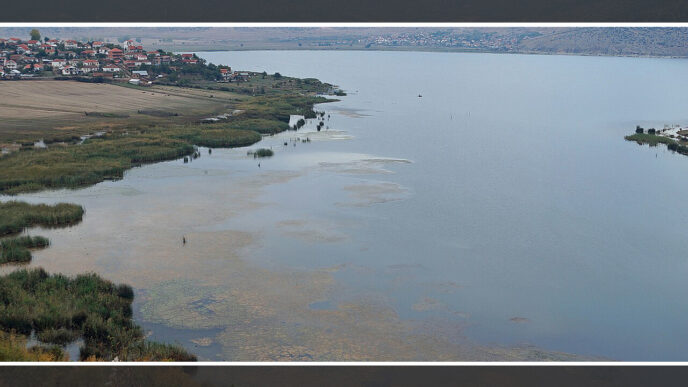
Tirana's artificial lake, with an area of 4.5 hectares and 6 species floating in it, seems to be one of the most popular and visited tourist attractions in the capital.
But, despite its apparent beauty, the dam of this basin is not monitored with maintenance systems by the Municipality. This dam, unlike many other basin dams which are used to collect drinking water such as the one of Bovilla or others for irrigation, is used as a tourist attraction but its administrator is Ujësjelës Kanalizime Tirana, a joint stock company with capital entirely owned by the Municipality of Tirana. This j.a. is responsible for providing drinking water, as well as for the maintenance and improvement of the water supply and sewage infrastructure, but it has no concrete connection with the dam of the artificial lake of Tirana which is used only as a tourist attraction.
Asked about the safety of the dam, the Municipality of Tirana gave this response via email:
"According to decision no. 33 dated 03.05.2015 by the Municipality of Tirana, only the Lake Dam (not the water basin) has been transferred to the administration of Tirana Water Supply and Sewage Company sh.a. Under these conditions, monitoring the safety perimeter, water level or even pollution and cleaning of the water basin (lake water) is not the competence of Tirana Water Supply and Sewage Company sh.a. "
"Sinjalizo" addressed the Commissioner for the Right to Information with a request for information and as a result of legal obligations, the Tirana Municipality responded that the powers for cleaning the basin of the Tirana Artificial Lake have been given to the Parks and Recreation Agency, but it does not clarify who is responsible for monitoring the safety of the dam.
We also addressed a request for information to the Tirana Water and Sewerage Authority to ask about its powers and responsibilities over the lake dam, but as of the time of publication of this article, it has not responded.
At the Tirana Lake dam, there is only a “primitive” system called “LAT” and it is a board marked in meters and centimeters to measure the water level. This “system” does not “notify” in case of a rapid increase in the water level.
The standard is that the dam must be monitored and inspected no less than twice a year. Also, by legislation and technical standards, there are 5 dam monitoring systems that must be applied to every dam.
Dam expert Arjan Jovani says that an alarm system should be put in place first.
"An alarm system with instruments should be installed to set off sirens in case a large amount of water arrives," he said.
The other four systems are: the placement of several pillar monuments on the dams and according to the standard, the latter must be monitored by a specialist at least twice a year, to assess whether there is a lowering or raising of the dam itself. Another system that is very important is that of seismic control, in the event of an earthquake this instrument records and gives an alarm for changes that have occurred in the structure.
"In the Tirana dam, if you look closely, there is a slab up to a certain point and then it is empty because when the earthquake struck 5 years ago, this part that is empty today broke and fell," expert Jovani told Sinjalizo.
The fourth system is the hydraulic control system, which serves to monitor the filters and clean them before the filtration system breaks down.
And the last system, very important for monitoring the dam according to technical standards, is the hydrogeological system, that is, the underground waters that are not visible.
Three pipes have been installed in the Tirana dam to monitor groundwater, of which only the lid can be seen with the naked eye.
"Unfortunately, all five of these systems do not exist in the Tirana dam and there is only one LAT that monitors water levels. This is the most primitive, the most manual. In 2025, a dam of this level should have all 5 of these systems with instruments. These systems are not that expensive in terms of money and if they break down, the damage is much greater," says Jovani.
In the "National Irrigation and Drainage Strategy 2019-2031", the Ministry of Agriculture and Rural Development found that out of 626 dams located in Albania, 410 of them present significant technical problems and require urgent attention in terms of dam safety as well as the available volume of water in reservoirs, where in total, the water capacity of the reservoirs has been reduced by about 45%.
"Alarm" for trees in the dam body
On the official website of the Municipality of Tirana, in the "Tourist Attractions" category, there is a detailed description of the Great Lake Park of Tirana, which specifically states:
"The Great Park is also called the lungs of the city because of its many plants, over 120 species of trees, shrubs and flowers." Dozens of these trees are located in the body of the dam, which create problems for the future. The trees send out roots that, to create the necessary space, expand until they loosen the mud under the water basin and damage the dam.
"There should be no trees in the body of the dam. The consequences are long-term, we can see them even after 10 years. At a minimum, cut down the tree so that it does not grow anymore. For me, we do not need to have attractions with trees or bushes in the dam," says expert Arjan Jovani.
The safety of the Tirana Lake dam is not simply a technical issue, but a public emergency that requires immediate action. In a city that is expanding without criteria and where construction continues to take priority over safety, the risk of another flood or disaster is no longer a hypothesis, but a matter of time.
Will the authorities wait for history to repeat itself, or will they finally take the necessary measures to prevent a foretold tragedy?