


Author: Antonio Cakshiri, Denis Tahiri, Jackie DeFusco
Ekrem Bardha left communist Albania in his youth, in June 1953, and ended up in the United States of America. It was there, in the Detroit, Michigan area, where he built a fortune by acquiring the rights to open 18 McDonald's fast food outlets.
But Bardha never forgot his country of origin. In the United States, Bardha served as an advocate for Albania among powerful people in Washington and played a key role in making American politicians aware of the plight of ethnic Albanians in Kosovo, which was then under the federation called Yugoslavia.
After the fall of communism he returned in 1990 together with his daughter, Donika, to open one of the first high quality private restaurants in Tirana, and then to establish and cultivate a successful vineyard.
"He always tries to improve the country's image... to convince people to come back and invest," says Donika.
Despite their best efforts, the White family is still the exception to the rule.
Today, a third of the Albanian population of 1991 lives outside the country's borders, forming one of the largest diasporas of a European country.
But only a small fraction of Albanians have decided to engage in economic relations with their country of origin, despite several studies showing that this would have a significant impact on the country's economic development.
"It's like the human body. If you're only using 75 percent of it, then you'll never function at full capacity, 100 percent," says Mark Kosmo of the Albanian-American Society of Massachusetts , based in the US.
The Albanian government has recently made its first coordinated effort to harness the human and financial capital of the diaspora, including the creation of the Ministry of Diaspora in September 2017, tasked with overseeing this project.
But a month-long investigation by the Albanian Center for Quality Journalism and the New England Center for Investigative Reporting, located in the US, has revealed that the ministry, during the policy-making process, has routinely neglected to consult continuous and fruitful with the very population it is supposed to represent.
Cooperation on the new legislation was too little and too late
“It is unfair to make policies on the diaspora without any of the diasporas (referring to the diasporas of Kosovo and Macedonia) present at the table,” says Liza Gashi, co-founder of Germin , a non-profit diaspora organization in Pristina, Kosovo.
Gashi says the organization seeks to simplify dialogue among the global Albanian community by using a virtual registry of diaspora organizations and task forces .
"The goal," says Gashi, "is to create a two-way communication channel, instead of the one-way one we had in the past."
After a three-day conference in Pristina in late May, Germin published a comprehensive list of recommendations for the creation of an advisory council.
Gashi says the document was the result of one of seven task forces that have been regularly exchanging ideas since September 2017.
The proposal projects the council as a decision-making body, independent of the government, which is temporarily appointed by the Germin organization's task force in cooperation with the diaspora ministries of Albania, Kosovo, and Macedonia, but ultimately elected only by the global Albanian diaspora.
The Minister of Diaspora, Pandeli Majko, attended the last conference, but Kosmo, who is involved with Germin , accuses him of ignoring their recommendations in favor of a more bureaucratic approach.
This comes after Majko signed a Memorandum of Understanding with the organization earlier this year, which was widely seen as a commitment to collaborate on a number of diaspora projects, including the creation of a consultative council.
Instead of adopting Germin 's proposal, in early June, the Minister of Diaspora set out its own legislative framework for the creation of the consultative council, an institutional body composed of 13 civilian advisors, elected from countries with large Albanian diasporas. The council will identify problems related to their populations and propose solutions to the Ministry of Diaspora, the Prime Minister, and government leaders in their countries of residence.
The new law, approved by the Council of Ministers, states that Albanian ambassadors will cooperate with local diaspora leaders to appoint the best candidates. Majko can also appoint individuals and together with the Council of Ministers – instead of the diaspora – has the final say on who will be selected.
Kosmo sees problems with top-down appointments and the confirmation process, although he praised the law as very detailed. He worries that the Council could be seen as an extension of the government, rather than an independent body that puts the interests of the diaspora first.
"I know there are concerns or reservations, because this is the first experience in this direction and these kinds of things are not a closed debate... this would be a big mistake for us," Majko said in an interview, pledging to work closely with Germin.

Majko says he does not support the Council as an independent body now or in the near future because of the varying levels of diaspora organization from state to state.
Gashi personally met with Majko on June 8, after the law was approved.

She says that Majko verbally promised to include some of Germin's recommendations.
"A question and answer session with the minister and members of the diaspora is currently being planned for the end of June", says Gashi.
In his 25 years of experience working on diaspora issues, Kosmo says there has been a constant lack of a culture of consultation.
"It's hard to be disappointed at this point because I'm already used to it," he says.
The story of a false engagement
In 2013, the Albanian government approached Harvard University researchers for advice on improving its economy. They recommended the creation of a Ministry of Diaspora by the Albanian government.
A 2015 Harvard survey – of nearly 900 Albanian-Americans – found that the diaspora was eager to stay in touch with its country of origin.
More than half of those who responded were involved in Albanian community organizations in the United States, but an institutionalized channel to connect these groups across state and national borders was still lacking.

In this context, the Germin virtual network was created , widely considered revolutionary.
The diaspora summit in Tirana, in November 2016, was the first, government-organized effort to connect global Albanians, but the summit had its problems.
After being postponed several times, invitations were sent out just a month before the agreed-upon date. Ljubica Nedelkoska of the Harvard Kennedy School’s Center for International Development Research says the event would have been more successful if it had been planned earlier, but it still attracted over 800 diaspora members from about 40 countries.
"You could see a lot of energy and people really needed to talk", - says Nedelkoska, - Albanians abroad had never had the opportunity to have the conversations they wanted with the government".
Looking back, Kosmo says the three-day summit was half-spectacle, half-substance:
"The show is not bad... but what happens next is what matters," he emphasized.
Kosmo was disappointed with the lack of further discussion after the summit. He says the creation of a Ministry of Diaspora in November 2017, a year later, was the first sign the government gave of taking the diaspora issue seriously.
But the problems continued.
Kosmo sent an email , approximately three thousand words long, to the newly appointed Minister Majko in November 2017, strongly suggesting the creation of a working group that would collaborate regularly on the creation of the 6-year National Strategy of the Albanian Diaspora.
"The best would be for the National Diaspora Strategy to be finalized with the inclusion of the contribution of the Albanian diaspora. It should not be done by the government with the Albanian diaspora commenting on it, but they should be as a joint product", he wrote.
He also recommended that the minister seek funding through donations to support this group's travel to Tirana in early 2018, to initiate policy consultation.
Majko responded by thanking him for his attention to the strategy and saying he would contact him if he had further questions.
In the absence of any further response from Majko, Kosmo wrote another letter in February 2018, jointly signed by over 200 members of the Albanian diaspora , many of whom were actively involved in Germin.
The letter argued that past public-private partnerships with the diaspora had been too informal and insufficient.
The group compiled a comprehensive list of questions, reinforcing their interest in creating a working group, and identified seven areas of expertise where the diaspora could help.
Kosmo says the minister did not respond, even though many of these points had been discussed informally, when Majko visited Boston, Massachusetts later that month.
Three months later, in May, the Council of Ministers approved the 6-year strategy and work plan of the Ministry of Diaspora, but in the absence of formal cooperation with the diaspora, Kosmo considered it a first draft – at best.
When asked by Center reporters why he did not create a diaspora working group, Majko did not give a specific explanation. He emphasized that his work plan specifically allows the diaspora to give its input on changes in strategy during the annual summits, the first of which cost the government about 18,000,000 lek or 167 thousand dollars, according to the Foreign Ministry.
Kosmo thinks that daily or weekly communication is a must to create a good work plan.
Before the diaspora is formally engaged in the policy process, Kosmo believes that a second summit, currently scheduled for November 2018, is premature.
Meetings with the diaspora and financial responsibilities
Over the past nine months, Majko has spent most of his time meeting face-to-face with individuals and community organizations in countries with large Albanian diasporas.
Majko says that listening to their ideas in these informal meetings is necessary for building good relations in this new chapter.
Leaders of the Albanian-American community say that some of these trips were planned at the last minute, forcing them to rush to meet the minister.
In Clearwater, Florida, the Albanian Business and Professional Network, ABPN, says it was notified two weeks before Majko's visit.
The minister's trip to Houston, Texas, was also arranged at the last minute, the exact date of which was confirmed only 72 hours before the event. About 50 people were able to participate with this short-term announcement, in an area with about 1,700 Albanians.
The prime minister's office, which currently oversees the Diaspora Ministry's budget, failed to respond to a Right to Information request for a breakdown of Majko's budget and travel expenses.
An official budget, which Minister Majko says is not yet "functional," found online for the Diaspora and Exile Agency, lists the ministry's total budget for 2018 at 17,000,000 lek, or about $160.
About 70 percent of that budget is being spent on salaries and bonuses for five workers, leaving less than 5,400,000 lek or about $50 for what are listed as operating and miscellaneous costs.
Multiple sources familiar with the minister's activities, including Kosmo, Nedelkoska and Richard Lukaj, an Albanian diaspora philanthropist living in the United States, attribute the slow pace of progress to a poor budget and an understaffed small.
Lukaj says these trips, dedicated to gathering and sharing information, are appropriate for an unprecedented ministry that is still trying to focus its efforts.
Leaders of the Albanian-American community in Florida and Texas say that Majko should continue communication even after the visits, which, according to them, have not produced tangible results.
Success requires a change of course
A question raised during the minister's meeting in Florida was what diaspora groups can do to influence policies in the country.
"The impression I got was that they weren't really looking for opinions and
opinions on how to change things, but people who were ready to invest", says Veton Krasniqi, vice president of ABPN.
Kosmo says that investments are generally the first thing that a minister emphasizes to the diaspora during his travels. It should be the last issue, according to him.
A 2015 Harvard survey found that investing is the least popular element of engagement in the Albanian-American diaspora.
More than 95 percent of respondents said corruption was their top concern about doing business in their home country.

Harvard 's Nedelkoska says a key lesson from previous examinations of the diaspora in the United States is that people are inherently distrustful of any Albanian government, not just the current administration.
"There is a way to break this attitude... to show transparency," she says.
- The government must be able to communicate well. They must be consistent and keep their promises."
Through focus groups and observations, Gashi has learned that Albanians abroad want as little government involvement as possible in diaspora projects. Kosmo believes that people are more likely to invest in Albanian businesses if a non-profit channel for direct investment is created by a non-governmental organization like Germin . That’s why the group created a task force for a philanthropic work plan.
One result that many hope will come from the diaspora effort is the passing of the skills and expertise of those living abroad to those in Albania.
Nedelkoska says that Albania's "permanent disease" is the serious lack of practical skills, which she considers more valuable than knowledge in developing economies. She says it is important for the government to focus on building networks that would move the Albanian diaspora with skills to the country, physically or virtually.
Educational or professional exchanges are the ways in which the diaspora is most willing to engage, according to Harvard 's survey.
"It is more important that they nurture these kinds of relationships, so that Albanian doctors learn from doctors in Massachusetts and entrepreneurs learn from entrepreneurs in New York", says Nedelkoska.
Majko says his ministry is in the early stages of planning projects that address needs and capacities. Germin has set up task forces for both of these areas. Gashi says they plan to share their final recommendations with the ministry by the end of June.
Unusual optimism
Despite the complaints of diaspora leaders, the popular feeling surrounding this ministry is unusually optimistic.
Eva Millona, an Albanian immigrant who today serves as the executive director of the Massachusetts Coalition of Immigrants and Refugee Advocacy, is part of the majority of Albanian-Americans interviewed who believe that Majko is a good choice to lead the ministry.
She says Albanians in Massachusetts, a state that is home to the best-educated diaspora in the United States, according to Harvard 's statistical profile , are eager to see the ministry take shape.
"It is a great opportunity for the diaspora to have a voice and support the improvement of the region," she says. "The budget is one thing, but the vision and commitment to make it work is something else."
"My dream is that the diaspora can be seen," says Majko. - We are working with human beings, with people and, if we have their understanding, we will be successful".
Full interview with the Minister of Diaspora Pandeli Majko (In English)

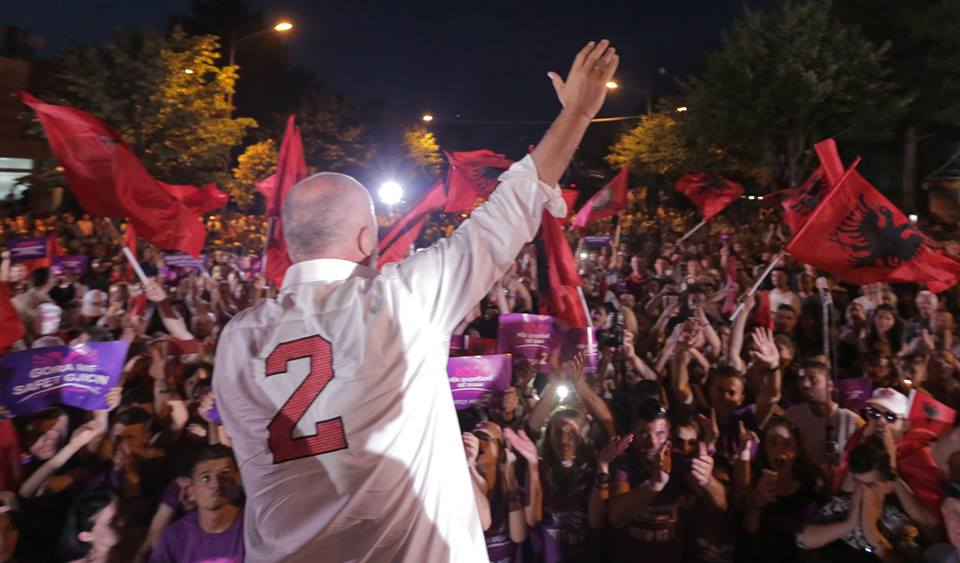
*The main photo at the beginning of the article, published by Prime Minister Edi Rama on Facebook during the Diaspora Summit in November 2016