


"Since the day the doors of 41-bis, which we call the 'prison within a prison', were opened in September 2020, we officers of this regime have not received the financial treatment provided for in the decision of the Council of Ministers," writes a police officer, appointed to guard 10 of the most dangerous protagonists of crime in the country, for "Sinjalizo".
Introducing himself as YK *, the tough prison police officer adds that he has been working as a security officer for 20 years and has been practicing his profession in one of the “41-bis” regimes established in Albania since 2020. Requesting anonymity for fear of losing his job, Y. K further tells “Sinjalizo” under the conditions of privacy that the special regime does not respect the General Prison Regulations, which define the privileges of police officers selected to serve in “bis”.
According to the witness, most of the policemen who are on duty during official working hours but also outside of it, have their residential centers outside the place where they are appointed with the duty. Without assessing the risk, we cover the costs and expenses ourselves. We pay for transport and uniforms with our monthly salary, which did not increase at all, even though the difficulty of our work has now multiplied", he confesses.
In one of the regulations that "Sinjalizo" has for police officers who have passed through strict control filters, there are a number of prohibitions, from not being alone with a convict that SPAK has considered dangerous. Such a police officer working in 41-bis is prohibited from revealing details from the place of service, family circle and personal information and also must not contact anyone, including lawyers who have connections with prisoners.
The prison of "Cosa Nostra"
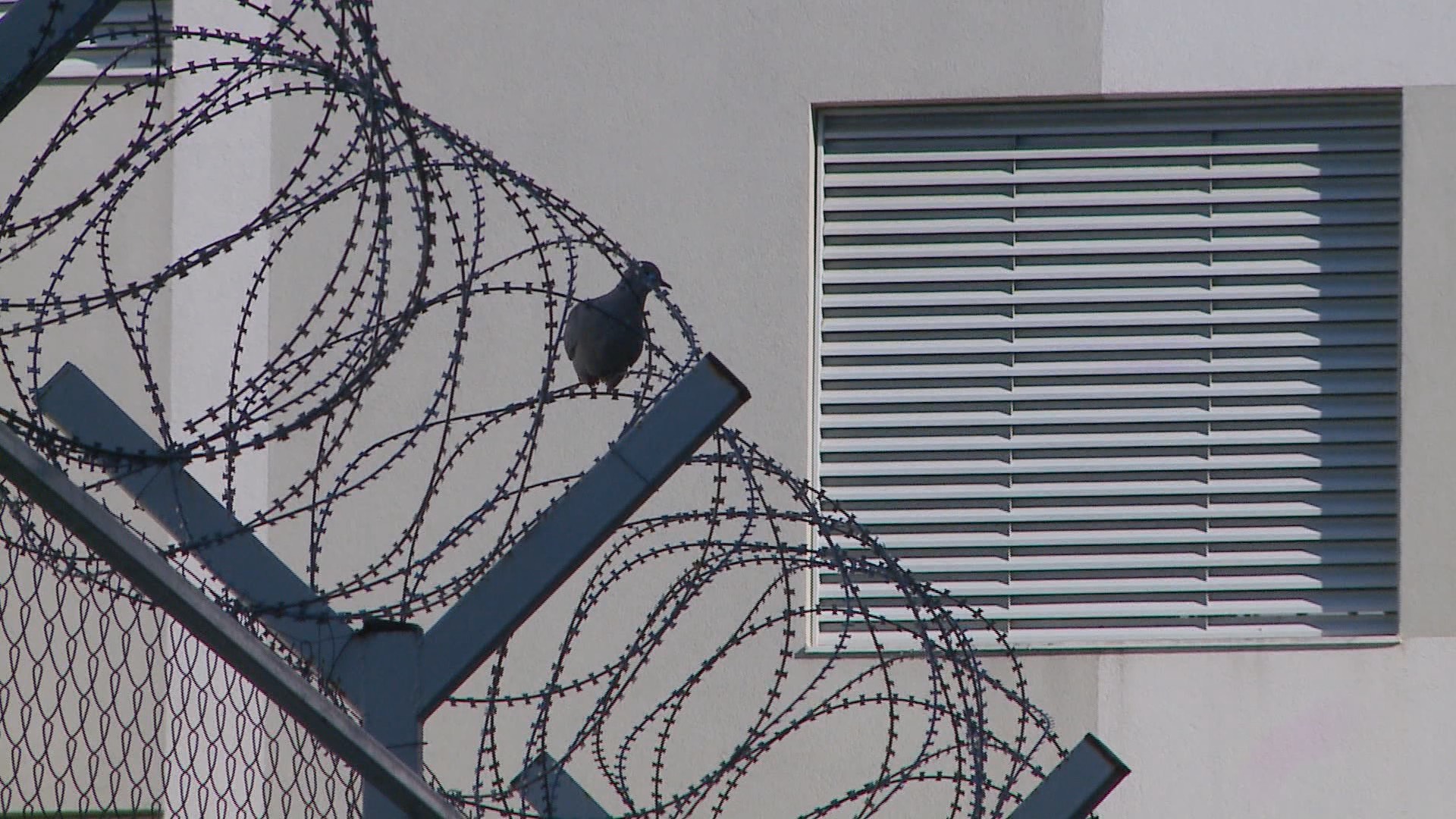
The "41-bis" regime began to be applied in Albania on January 2020 in the PEQ Peqin and in the detention center "Jordan Misja", Tirana.
Borrowed from the Italian system, this regime aims at the isolation from the outside world of those convicted of serious criminal offences, thus not allowing the exercise of criminal activity during the time the sentence is being served.


What makes this regime different from the usual prisons in the country are the strict rules on convicts, as well as the selection of special police officers, through strict verification of integrity, honesty, reliability and education.
Convicts isolated in the "41-bis" regimes
| Arbjon Aliko | Accused of murdering FNSH officer Ibrahim Basha in 2015 |
| Genc Balla | Extremist imam, member of ISIS |
| Alexander Llanaj | Author of the murder of 3 young people in Vlora in 2015 |
| Endrit Qyqja | Accused of being part of the criminal structure created by his uncle, Emiljano Shullazi |
| Emiljano Shullazi | Convicted of fines and destruction of property |
| Redjan Rrahja | Accused of the assassination of former prosecutor Arjan Ndoja |
| Arber Çekaj | Suspected of organizing the criminal activity of cocaine trafficking from Colombia to Albania |
| Fatmir Peter | Known as "Grandfather", he is charged with the criminal offenses of "Theft with a weapon committed in collaboration", "Structured criminal group" and "Structured criminal group". |
How does the Albanian bis differ from the Italian one?
In contrast to the bis regime in Italy, where convicts are temporarily suspended from certain rights in proportion to the dangerousness of the criminal activity, in Albania the isolation of convicts is carried out at the request of the SPAK special prosecutor's office and with the signature of the minister of justice. But this term superimprisonment was contested at several levels of the judiciary, ending up in the Constitutional Court, with the plaintiff, the convict Emiliano Shullazi, who was extended his detention in a separate cell in this regime on two consecutive occasions. Constitutional judges assessed that several constitutional provisions had been violated regarding the hearing of evidence by special judges, following SPAK's claim that the information was secret. Other constitutional aspects of being held in these cells where prisoners are banned from outside food and only allowed one meeting a month have not yet been assessed, although recently 6 of the 'dangerous' objected to being locked up under this regime with these bans. The most important of the prisoners' demands is the revision of the food diet, which is considered to have a low content of nutritional values.
Ombudsman: Food is poor
For "Sinjalizo", the People's Advocate, Erinda Ballanca, said that she has inspected the special regimes, after the complaints addressed to this institution by the former lawyer of Emiljano Shullazi, Vladimir Meçe, and the family members of Arbjon Alikos (sentenced to life for the murder of the officer of FNSH, Ibrahim Basha, in Lazarat) and Genc Ballës, the radical imam.

Erinda Ballanca, People's Advocate
" Each of them does not have the right to communicate with other convicts and the number of books allowed to enter the cell is reduced. The prison food menu remains a problem, " said Ballanca, who emphasizes the fact that the menu has not been changed since 2004.
Not receiving food from family members and consuming prison food has brought quite a problem to the health of prisoners.
Emiljano Shullazi, convicted of fines and destruction of property, at the same time among the first prisoners isolated in this regime, is facing a series of health problems closely related to the quality and type of food served in prisons. The prisoner has been transferred to the Prison Hospital, Mother Teresa Hospital Center and is being treated under strict security measures as well as under the supervision of the "tough" policemen of the 41-bis.
" He has bone pain, stomach and heart problems " - admits lawyer Bledar Meminaj during an interview for "Sinjalizo". Meanwhile, Ballanca reveals that Endri Qyqja, one of Shullazi's associates, lost 10 kilograms from the first day he was isolated. After completing the temporary super sentence, the young man was taken out of the regime where everything is monitored by cameras and separated from everyone else. Even going out for air is done alone, and sunlight does not penetrate the cell due to the iron bars.
According to the inspections carried out by the People's Advocate, it results that every day activity of bis convicts was supervised by the security staff of the institution treated for this purpose.
Through the official response to "Sinjalizo", the General Directorate of Prisons announced that 63 police officers are stationed in the two "bis" regimes, of which only two are officers.
These special police officers have been selected by undergoing a verification process that is carried out in cooperation with relevant institutions such as the State Police and the Internal Control Service of Prisons.
According to Decision no. 920, dated 25.11.2020 of the Council of Ministers, the police officers of "41-bis" in IEVP Peqin and IEVP "Jordan Misja" benefit from financial treatments for extra hours at night, for the degree of difficulty, which it is 15 old lek above the basic salary. Also, according to this decision, bis police officers who are not able to guarantee transportation from the institution itself, or rent and food, have the possibility of compensating expenses. But in the field, something like this is not implemented, exposing even the policemen.
How are the decisions for the policemen in bis being respected?
Another police officer, who also asked to remain anonymous, emphasized that another rule that does not apply in "bis" is the 'separation' of policemen from other colleagues who perform service in other sectors.
" Like our prisoners, we are also special police officers and according to the regulation we should not communicate with colleagues from other sectors, but this does not happen. Due to the lack of police officers, we are forced to perform service in other sectors as well ," he said, admitting that he was threatened with dismissal when he refused to perform service in other sectors.
Valentin Maçaj, the President of the Police Union in Albania, says that the payment of "bis" police officers does not justify the stress and coping with the threats that are made to them in different ways.
" In Albania, the '41 bis' regime does not function like in Italy, where the identity of the police officer is kept secret. Here, the regime's police officers are easily recognizable and blackmailable by the underworld, " says Macaj.
He adds that the Prison Police is in a difficult socio-economic situation as a result of constant pressure in the workplace and low pay.
" The Prison Police still do not benefit from the right to transportation, food allowances, receiving ranks based on merit, and the right to a uniform, " added Maçaj.
People's Advocate, Ms. Ballanca admits that the institution he represents has implemented recommendations for police officers and convicts of the regime, emphasizing the creation of special psycho-social education rooms, as well as denying that bis officers have complained about non-compliance with the regulation.
" 'VIP' convicts need to talk to someone, as they are isolated all the time, " says Ballanca, while police officers have denied receiving psychosocial Services at the workplace.
" We don't have the opportunity to consult with a psychologist ," says the police officer, admitting that this case is just one of the points of the prison regulations that have been violated.
According to Ballance, Albania's police force is too small to always address new tasks.
" The pandemic was a concrete example. Police officers worked long hours, while everything was suspended. The demands and expectations on the police are very high ," she said, while concrete improvements in the treatment of police officers are still pending. Recently, several other convicts, such as Arbër Çekaj, Fatmir Pjetri, Viktor Ymeri and Redjan Rraja, were added to the harsh regime, all four facing justice for serious charges.