Author: Ina Allkanjari
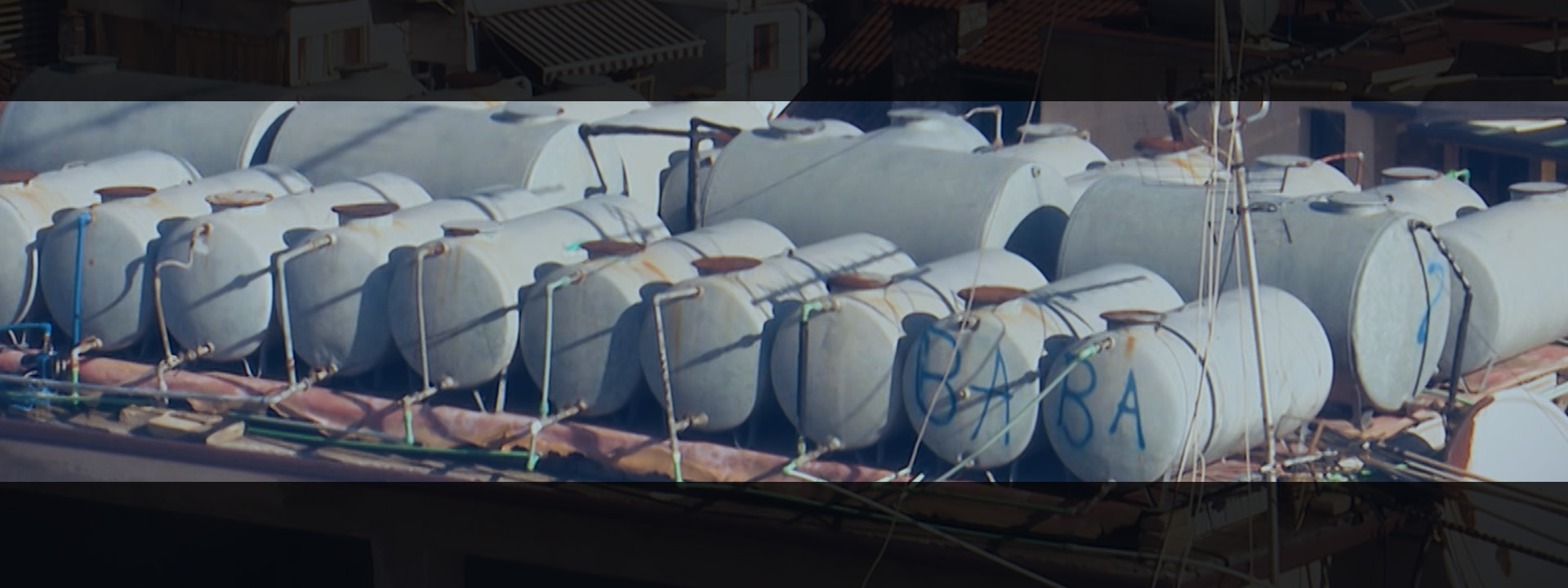
Despite a decision of the City Council four years ago to remove deposits from the terraces of buildings in the capital, Tirana of 2024-ws continues to face this urban challenge. Unlike other European capitals where urban development has largely eliminated such structures, building terraces are still filled with these potentially dangerous additions.
The water tanks which were placed on the terraces of the buildings continue to be present even today. They seriously endanger the lives of the residents, due to their weight, but also the depreciation, as they damage the supporting construction of the terraces.
The action for their removal affects over 1500 buildings built before the 90s in Tirana. But just as the Mayor of Tirana warned, the action to remove them started from Kombinati, where hundreds of deposits were removed from buildings declared uninhabitable.
" We removed the deposits after the earthquake because they told us they were dangerous, since then our water has been coming on schedule ," Bujari, a resident of the Kombinat area, tells Sinjalizo, who among other things acknowledges the difficulties his family faces due to the limited water hours.
" We removed the deposits because we were afraid of the earthquake, but we couldn't find a solution with the other residents to put them back, even at the entrance to the building. Now we suffer from water, it comes on schedule, my wife is forced to do a lot of housework depending on the time when the water comes ," says Bujari.
Water with limited hours is a problem that extends to different areas of the capital. Ana, a resident of the Xamlliku area, says that she lives with her family in a building built before the 90s.
" I live in this rented apartment and I don't know why they haven't solved the problem with the deposits yet, since they continue to be on the terrace of the building. But even though we have deposits, we don't have a water pump and the water comes to us on a schedule. We have water in the morning from 06:00-08:00, at lunch from 11:00-14:00 and in the afternoon from 18:00-21:00 ," says Ana, who emphasizes that in addition to the water supply with time restrictions, this water is not drinkable.
" We pay a monthly bill for drinking water, but apart from the fact that it comes to us on schedule, it cannot even be consumed. It has a lot of chlorine and looks dirty. I also have a small child and we don't use it for drinking, but I am forced to use it at least for cooking because I cannot afford to buy water for cooking ," says Ana.
Another problem remains the lack of spaces around the buildings to place deposits. According to the Decision of the Municipal Council, the deposits must be removed by the residents themselves in cooperation with the administrators. During the on-site verification, residents of the Student City area who live in buildings built before the 90s and placing deposits on their terraces can bring risks, tell Sinjalizo that despite the risk, the solution offered for the relocation of deposits was accompanied by with economic cost.
"In order to place the large joint deposit at the entrance of the palace, we were asked for 20 thousand new lek per family. Some families accepted, some others didn't because we don't have any money to pay for the water with the bill, for the deposits and meanwhile for the drinking water we buy", says Olgersa K.
Deposits in buildings are a danger to the lives of residents
Dealing with the risk of deposits placed on the terraces of old buildings in Tirana is an issue that is also a problem for engineers who raise the concern of damaging the structure of these buildings, bringing a constant risk to the safety of residents. Engineer Luljeta Bozo emphasizes that the deposits are dangerous due to a potential overload, especially after the 2019 earthquake.
"They are definitely dangerous both due to the effect of an earthquake and due to the effect of an overload because they are usually old buildings that have had unusable terraces that have a load on the terrace of 75 kg per square meter. They have much more, so they are overloaded and pose a risk even without an earthquake," says Bozo.
The engineer emphasizes that the evaluation of the terraces of these buildings for stability is done by a group of engineers who look at the condition of the building, how much it is amortized, how much the bearing capacity of the materials has decreased.
Meanwhile, according to the president of the association of building administrators, Adem Cemurati, this issue has been forgotten after the 2019 earthquake.
" Some checks and reports by engineers to verify whether these buildings can support the weight of the deposits were carried out at the time of the earthquake, but afterwards there was not the same attention. As usually happens in Albania, when a problem occurs everyone is brought to their feet, as soon as the problem passes everyone falls into silence," says Cemurati.
According to him, the cost of posting the deposits is one of the reasons why a solution has not been given, as there is no agreement among the residents to make the payment.
Luljeta Bozo says that the solution to this problem is to move the deposits in the underground floors or in the entrances of the buildings until the capital can be supplied with water 24 hours a day.
" They have given us the solution to move them down so that we are not at risk from earthquakes or from the stability of the building. Also, very bad conditions are created for residents living on the top floors of buildings, whose quality of life is ruined because humidity and mold are created inside the house because technical rules are not respected. There are many such cases in Tirana that they complain about but cannot solve because the resident cannot solve it himself ," says Bozo.
According to Adem Cemurat, the complaints addressed to the institutions mostly by the residents have to do with the moisture that these deposits cause on the top floors of the buildings.
" Residents have more of a problem with the humidity caused by these deposits on the top floors than with durability. Residents of the top floors suffer from this and may, from time to time, complain to institutions ," says the president of the association of building administrators.
Drinking water quality and disinfection of deposits
The quality of the drinking water of the water supply network that supplies households in the capital is a concern raised from time to time by various experts. Bilbil Daci, researcher for water purification and supply, tells Sinjalizo that the quality of water in our country is unsafe, stressing that the water is uncontrolled even though the analyzes are done.
"The water is polluted by chlorine that is disposed of without criteria and outside the permitted standards. The chlorine used for disinfection harms the health of the consumer not only when we drink it but also when we bathe. It harms all vital human systems, the immune, cardiovascular, nervous systems, etc. The network water is contaminated with bacteria, microbes and viruses ," says Daçi.
He also stops at the deposits, showing that even if they are cleaned, the water that supplies them is impure, in cases where the water comes within the standard, the long residence time and temperature affect the water quality. According to him, bacterial, microbial and viral pollution increases in water deposits.
The Bozo flower also raises concerns about water consumption from tanks, considering them unhygienic.
"Tanks are unhygienic, it's very harmful to use leftover water, but when you don't have a water supply that brings you water 24 hours a day, you're forced to put a tank in," says Bozo.
The president of the association of building administrators, Adem Cemurati, dwells on the age and depreciation of the deposits placed on the terraces of the buildings.
" These deposits are very old and depreciated, as they have been used for over 10-15 years. There are also many cases where they are not maintained or cleaned, especially in buildings that do not have an administrator. There are many old buildings built before the 90s that do not have an administrator ," says Cemurati.
According to the epidemiologist Ilir Alimehmeti, we cannot claim to clean the deposit when we have water from an impure origin.
"The barrel is the terminal, it is the end, while what makes the barrel dirty from the inside, from the water that comes from the networks. The water that comes from the network is undrinkable. Gastroenteritis is the fastest thing caused by water consumption, the simplest thing, if there are microorganisms inside. If there are also chemicals, depending on the relevant chemicals, therefore analyses must be done, " Alimehmeti tells Sinjalizo, emphasizing that from the analyses carried out of the waters in different areas, it results that there are areas with high levels of contamination.
The epidemiologist focuses on the diseases that can be caused by the consumption of drinking water if it contains harmful elements for the human body.
" Citizens are exposed to any type of disease that can come from either microbiological sources, i.e. infections, or toxic sources, i.e. chemicals that cause various diseases over time. The advice is not to consume this water, because it is not drinkable ," says Alimehmeti.
Disinfection of deposits should be done twice a year, according to the president of the association of building administrators, but Adem Cemurati says that there are no results and data if they are actually cleaned.
" A concrete case of not disinfecting the deposit for years is the building where I live, which was built in 2000. Until 2017, the collective deposit had never been cleaned ," says Cemurati.
Limited water supply
In a reality where deposits still remain in place, residents of various areas in the capital are forced to adapt to limited water supply schedules. In the ERRU performance report, it is emphasized that the lack of continuous supply, regardless of the causes, also affects the quality of drinking water, which is also related to the risk of harming the health of the population. According to the report of the Water Regulatory Entity, the capital has no improvements in terms of water supply schedule from 2021 to 2022, where it indicates that the supply is 17 hours a day.

Engineer Luljeta Bozo shows that although there has been commitment to improving the water supply network in the capital, Tirana has simultaneously faced a tripling of the population over the last few years.
" The deposits are in trouble because Tirana has a water supply network that is being modernized and improved, but the capital has tripled in size. We had a water supply network that supplied water to a city with a maximum of 300 thousand inhabitants, now it has become almost 1 million inhabitants, it has tripled. It cannot be solved immediately, Tirana has grown a lot over a period of 10 years and interventions cannot be made so quickly ," says Bozo.
The problem of deposits on the terraces of buildings in Tirana is a serious challenge for residents. Even after four years from the decision to remove them, this phenomenon continues to be present, affecting the daily life of citizens. The risk to the safety of the residents is present, and the amortization of the deposits on the terraces increases the concerns about the durability of the buildings.
This article was created based on input provided by individuals who have chosen to speak up. Share your story, empower others and be an agent for change. Visit the website: www.acqj.al/sinjalizo-dhe-ti/