


An investigation by the Center for Quality Journalism identifies at least 80 unlicensed brokerage firms running operations from Albania that extort foreign nationals, engage in tax evasion and expose thousands of young people to legal liability.
Author: Fatjona Mejdini, Juliana Jakimi
Blerta*, 23 years old, since January of this year has opened a business as a natural person with the activity "computer data processing", although this had never been in her plans before.
After three years of working as a telephone operator in a call center in Tirana – where she advertised food products to Italian consumers – she gave in to the temptation to change her profile for higher earnings.
It tries to convince Italians again, but this time to invest in company shares, currencies, digital currencies, raw materials, gold, silver and anything else tradable. The exchanges are carried out on electronic platforms, which function as online stock exchanges.
Opening a personal business and de jure attachment as an external consultant to the company that offered her employment, the platform and the infrastructure, where the citizens she contacts conduct exchanges, was a condition that was imposed on her in advance.
She accepted without hesitation. At stake were extremely high monthly profits for the labor market in Albania.
"The representatives of the company told me that every month I would earn about 1000 euros.
I was doubtful, but now I have managed to earn 700 euros a month and I think that very soon I will increase it to 1000, and I will even exceed it", she emphasized.

An investigation by the Center for Quality Journalism shows that Blerta is just one of thousands of young people who are living the dream of big profits in Albania today, in a job that only requires a foreign language and the ability to be persuasive.
The center has identified 80 companies that currently operate in the country as brokerage firms (selling and buying company shares on behalf of clients) and continuously offer job vacancies on the website anotice.com.
But the dream takes the form of a nightmare, at a time when the investigation proves that all the above companies develop an unlicensed activity, tax evasion and are often part of fraud schemes that extort the savings of citizens around the world.
The evidence collected by the Center also shows that these companies directly expose their employees – registered as businesses – to criminal acts of financial fraud.
Regulatory institutions such as the Financial Supervision Authority, the AMF and the Bank of Albania tell the Center that they are aware of the phenomenon, although so far no measures have been taken to combat them. AMF emphasized that due to the high risk of these schemes, they have officially notified other law enforcement bodies as well.
The General Directorate of Taxes and the State Police as inspection institutions were asked by the Center about the phenomenon but did not respond until the time when this article was published.
A fraud scheme
During the last months, the creation of companies, which trade assets on electronic platforms through Albania, is turning into an epidemic. Through the streets of the capital, young girls and boys conduct a direct, aggressive recruitment campaign.
Online employment sites have created a special category for those interested in getting involved in brokerage or Forex (buying and selling currency on behalf of clients).
On social networks, photos taken from the footage of the movie "The Wolf of Wall Street" are used to illustrate the work.
The promises are the same: Minimum salary 450 to 500 euros, average 700 to 1000 euros and, if there is dedication and talent, then the financial benefits have no limits.
Testimonies of five employees or former employees of these companies, obtained by the Center for Quality Journalism, show that promises regarding payment are kept.
But, what is not said out loud, is the fact that these companies exercise their activity illegally.
Based on Albanian legislation on financial activities, companies that conduct Forex trading are licensed by the Bank of Albania, while those that provide brokerage Services are licensed by the Financial Supervisory Authority, AFSA.
The companies identified by the Center conduct both activities on electronic platforms and therefore require licensing from both institutions.
If an Albanian company acts as an agent for a broker licensed by a regulatory authority abroad, then this company is required to obtain approval from the AFSA and to report periodically to this institution.
AMF told the Center that the institution has only three licensed brokerage companies that can develop activity in Albania or act as an "agent" of a licensed broker abroad.
Eurotrade Securities , Smartcom and Prodata Securities are the only companies that have the right to conduct brokerage activities in Albania or through the latter in foreign countries.
Other companies, identified by the Center, which "de facto" develop brokerage and Forex Services , appear registered with the National Business Center as call centers , marketing or as providers of financial Services or consultancy.
When asked by the Center, an administrator of the company that recruits online under the name Global IP Center , emphasizes that they do not have a license in Albania, because they only act as an intermediary for a brokerage company in Bulgaria.
"The company has its headquarters in Sofia... We just mediate, they do the payment procedures there... We carry out the actions online, there is no need for a NIPT number here in Albania", he emphasized.
By developing activities different from those declared, these companies clearly commit fiscal evasion, but economic experts see even greater risks in this scheme.
Zef Preçi, director of the Center for Economic Research, emphasizes that Albania is becoming part of an international fraud scheme and the companies that are spreading it are not only doing fiscal evasion, but are giving the country a bad image.
[Pullquote]
Evidence received by the Center shows that Albanian companies recruit up to 100 people to work on online exchanges . Each of the recruits undergoes almost two weeks of training related to the job position. They are then divided into three levels:
The call center employee , who invites a citizen to consider investing on the platform; those who undertake to make the financial transaction with the client and those who are considered financial consultants who advise him on the steps he should take and where he should invest.
[/ pullquote]
"This scheme is more than a case of tax evasion. Albania has become part of an international fraud scheme and the phenomenon is taking strong roots in the country", he emphasizes.
According to him, the responsible institutions should launch without wasting time a broad public awareness campaign about what is happening, strengthen its supervision and without wasting time attack the phenomenon.
Theft of foreign citizens
Companies that recruit young Albanians as brokers for online stock exchanges target foreign clients from many countries around the world. This is also evident from the wide range of languages offered, from Italian, English, Spanish to Portuguese, Arabic and Japanese.
Meanwhile, the five employees or former employees recruited by these companies emphasized to the Center that in 90 percent of cases they were not licensed by any authority of any country and acted in complete informality.
Companies obtain the right to use online brokerage platforms, place them on websites disguised as legal ones, for brokerage or Forex , and ask foreign clients to invest money, which is transferred to untraceable bank accounts in tax havens.
The more customers circulate on these platforms, the higher the rewards for Albanian brokers.
"When the client loses a lot of money, the administrators immediately start celebrating with champagne. The bonus for brokers who convince them to invest in that way, starts from thousands of euros to the donation of luxury cars", said a former employee of a hidden brokerage company in Tirana for the center.
But, in cases where customers win and insist on withdrawing the profits to their accounts, operators in Albania are ordered to cut off communication and disappear for the investor eventually.
The AMF recognizes this practice and has characterized it as a pyramid scheme.
"Unlicensed companies may be associated with companies established in the territory of Albania with call center activity , marketing financial products and Services to clients outside or within the territory of Albania," the institution emphasizes in an email , responding to the Center for identifying the phenomenon.
"They can result in "Ponzi" schemes or "phantom brokerages", where, after receiving investors' funds, they disappear", - continues the answer.

The Bank of Albania also emphasized to the Center that the risk is present in any case where companies or individuals may carry out activities unlicensed by the regulatory and supervisory authorities.
"Considering the growing trend of trading through electronic platforms, it remains important to inform and raise awareness of investors in advance about possible risks, which may lead to a total loss of the invested value," the Bank said in an email.
Blerta, whose role in the company is to call Italian citizens to invest in electronic platforms, insists that she is aware that she is part of a fraud scheme.
"I don't tell callers about the risks of investing. I don't tell them that we are unlicensed and what is more important, that they will lose everything.
I'm sorry, but this is my job", she emphasizes.
Fear of recruits
The evidence collected by the Center shows that young Albanians see working in ghost brokerage companies as temporary, as an opportunity to raise money, until they have the opportunity to pursue the profession they want.
Lured by the big profits at first, they think little of the step taken.
"To be honest, I haven't even thought about why the company I work for asked me to register as a small business. I want to finish school and all I care about is money", - an employee of a company told the Center.
But, after several months of working in such companies and being fully aware of the nature of this work, some of the recruits begin to face the fear of the consequences that this initiative may have on them.
"In recent weeks, we started thinking with our colleagues about why we opened a business in our name and what it really means for us. We are afraid that, if the company will be found out about the frauds committed, it will blame us", - emphasized Blerta.
Zef Preçi, director of the Center for Economic Research, is of the opinion that the obligation of employees to open a business and work as contractors is done mainly for fiscal convenience and to avoid doubts that may come from tax institutions regarding the number of employees and high salaries.
But, according to him, the separation of legal responsibility against third parties for illegal activity is also an important element that prompts administrators to require their recruits to be registered as businesses.
According to the Criminal Code, securities and currency fraud – spreading false information about price increases or decreases or their fictitious trading – are criminal offenses punishable by imprisonment from six months to three years.
In case these crimes are committed in collaboration and more than once, they are punished with imprisonment from two to five years.
These provisions leave little room to interpret the real danger that threatens thousands of young Albanians from involvement in these activities.
* The real name of the company employee has been withheld for security reasons.
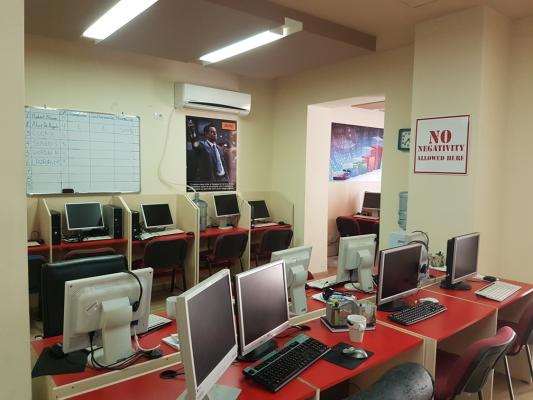
The main photo is taken from an announcement of an Albanian brokerage company on the website Lajmerime.com
Follow on Twitter: Fatjona Mejdini | Juliana Yakimi