


Author: Dallandyshe Xhaferri
In the month of April, when nature shows that life is reborn after winter, three employees in Albania died as a result of workplace accidents.
SB was one of the many workers who every day play an important role in the creation of a new Tirana, ostensibly a European city, but the scaffolding of its ambitions is fraught with dangers that cost lives.
Due to an accident that happened around 9 am at a construction site in Kodra e Diellit, the 55-year-old man died 4 hours later due to the injuries he received. But this is not the only case with fatal consequences due to accidents at work.
Two other employees of the same age lost their lives after an accident at the workplace; a 40-year-old man had an accident at the brick factory in Maminas and then a 56-year-old man who worked in a company for the distribution of alcoholic beverages.
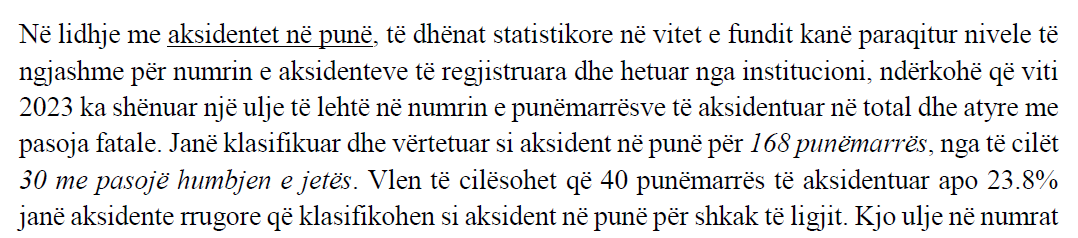
During the past year, 2023 were classified and certified as workplace accidents by the Spatial Inspectorate of Labor and Social Services (ISPSSH) 168 cases, 30 of which resulted in loss of life for employees.
In 2022, the number of employees who had accidents and those who lost their lives as a result of injuries received was higher. 32 employees out of 194 accidents at the workplace lost their lives.
Due to exposure to difficulties, the construction sector is involved in activities with high levels of risk. The main reason for accidents in the workplace is related to the non-implementation of occupational health and safety regulations. In the official data of the ISPHSH, it is specified that in the field of construction, accidents occur as a result of falling from heights.
Employees who complain the most
Renato Muçaj, the head of the Union of Postal Employees - One Shqiparian, tells "Sinjalizo" that even for the field workers of this sector there have been no shortage of accidents at work, although the injuries were minor.
"We have had two or three cases of minor injuries and they have been cases of employees working in the field, who are telephone network technicians," says Muçaj, adding that sometimes it is the employees themselves who neglect technical safety rules.

"Sometimes they themselves neglect to respect technical safety, because when one person climbs a ladder, there must be another to hold them, two people must work when they are at height," says Muçaj, who adds that companies try to resolve such issues directly with the injured employee by promising treatment for the injuries received and additional payment.
This direct agreement between both parties bypasses the role of the Labor Inspectorate, which, among other things, has the mission of controlling, ascertaining, mitigating conflicts and guaranteeing compliance with legal requirements in the field of labor legislation and that of social Services. .
According to the data received by "Sinjalizo" from the Institute of Public Health, it results that in the last three years the number of employees has increased, who have complained to the employer about the non-respect of various rights in the workplace.
According to the data that this institution has placed at the disposal of "Sinjalizo", it results that 2021 complaints against employers were filed by employees during 2022 and 1. Most of these complaints have been described as "genuine". Specifically, 609 complaints were deemed as such after the inspection.
Most of the complaints were filed by employees, who complained about non-notification of accidents at the workplace, non-payment by the employer of arrears of wages, non-payment of social and health insurance, etc.
For the year 2023, the largest number of subjects inspected by ISPHSH belong to the region of Tirana. The highest number of complaints filed by employees are related to companies that exercise economic activity in this region, constituting 75% of the total inspection-complaints.
"During 2023, this region results in this indicator increasing by 16 more inspections than in 2022, an indicator related to the fact of the high concentration of businesses that develop economic activity in this region and to a higher awareness of employees employed in these entities to address their concerns for solutions," writes the IHSPSSH in a report published on the official website for 2023, during which 800 complaints and requests were filed with this institution.
Meanwhile, Muçaj emphasizes that companies with more than 50 employees have a legal obligation to set up the Occupational Health Insurance Council, which is an instrument that works in a formal sense, while on the practical side there is still work to be done. done. One reason why this organization does not work in the country, according to Muçaj, is related to the fact that everything is done voluntarily.
"The Occupational Health and Safety Council is an element that functions, but not 100 percent, as there are cases where things are done formally. The minutes are regular, because it is one of the conditions of the Labor Inspectorate when it comes for an inspection ," says Muçaj in "Sinjalizo", underlining that it raises issues related to the safety of buildings, emergency stairs and carries out evacuation tests in cases of fire.
Albania, European in laws but not in implementation
Since 2010, Albania has adopted a new law on occupational health and safety based on European Union directives, which aim at risk prevention, risk assessment at work taking into account all aspects of work. Albania has also been supported with technical assistance by the ILO (International Labour Organization) to draft the Policy Document and Action Plan on Occupational Safety and Health for the years 2016-2020.
Frosina Gjino, director of the Albanian Occupational Safety and Health Center (AOSHC), tells "Sinjalizo" that despite the fact that the safety situation of Albanian employees has changed compared to the period before 2010, the implementation of Albanian legislation still faces difficulties.
According to her, having laws similar to developed countries helps to improve the situation of Albanian employees, but it cannot be effective if it is not recognized by employees and employers. The latter should learn more about the rights and obligations of each party.
"Since the legislations are almost the same, the implementation should also be the same", - emphasizes Gjino, continuing, - "because employment relationships are a contract. Just as the employee has the duty to implement the contract in terms of work, so too do his rights in the contract ".
The director of AOSHC indicates that, in addition to workers in the construction sector, the most exposed to the risk of accidents are miners and cement workers, who are also exposed to occupational diseases.
Reducing the number of deaths in workplace accidents and increasing the safety of the worker's life requires the observance of numerous measures, starting from informing how workers should be protected in different cases of accidents at work.
Renato Muçaj considers it important to improve this situation more frequent monitoring of workplaces by the Labor Inspectorate, but also the establishment of action manuals in special situations.
"Sometimes even companies themselves don't know and should be informed more often by state institutions about their obligations in the area of security. Incidents happen and they don't know how to handle them," Muçaj concludes for "Sinjalizo".
Worker deaths are not just statistics; they are a clear and strong call for a comprehensive review of safety standards and enforcement. It is imperative for both government bodies and businesses to take workplace safety more seriously.